
Original 2011 deck · 8 slides. Click a thumbnail or scroll down for the full breakdown.
Intercom
Intercom's 2011 seed deck raised $600K on just eight slides, no polish, no Gartner quadrant, just a product-led story about why SaaS companies couldn't build real customer relationships. Founders Eoghan McCabe, Des Traynor, Ciaran Lee, and David Barrett opened with the team, named the fragmented CRM and messaging stack, and closed with a $600K convertible note ask. It's one of the most cited early SaaS pitch decks for brevity and clarity.
Original 2011 deck · 8 slides. Click a thumbnail or scroll down for the full breakdown.
Intercom wordmark and logo on a pale blue gradient, marked DRAFT in the corner.
No tagline, no raise amount on the cover. The deck trusts the next seven slides to do the talking, a confidence move for an eight-slide seed pitch.
Four co-founders with defined roles. Eoghan McCabe (CEO), Des Traynor (COO), Ciaran Lee (CTO), David Barrett (front-end), plus Contrast consultancy, Qwitter and Exceptional acquisitions, and speaking/blogging credibility.
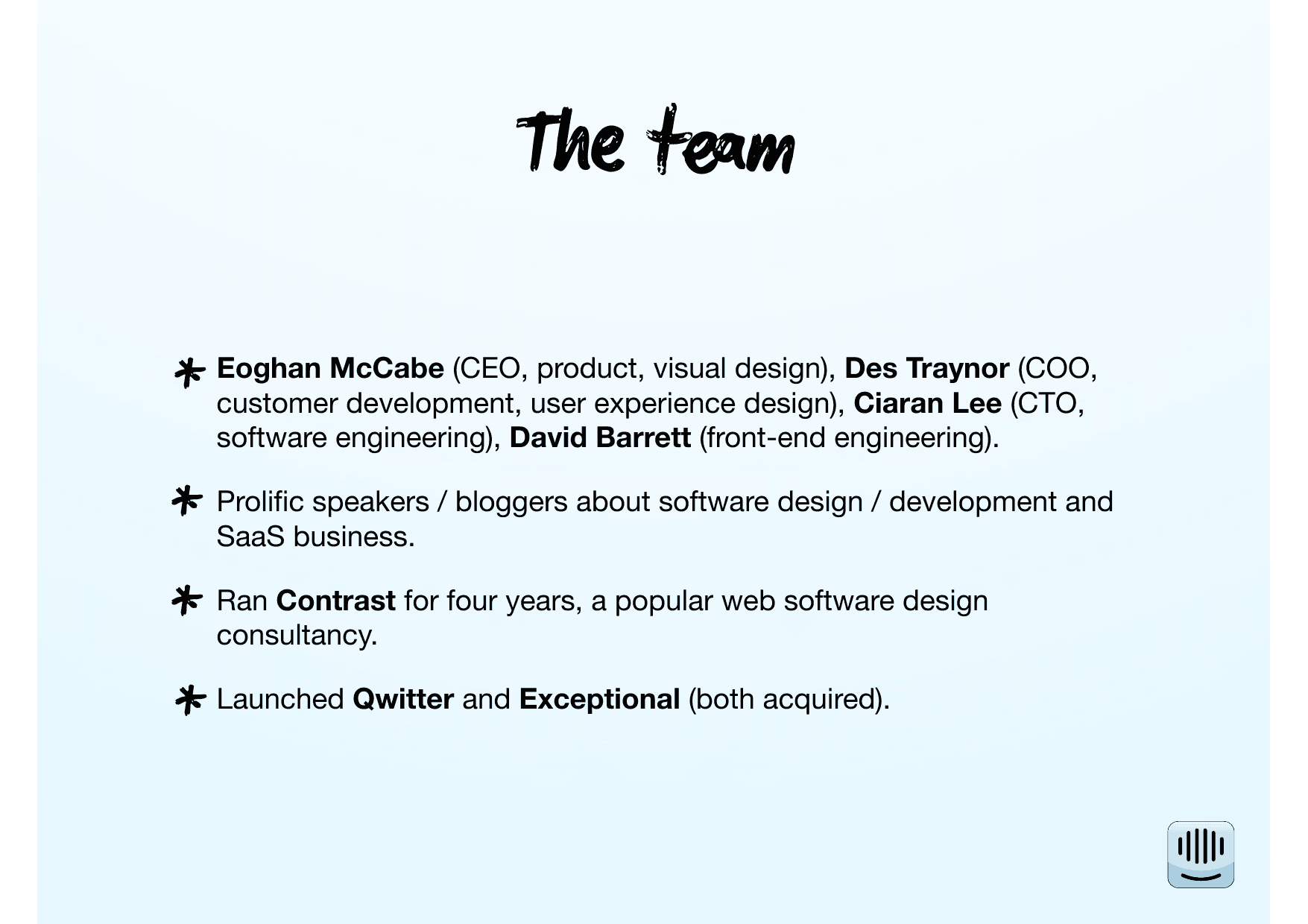
Team comes before problem, unusual order, but the thesis is execution risk off the table. Shared history at Contrast and two prior exits signal they can ship together.
SaaS providers can't build meaningful customer relationships; the work requires discovery, research, communication, and CRM, but tools are complex, email engagement is terrible, and no single product serves SaaS.
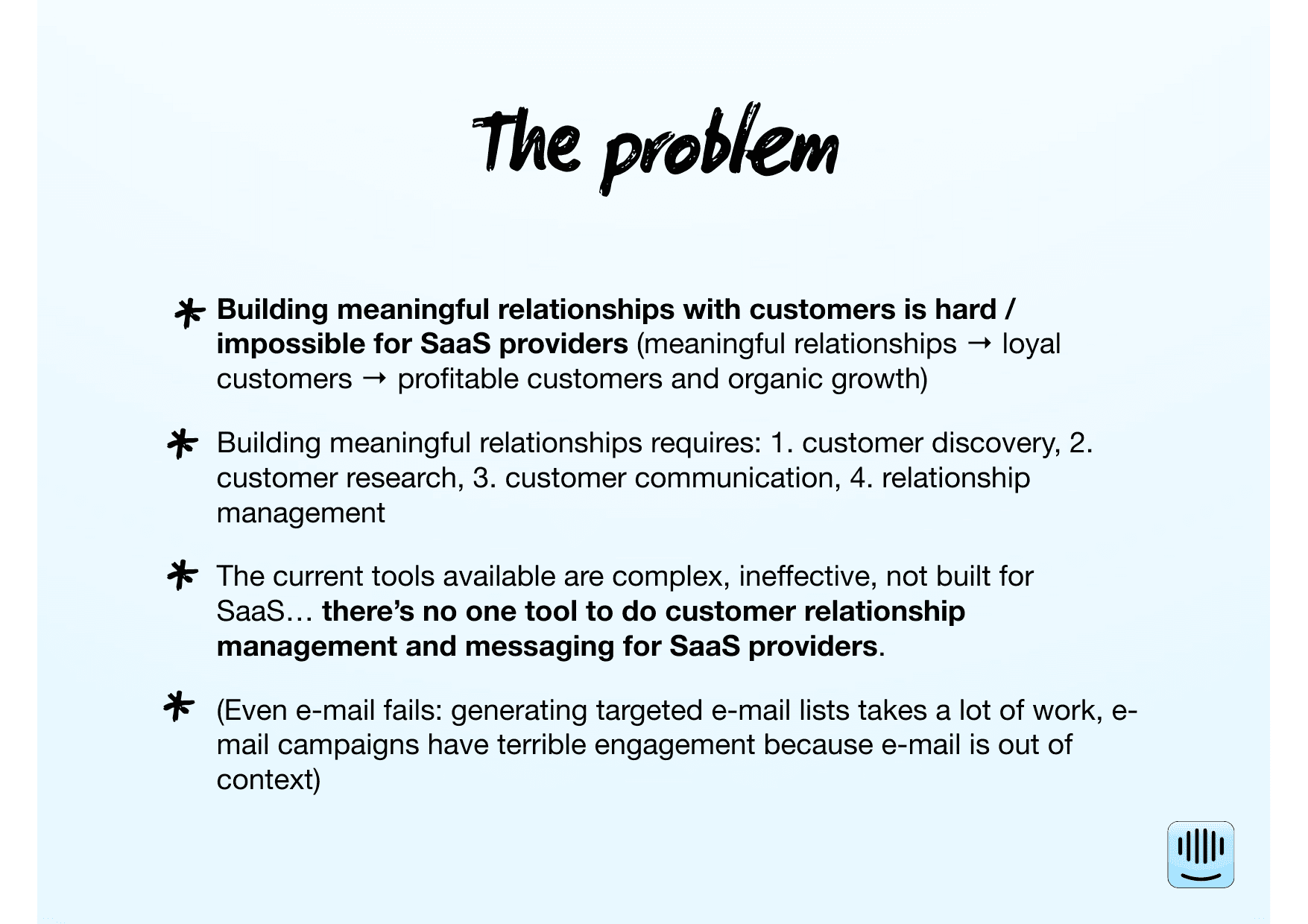
Problem chains emotion to economics: meaningful relationships → loyal customers → profitable growth. Email failure is called out specifically, investors feel a pain they've lived, not abstract TAM jargon.
Intercom as a five-part platform: simple install like Google Analytics, customer base browsing, individual customer research, in-app messaging on login or event triggers, and CRM with a relationship metric over time.
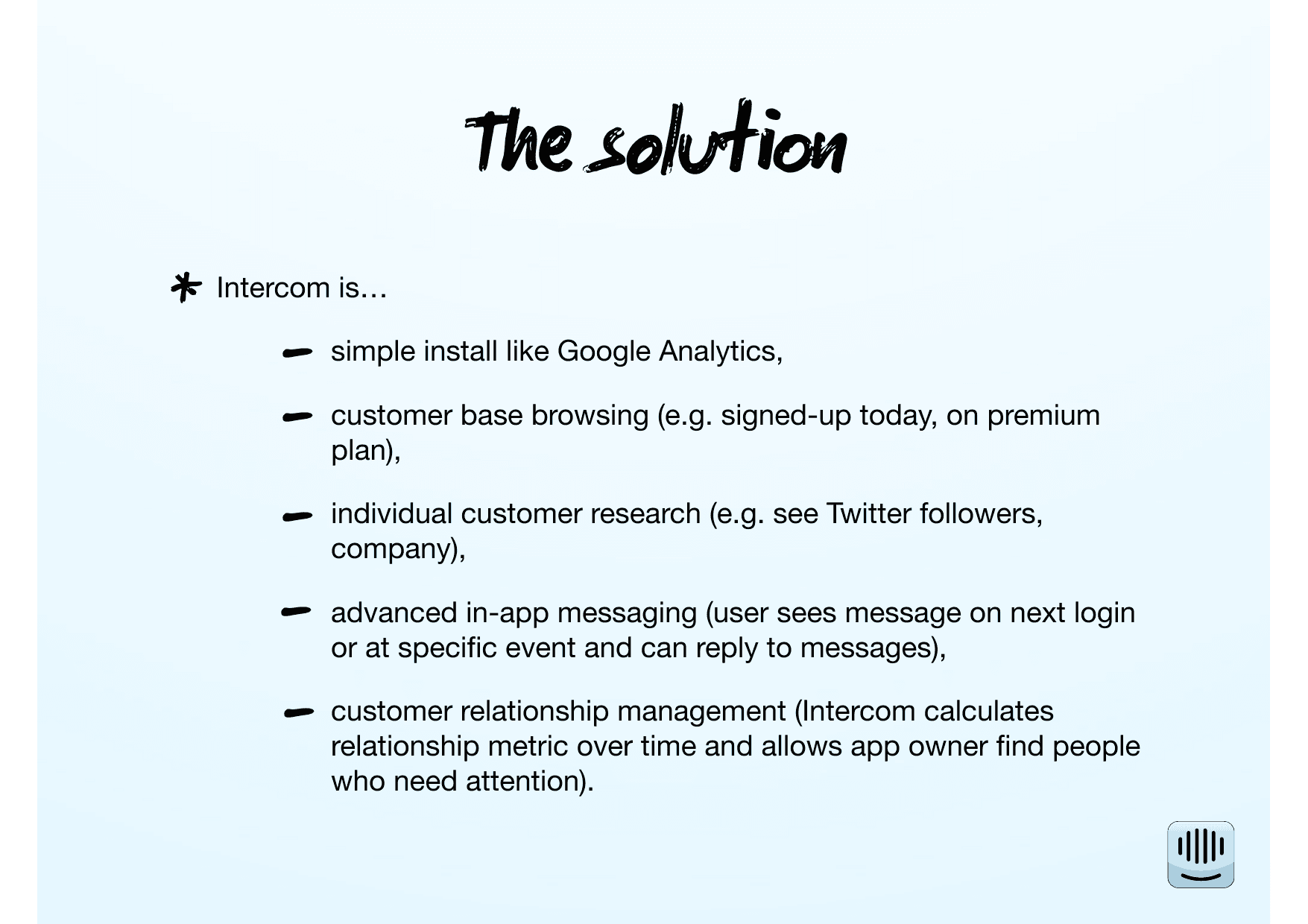
Solution maps feature-by-feature to the four problem pillars. No screenshots yet, bullet clarity lets investors picture the product before the demo slide.
Now: SaaS providers. $21 billion market, $93 billion by 2016 (Forrester). Later: mobile and desktop app providers.
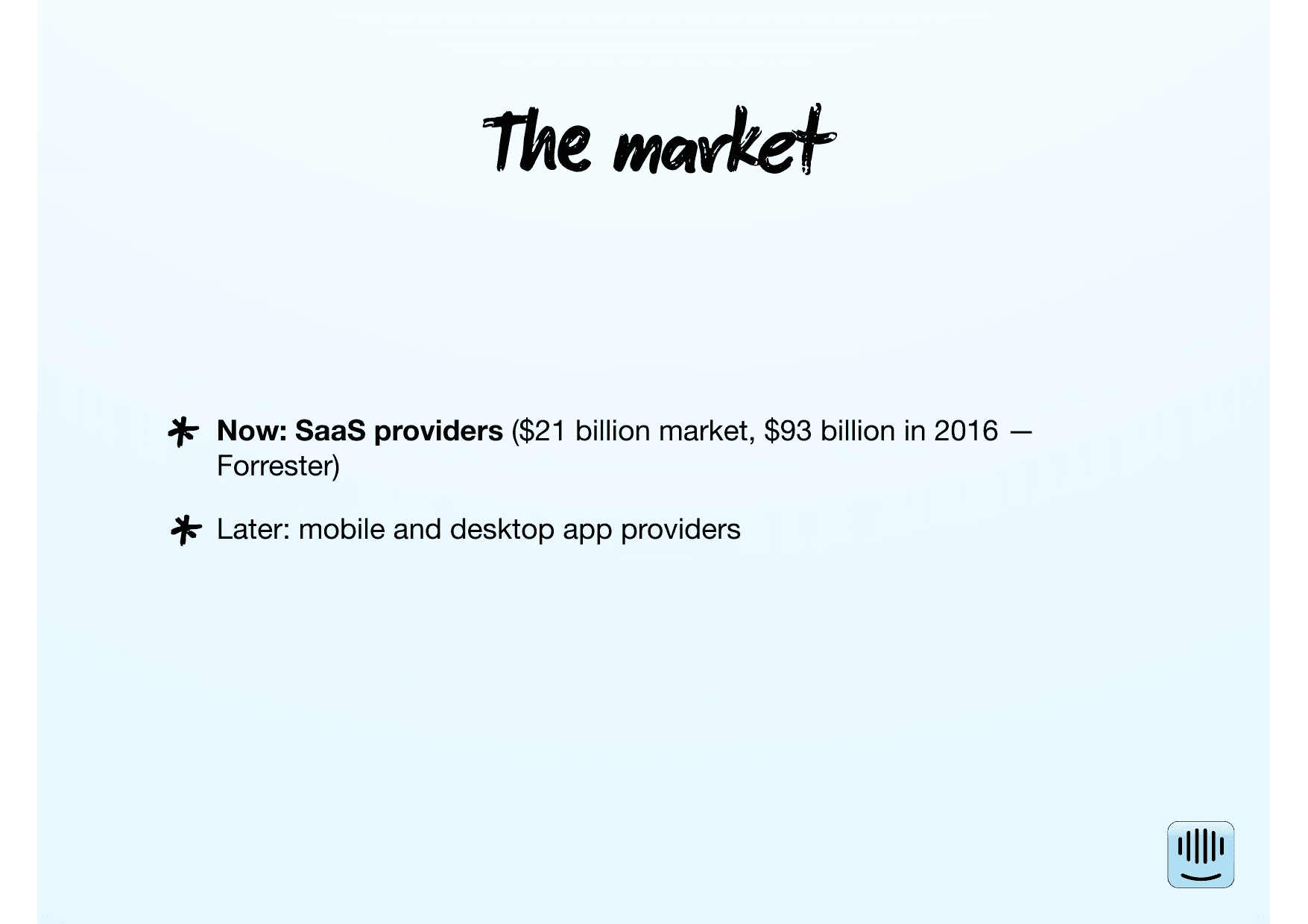
Two-tier market sizing in one slide, credible niche today, bigger adjacency tomorrow. Forrester citation gives the number weight without a dense TAM funnel.
Five fragmented categories, social media (Radian6, Hootsuite), support (Zendesk, UserVoice), email (MailChimp), in-app messages (Hello Bar), analytics (Mixpanel, KISSmetrics), with no single integrated player.
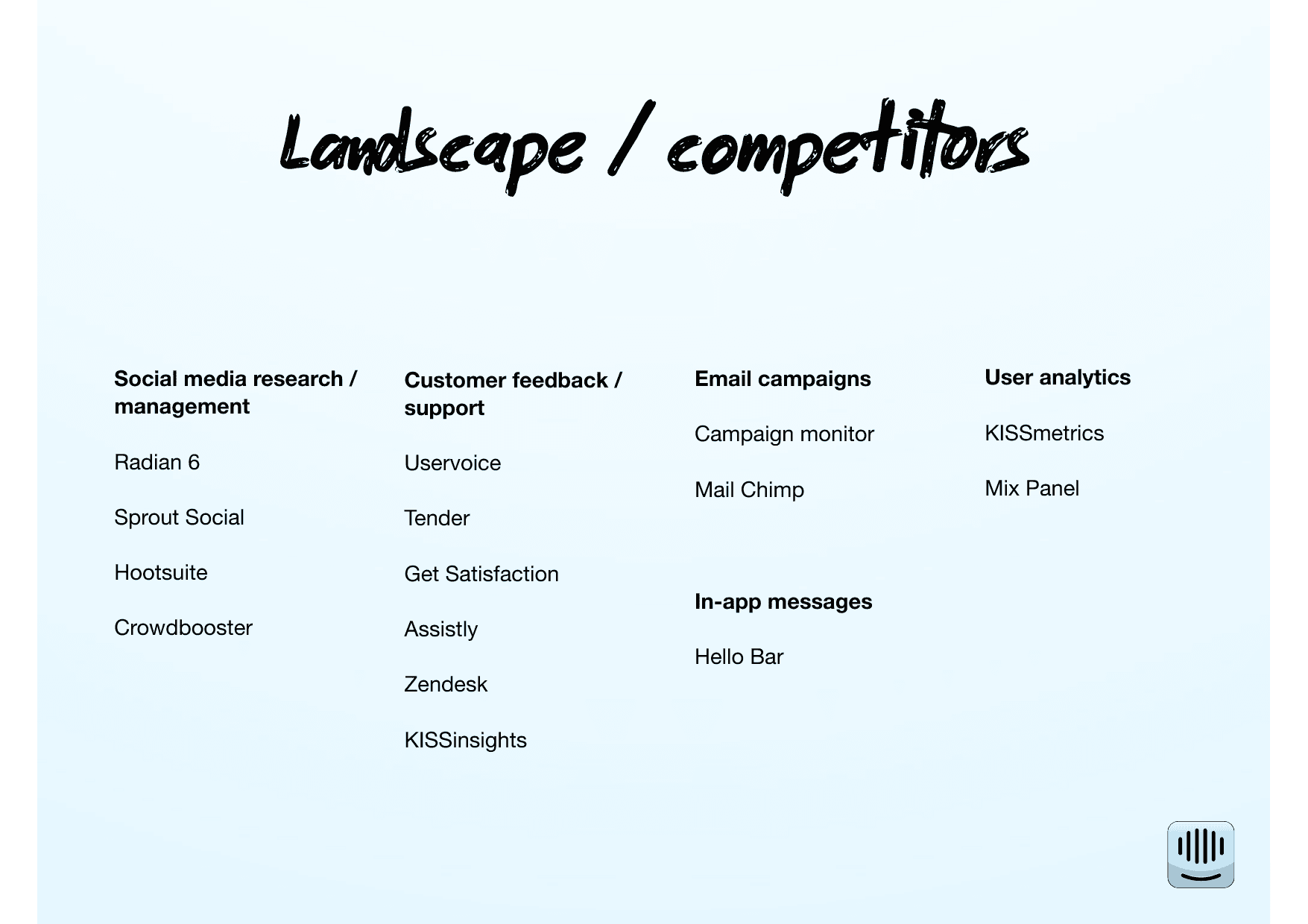
Competition slide shows the gap, not a battle. Listing a dozen point solutions makes the unified-platform pitch feel inevitable rather than arrogant.
Product in development since January, ready for public beta at intercomapp.com, plus a Jason Fried tweet: "What a fantastic product idea. Wish I'd thought of this."
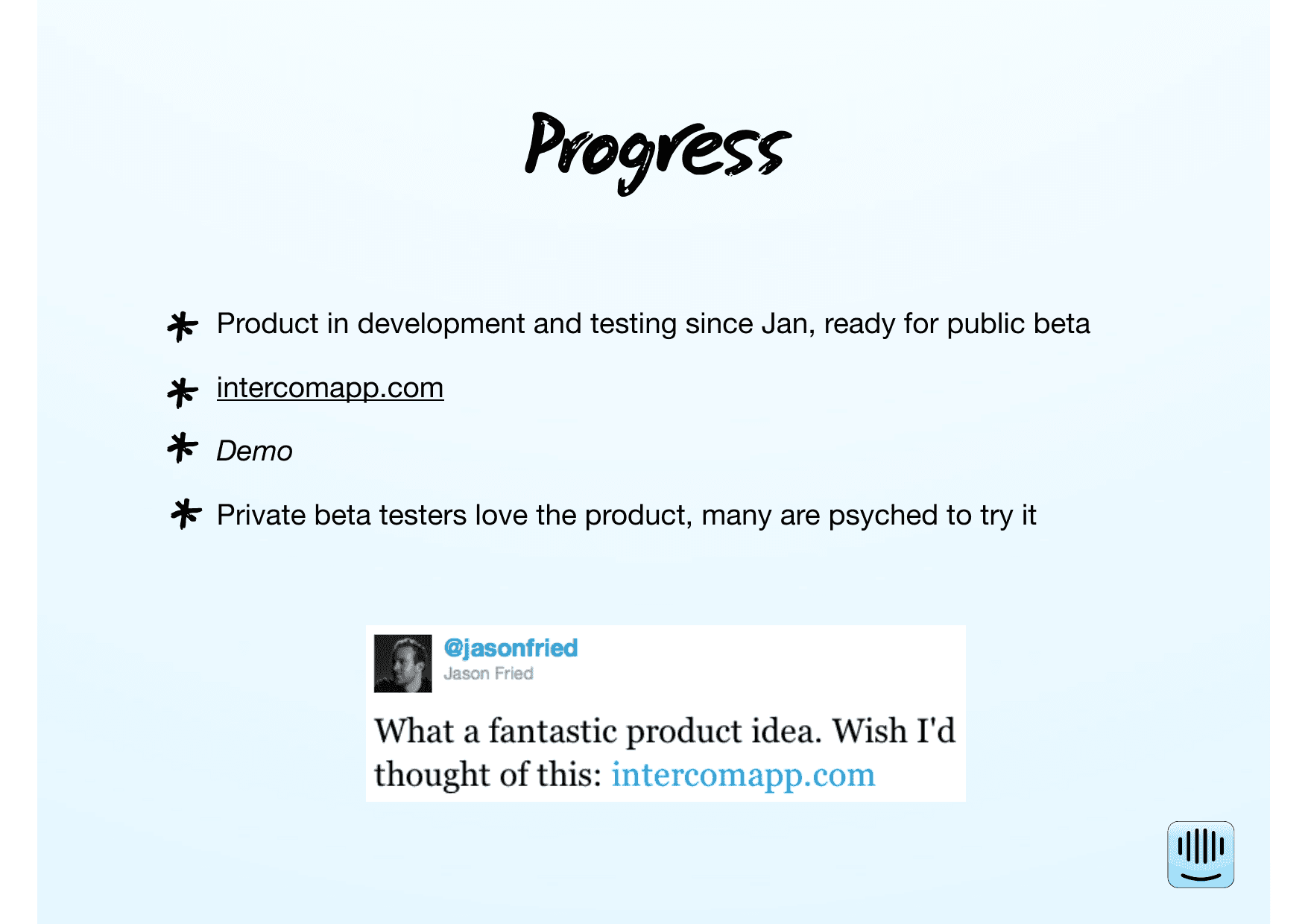
Traction without MRR, beta readiness plus one high-signal endorsement. Shows pull exists before they have revenue charts to show.
$600K convertible note for 18 months, product-market fit, customer development, early marketing, profitability, with a follow-on raise planned in 12–18 months.
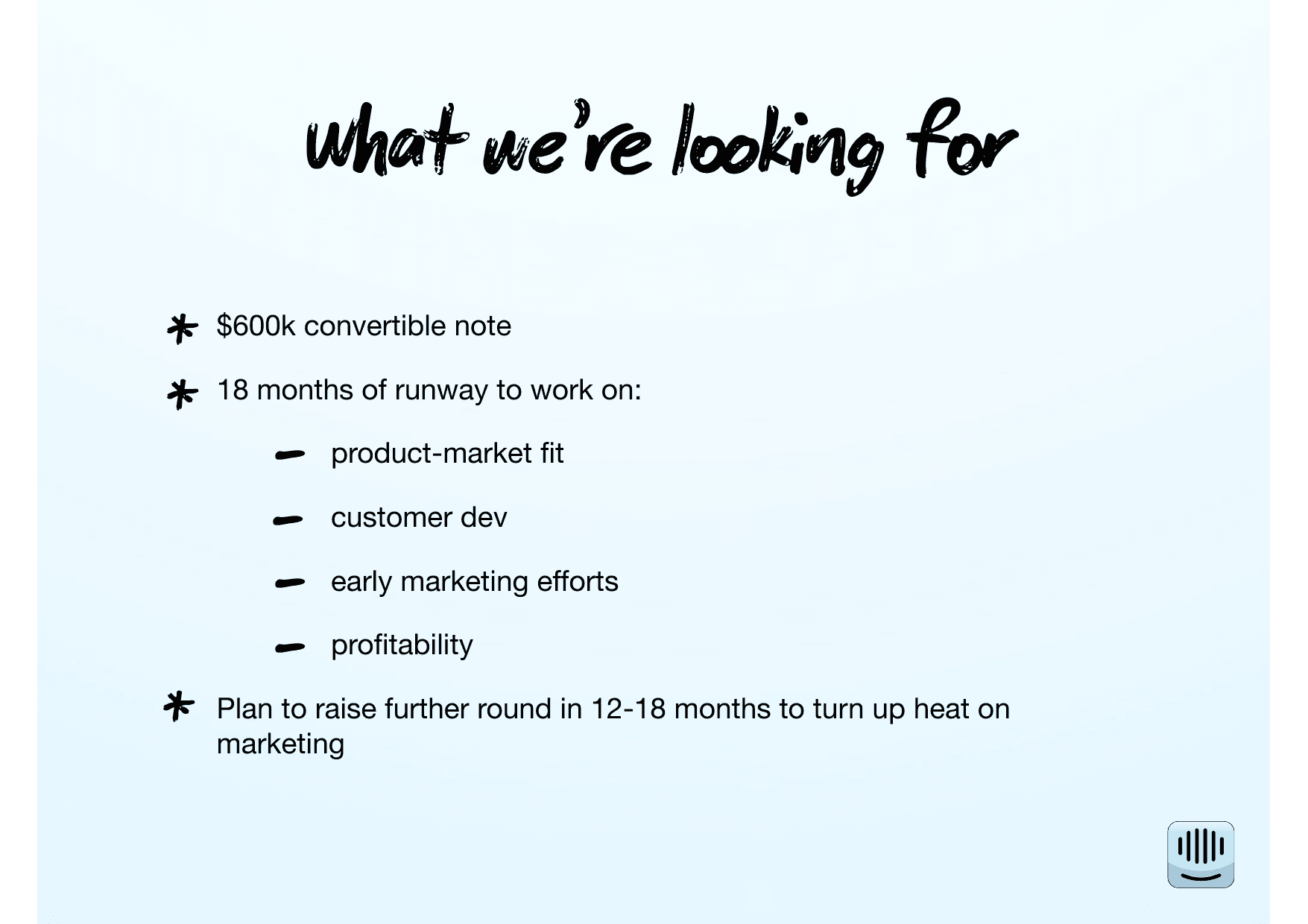
Ask slide names exactly how capital gets spent and when they'll come back. Convertible note + runway timeline de-risks the check for seed investors.
Join 100,000+ professionals creating presentations worth presenting.
Intercom
Intercom's 2011 seed deck raised $600K on just eight slides, no polish, no Gartner quadrant, just a product-led story about why SaaS companies couldn't build real customer relationships. Founders Eoghan McCabe, Des Traynor, Ciaran Lee, and David Barrett opened with the team, named the fragmented CRM and messaging stack, and closed with a $600K convertible note ask. It's one of the most cited early SaaS pitch decks for brevity and clarity.
Original 2011 deck · 8 slides. Click a thumbnail or scroll down for the full breakdown.
Intercom wordmark and logo on a pale blue gradient, marked DRAFT in the corner.
No tagline, no raise amount on the cover. The deck trusts the next seven slides to do the talking, a confidence move for an eight-slide seed pitch.
Four co-founders with defined roles. Eoghan McCabe (CEO), Des Traynor (COO), Ciaran Lee (CTO), David Barrett (front-end), plus Contrast consultancy, Qwitter and Exceptional acquisitions, and speaking/blogging credibility.
Team comes before problem, unusual order, but the thesis is execution risk off the table. Shared history at Contrast and two prior exits signal they can ship together.
SaaS providers can't build meaningful customer relationships; the work requires discovery, research, communication, and CRM, but tools are complex, email engagement is terrible, and no single product serves SaaS.
Problem chains emotion to economics: meaningful relationships → loyal customers → profitable growth. Email failure is called out specifically, investors feel a pain they've lived, not abstract TAM jargon.
Intercom as a five-part platform: simple install like Google Analytics, customer base browsing, individual customer research, in-app messaging on login or event triggers, and CRM with a relationship metric over time.
Solution maps feature-by-feature to the four problem pillars. No screenshots yet, bullet clarity lets investors picture the product before the demo slide.
Now: SaaS providers. $21 billion market, $93 billion by 2016 (Forrester). Later: mobile and desktop app providers.
Two-tier market sizing in one slide, credible niche today, bigger adjacency tomorrow. Forrester citation gives the number weight without a dense TAM funnel.
Five fragmented categories, social media (Radian6, Hootsuite), support (Zendesk, UserVoice), email (MailChimp), in-app messages (Hello Bar), analytics (Mixpanel, KISSmetrics), with no single integrated player.
Competition slide shows the gap, not a battle. Listing a dozen point solutions makes the unified-platform pitch feel inevitable rather than arrogant.
Product in development since January, ready for public beta at intercomapp.com, plus a Jason Fried tweet: "What a fantastic product idea. Wish I'd thought of this."
Traction without MRR, beta readiness plus one high-signal endorsement. Shows pull exists before they have revenue charts to show.
$600K convertible note for 18 months, product-market fit, customer development, early marketing, profitability, with a follow-on raise planned in 12–18 months.
Ask slide names exactly how capital gets spent and when they'll come back. Convertible note + runway timeline de-risks the check for seed investors.
Join 100,000+ professionals creating presentations worth presenting.