
Original 2008 deck · 25 slides. Click a thumbnail or scroll down for the full breakdown.
Uber
Garrett Camp and Travis Kalanick pitched UberCab in late 2008 with a 25-slide deck that raised $200K, before ride-hailing was a category. The deck sells a members-only luxury car service for urban professionals: one tap on your iPhone or BlackBerry, Mercedes sedans, cashless billing, and GPS-optimized dispatch. It is long by modern seed standards but famous for market sizing, product screenshots, and framing taxis as a broken monopoly ripe for digital hail.
Original 2008 deck · 25 slides. Click a thumbnail or scroll down for the full breakdown.
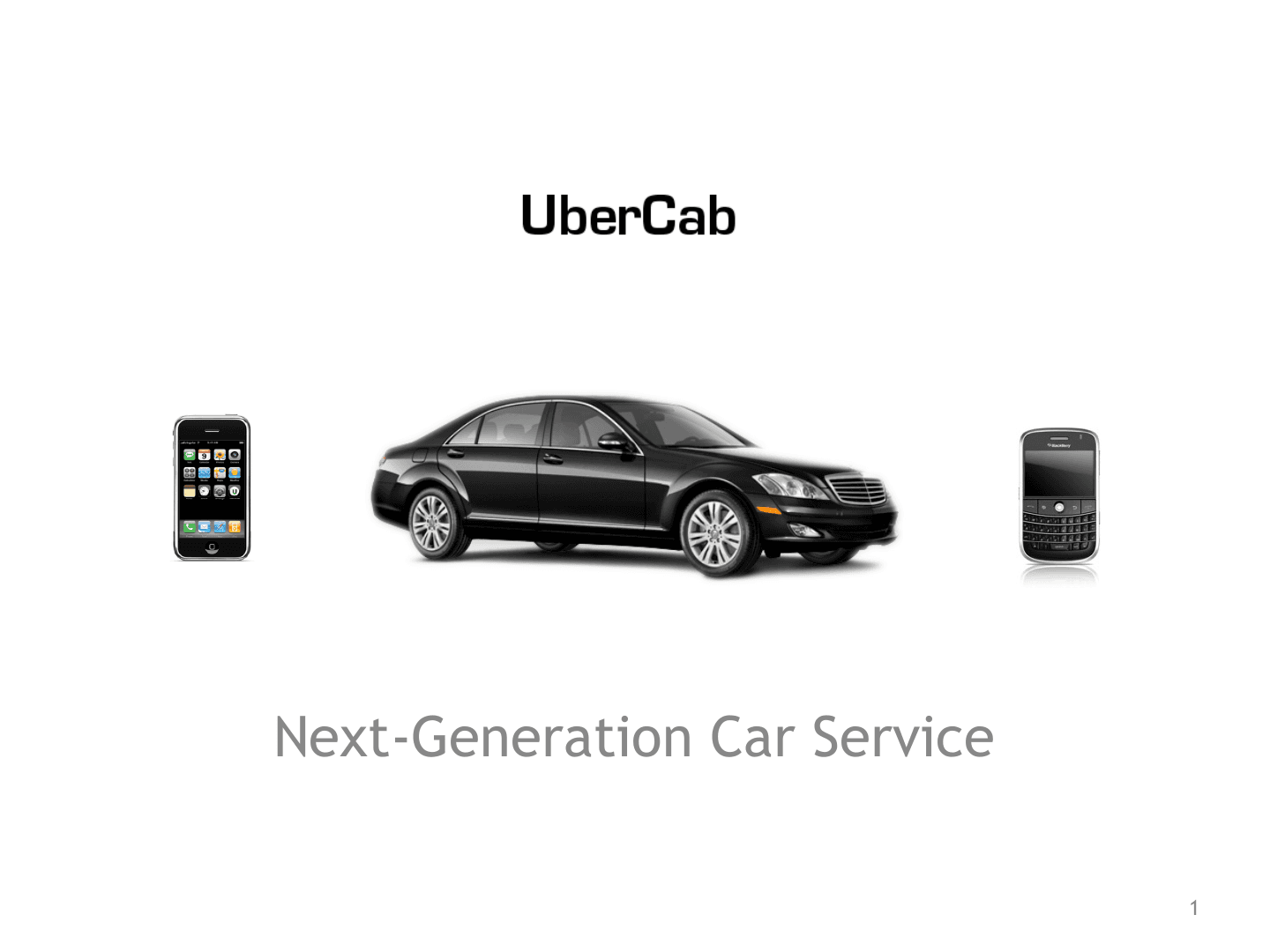
UberCab. Next-Generation Car Service, with a black Mercedes flanked by an iPhone and a BlackBerry.
The cover states category and positioning in one line. Luxury car plus dual smartphone icons signal premium mobile dispatch, investors know the wedge
Radio dispatch with no GPS, Ford Crown Victoria fleets at 14 mpg, and hailing by hand or phone with significant driver dead-time.
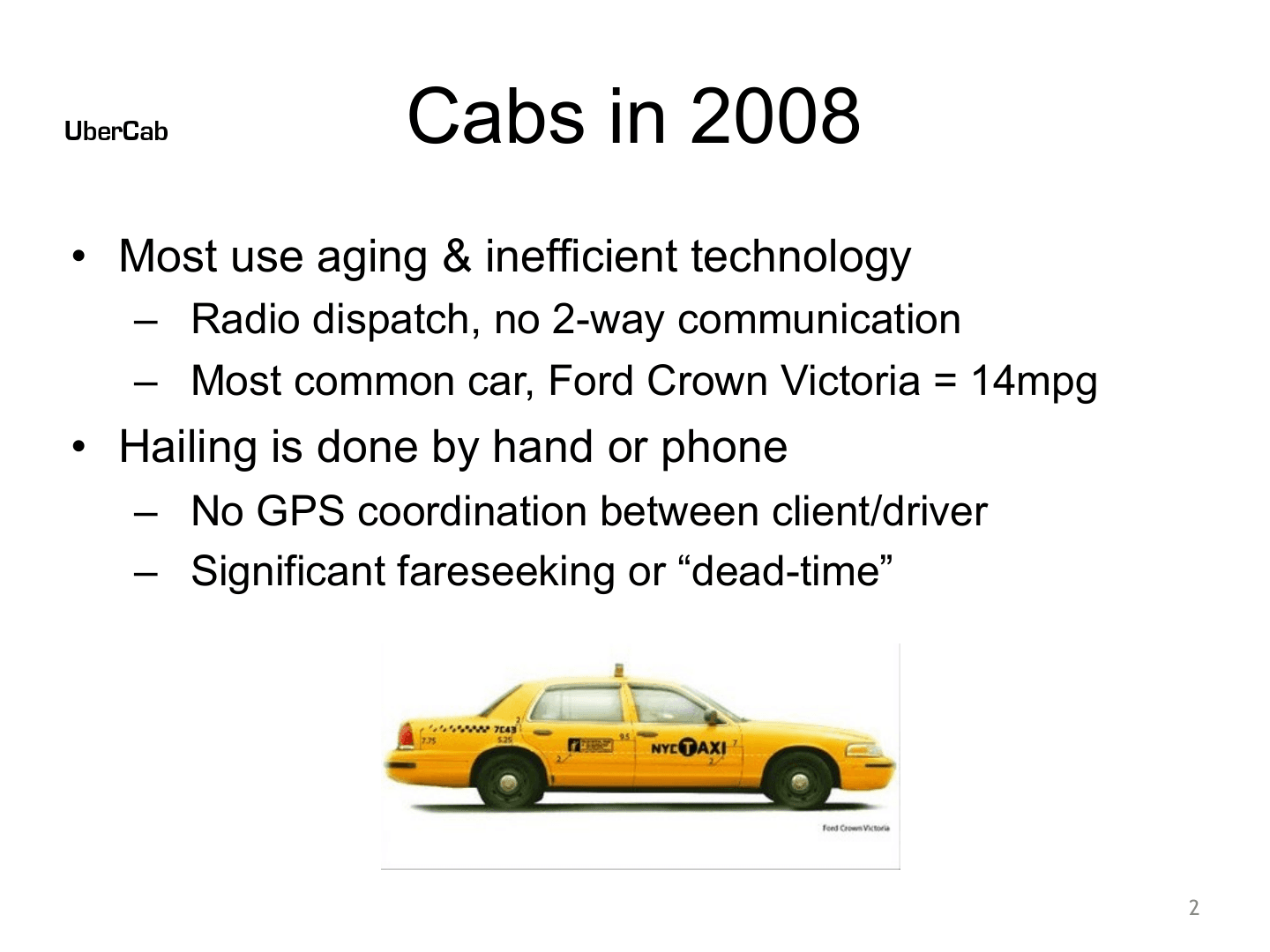
Three concrete industry failures with a yellow-cab photo anchor the problem in 2008 reality. Founders describe supply-side inefficiency, not just rider frustration.
NYC medallions near $500K while drivers earn ~$31K, no accountability, and a green line: digital hail can make street hail unnecessary.
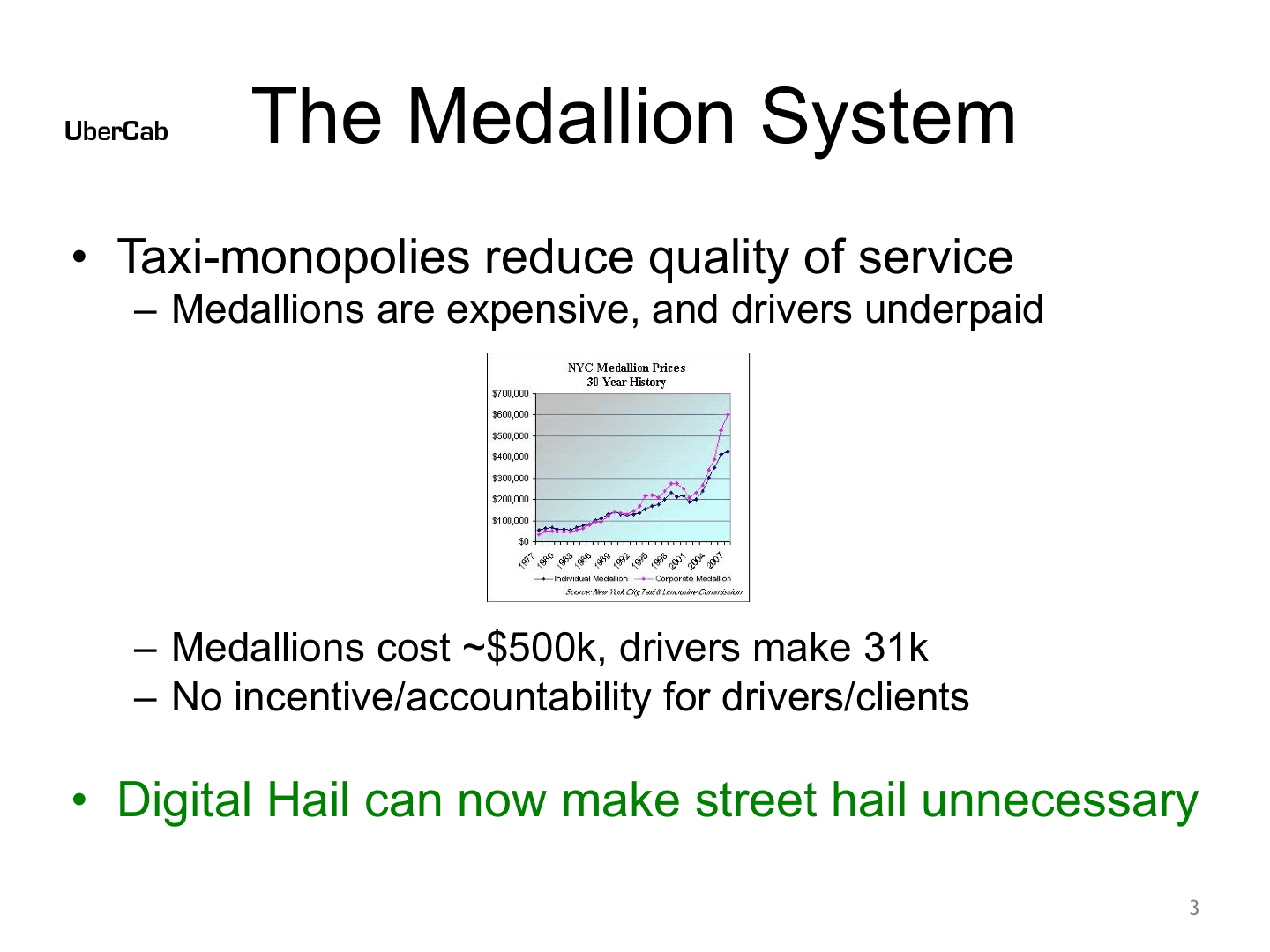
Regulatory economics plus a 30-year medallion price chart show why incumbents cannot innovate. The digital-hail teaser bridges problem to solution without a product screenshot yet.
On-demand car service for urban professionals. NYC cab convenience plus chauffeur experience in SF and NYC, automated dispatch, NetJets of car services.
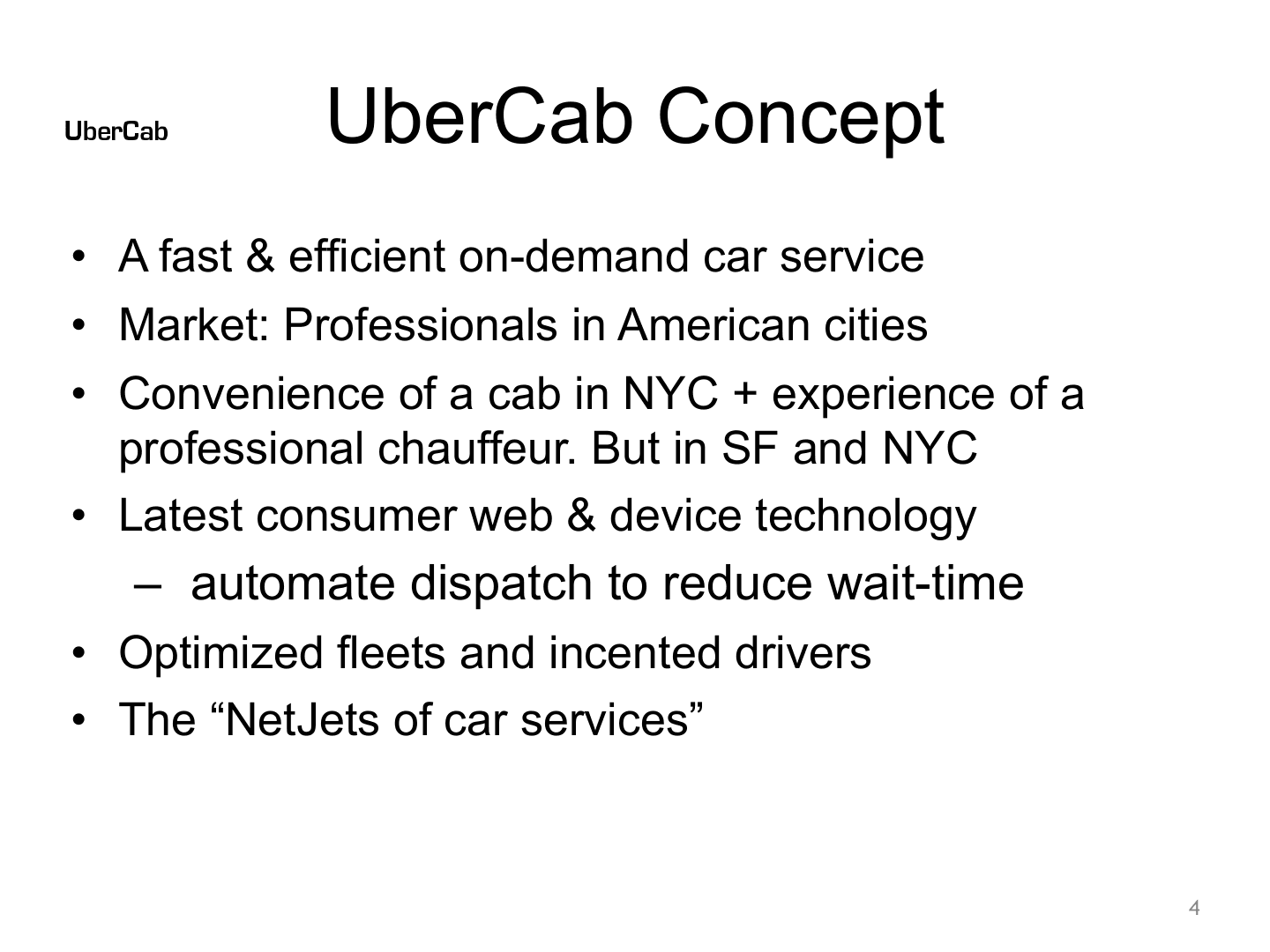
NetJets analogy gives investors a mental model for a members-only premium fleet. Targeting professionals in two dense cities keeps the wedge believable at seed stage.
Members-only digital hail, no street hailing, no medallions, guaranteed pickup with driver and rider photos via the mobile app.
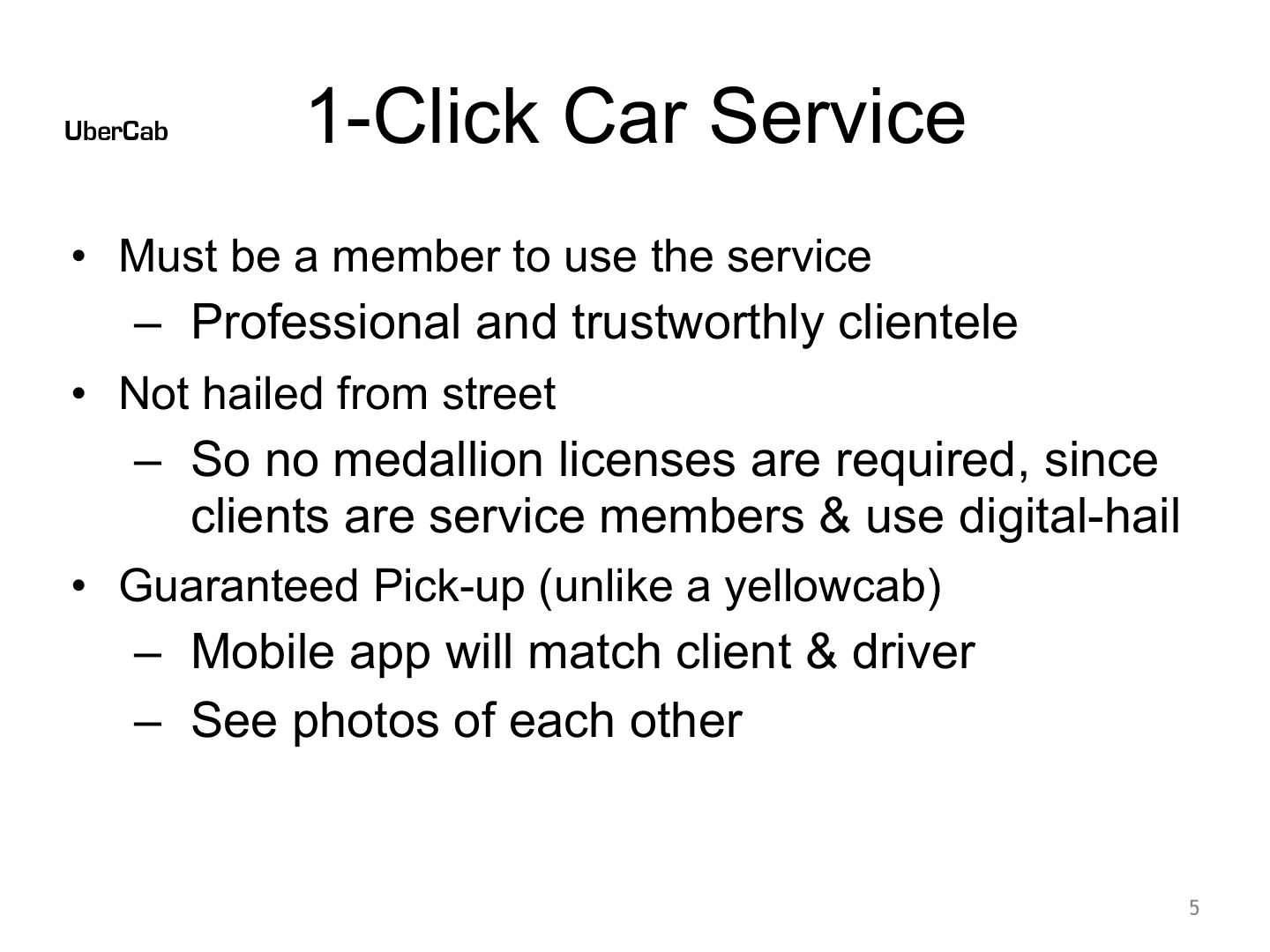
This slide is also a regulatory strategy: pre-screened members and app-based requests sidestep medallion rules. Guaranteed pickup directly answers slide 2's dead-time and uncertainty pain.
Members only, one-click hailing, fast response, Mercedes sedans, rate-your-trip, geo-aware dispatch, and optimized fleet software.
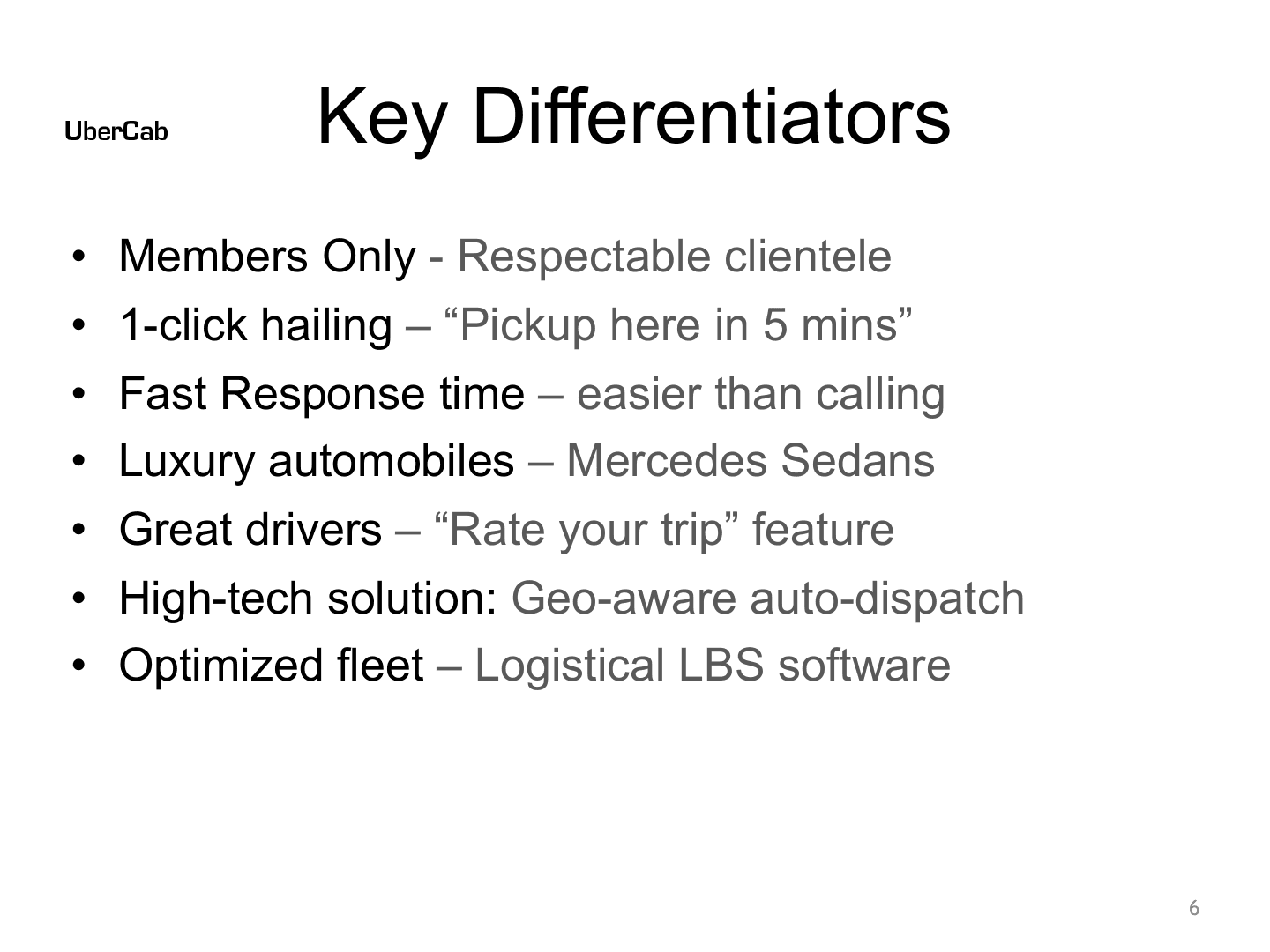
Seven scannable differentiators in a grid, each maps to a taxi pain point. Trip ratings and geo-dispatch were novel in 2008 and foreshadow Uber's two-sided reputation loop.
Luxury on-demand, fuel-efficient fleet, computer-coordinated service, optimized response time, cashless pre-paid billing, profitable by design.
Mission bullets read aspirational without metrics, useful as talking points live, thin on a standalone deck. Cashless billing and profit-by-design are the lines investors remember.
One-click requests from geo-aware devices plus SMS pickup commands like 'pickup @work in 5', shown on iPhone, BlackBerry, and Nokia.
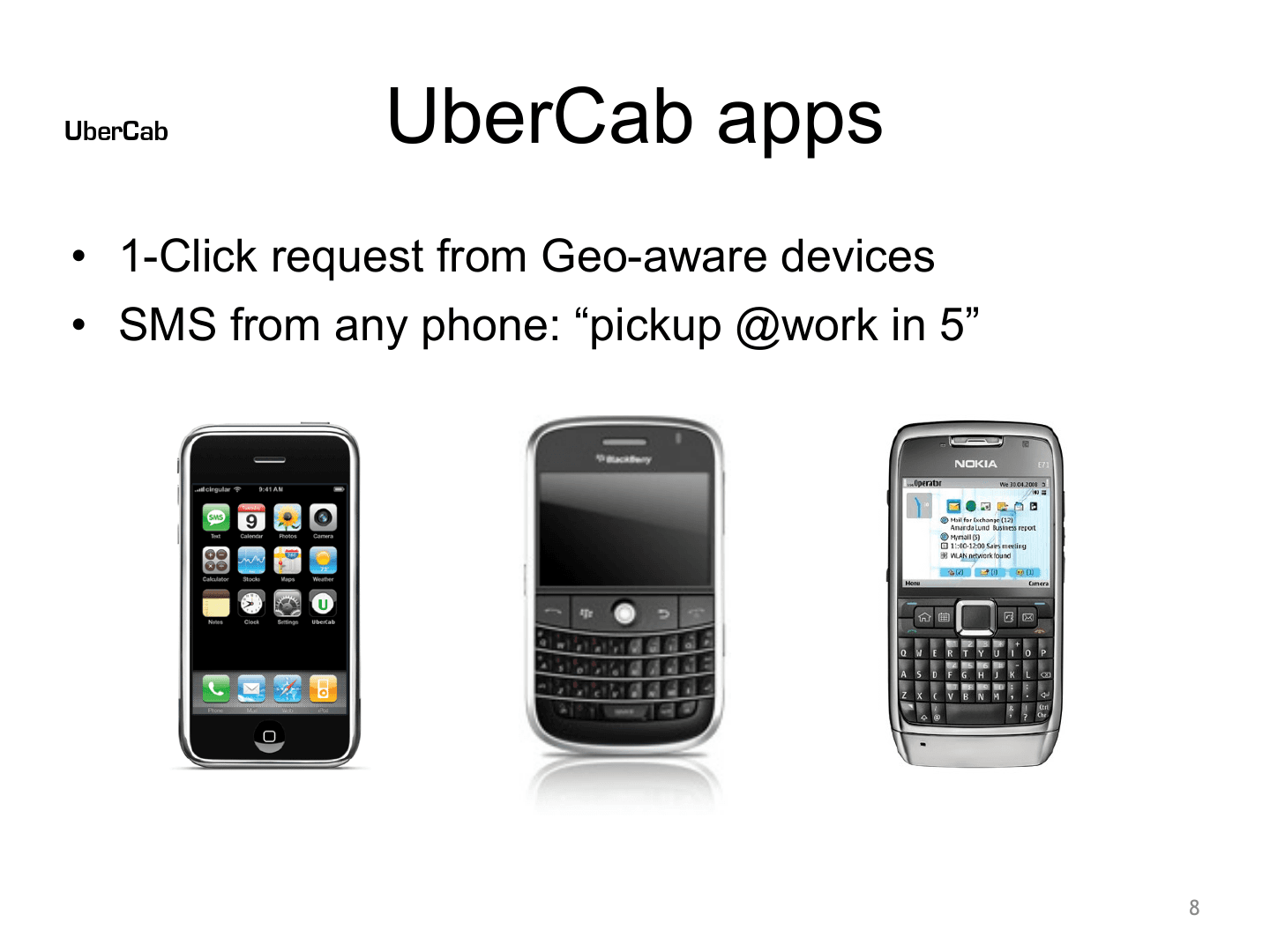
Multi-platform hardware photos prove mobile-first thinking before the App Store era. SMS fallback widens addressable users beyond early smartphone owners.
Web portal to book trips, view fleet status and history, and save labeled locations (home, work) with Google Maps lat/long for easy SMS hailing.
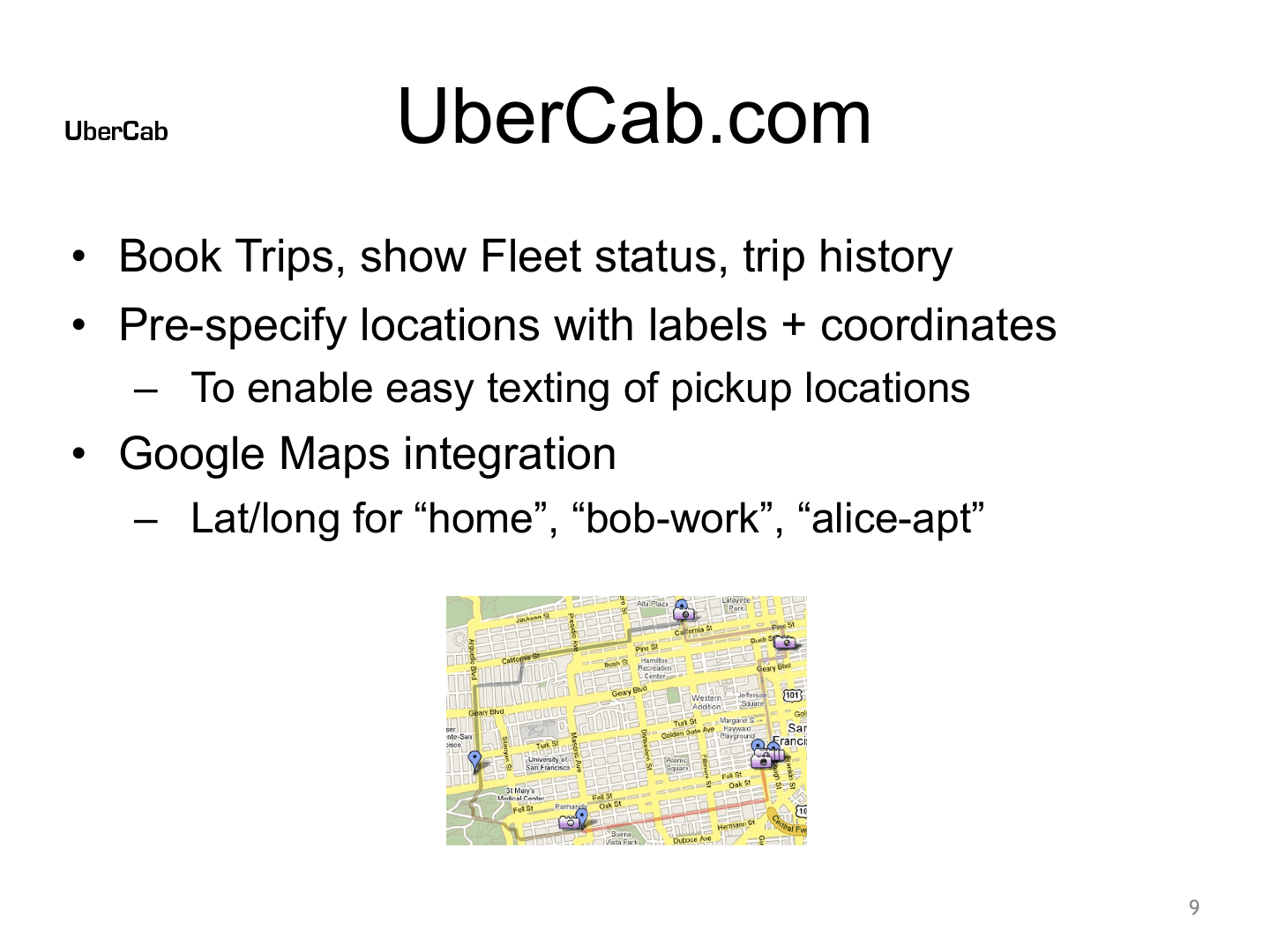
Product depth beyond the app, saved places and fleet map show a full dispatch stack. The SF map screenshot makes abstract logistics tangible for investors skimming alone.
Restaurants and bars, parking-scarce trips, pre-scheduled airport runs, in-car WiFi commutes with rideshare, school drop-offs, and elderly transport.
Everyday scenarios expand TAM beyond business travel, airport and nightlife use cases still drive Uber volume today. WiFi-in-car and campus rideshare hint at UberPool years early.
Cabs can take 45 minutes with no pickup guarantee; limos need hours of notice and $60+ transfers. UberCab splits the difference on speed, price, and cleanliness.
Positions UberCab between taxi and limo on a value spectrum, faster than car service, nicer than a cab. Repetitive after earlier slides but gives investors a one-line positioning sound bite.
Less fare-seeking dead-time (35% in NYC), hybrid Mercedes and Lexus fleets at 2× cab efficiency, and rideshare incentives for SFO and event trips.
Efficiency arguments double as unit-economics story, fewer empty miles mean better driver utilization. Carpool bullet is prophetic; it became core product strategy, not a footnote.
Premium S550 for SF beta, future S400 hybrid at 30 mpg, standard Lexus GS450h or E320 at 23 mpg, versus 14–16 mpg for existing cab fleets.
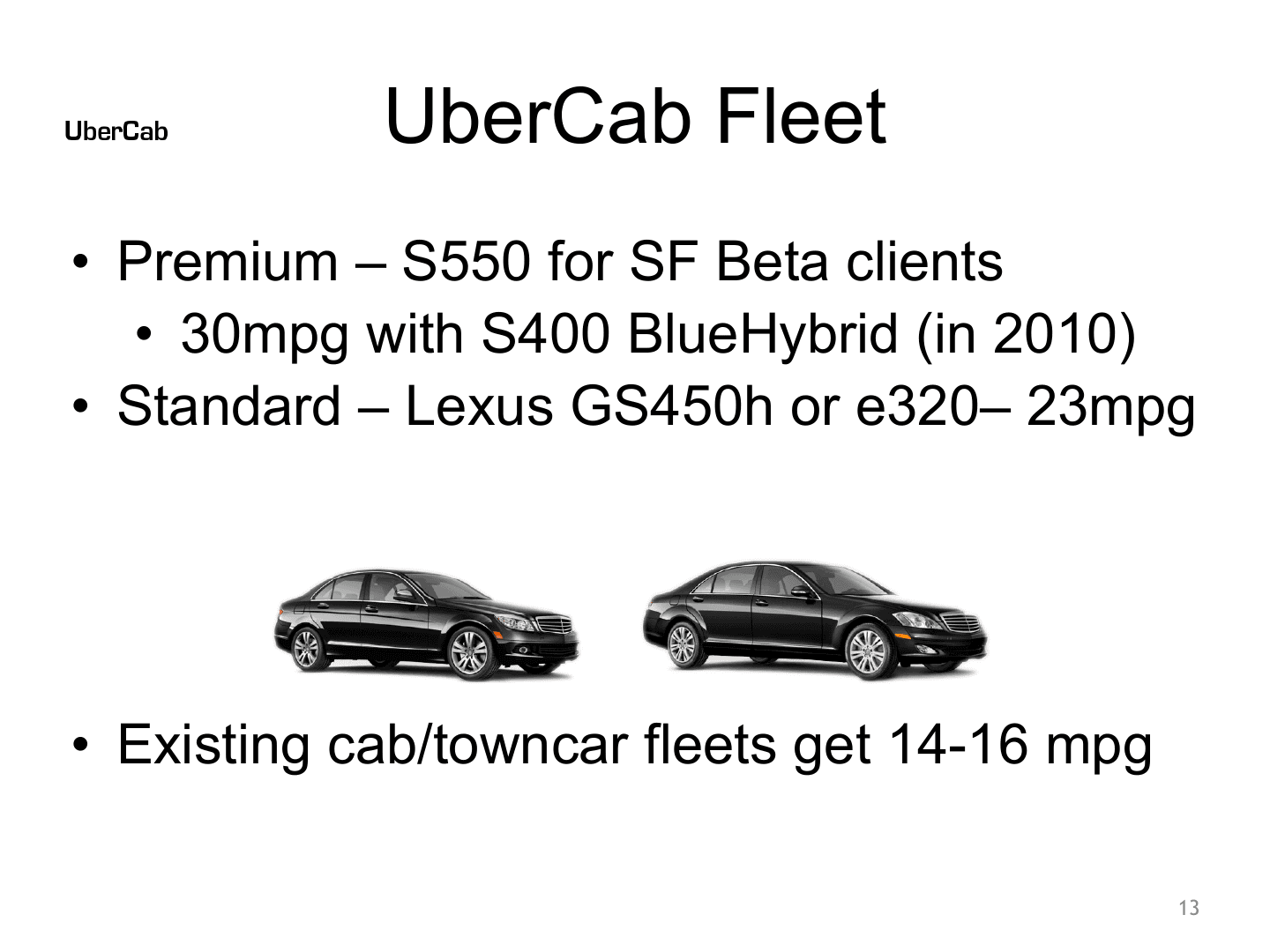
Specific vehicle tiers signal luxury positioning and fuel-efficiency moat. Founders assumed owned or regulated fleet, a plan Uber later abandoned for the asset-light marketplace model.
Launch in central San Francisco first, Manhattan soon after, map pin on downtown SF.
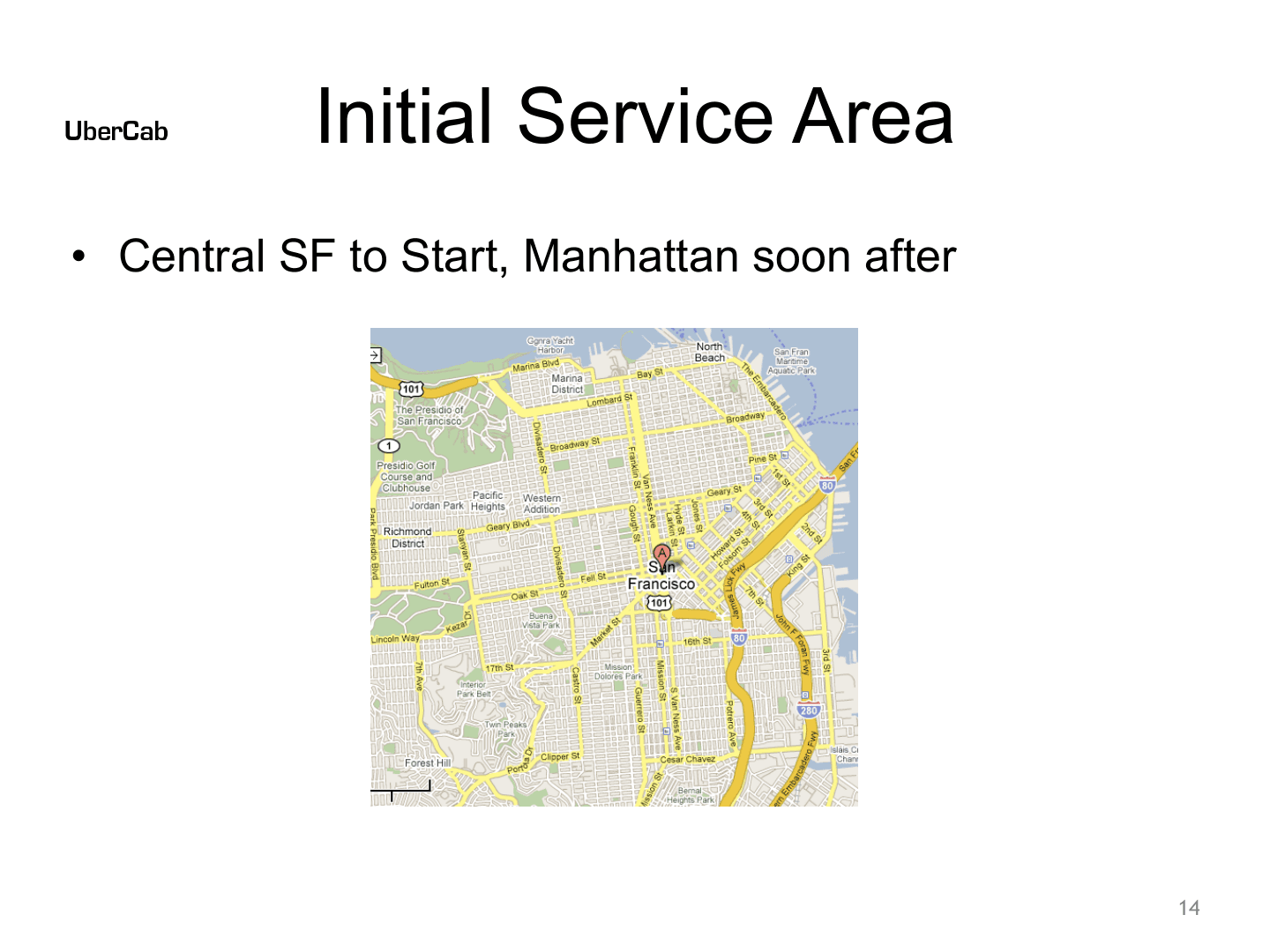
Classic wedge GTM: two dense coastal cities with painful taxi markets and high-income professionals. Map visual makes geographic focus impossible to miss.
iPhone, BlackBerry, and Symbian apps with operations-research route optimization, payment and reputation tracking, patent-pending system design.
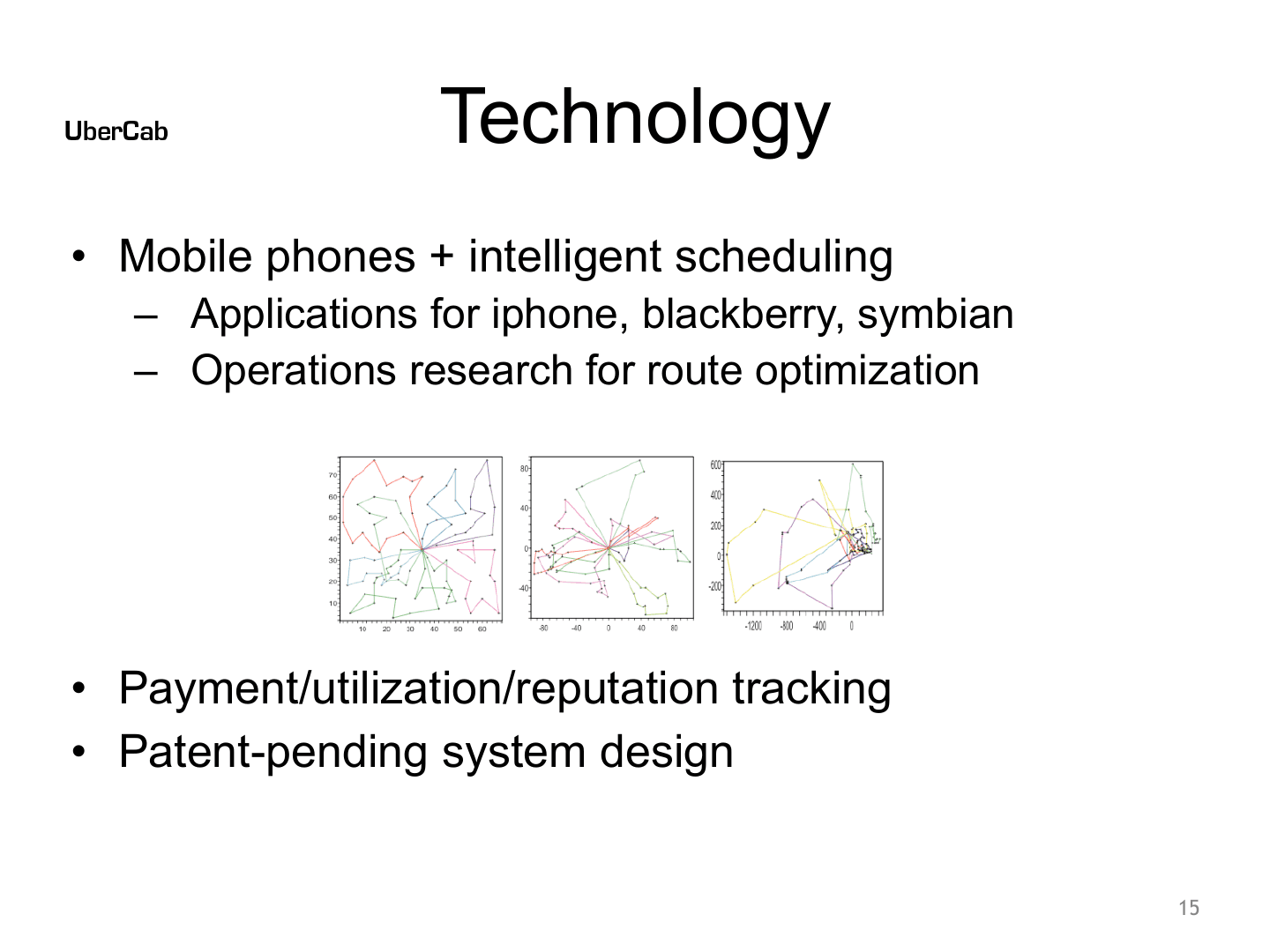
Positions UberCab as a logistics software company, not a car company. Route-optimization diagrams add technical credibility beyond bullet claims.
Cars hover in statistically optimized positions to minimize pickup time by hour, weather, and traffic. SF grid heat-map visualization.
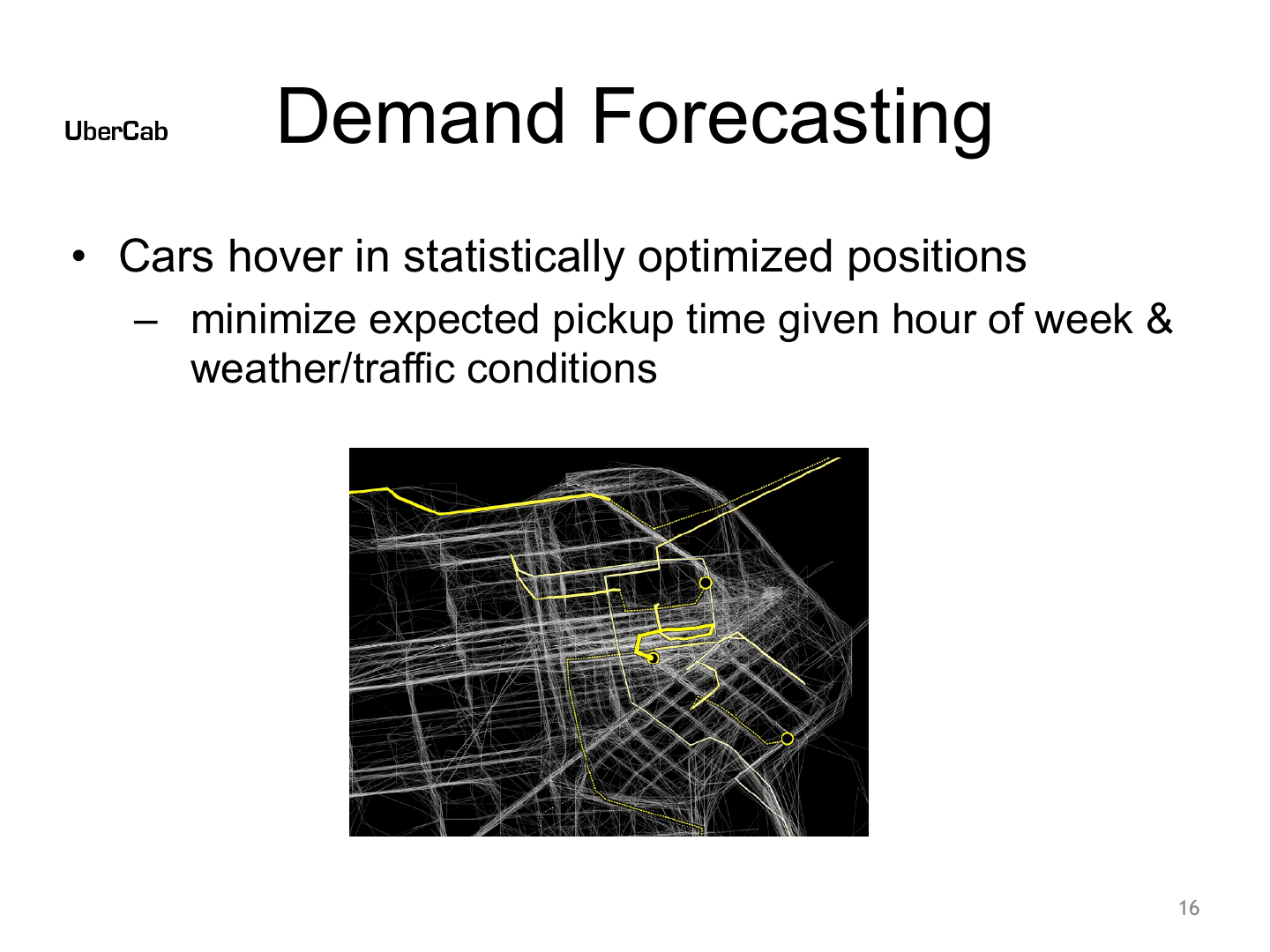
Predictive positioning is the defensibility slide, traditional dispatch cannot replicate this. The heat-map visual sells data science before 'AI' was pitch-deck vocabulary.
$4.2B US taxi and limousine market growing to ~$4.8B by 2014; top four players hold only 22% of revenue.
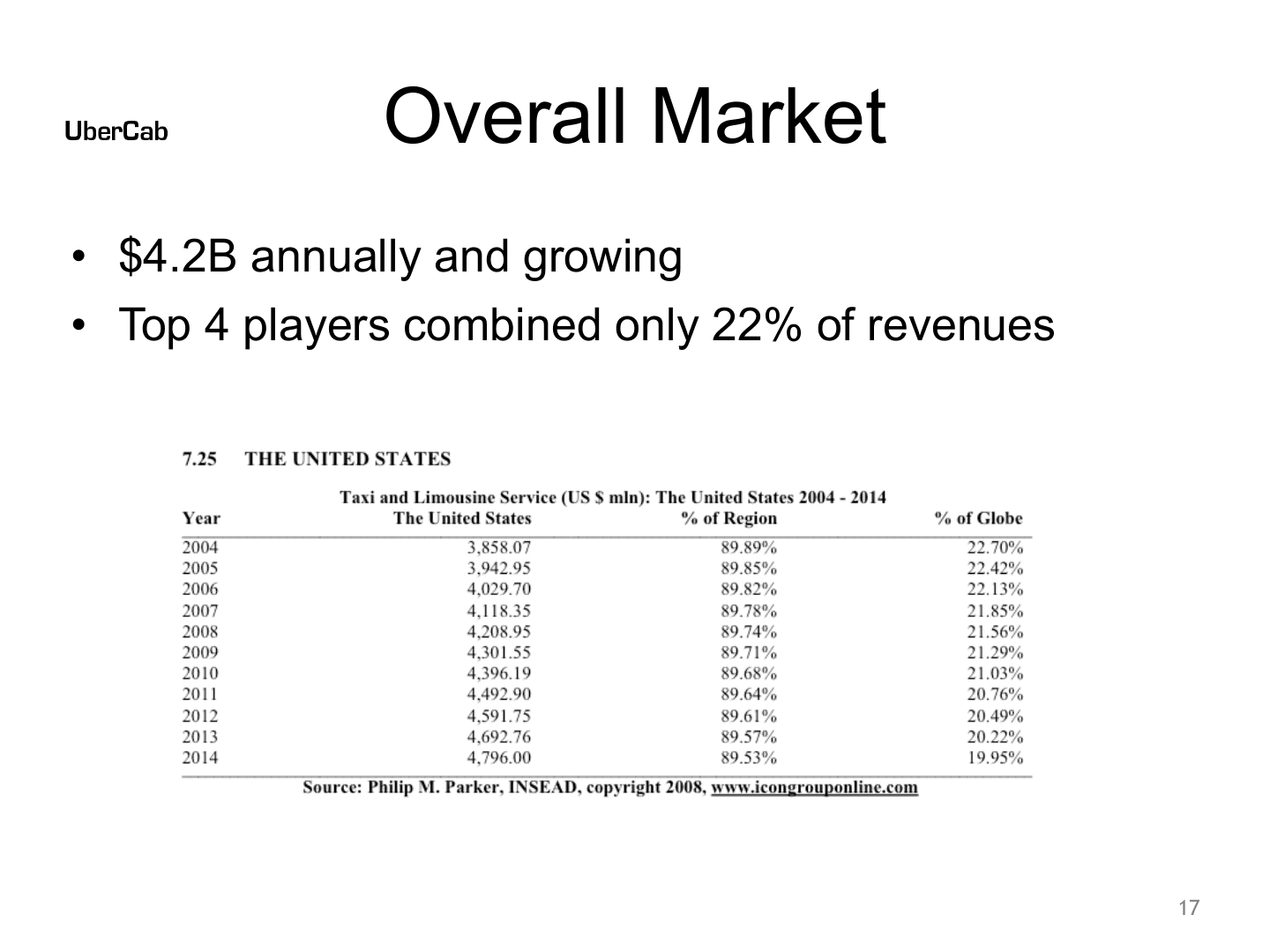
INSEAD-sourced table backs the TAM number investors can cite. Fragmentation stat argues a tech entrant can win share without displacing a single dominant incumbent.
2007 segment pie chart. 64% retail non-airport trips, 15% business non-airport, 12% retail airport, 9% business airport; focus on urban on-demand.
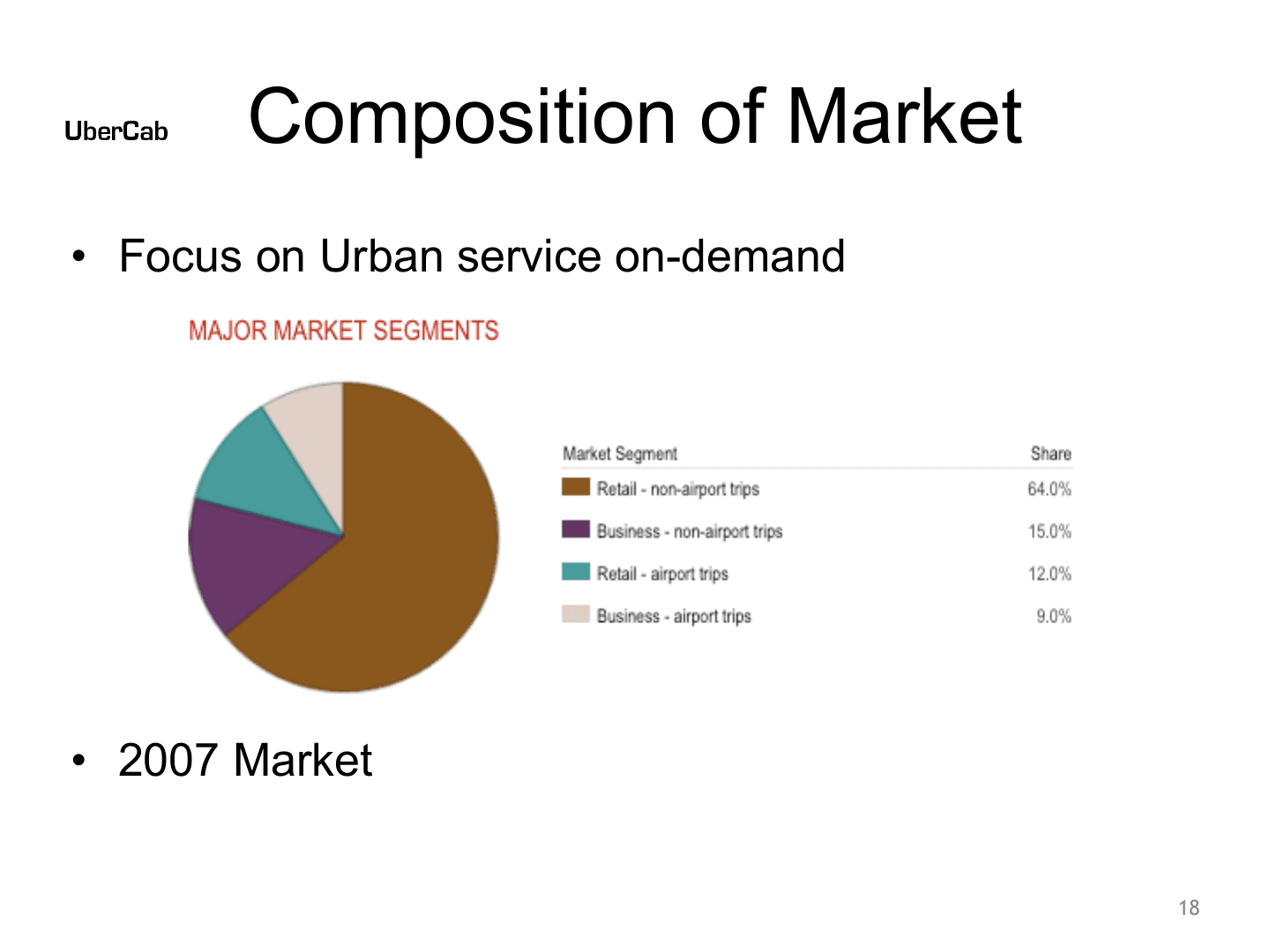
Segmentation justifies everyday urban rides, not just airport black-car niche. Retail non-airport majority supports the use-case slides and a mass-market path Uber eventually took.
Start SF and NYC, expand to LA, Chicago, Houston, Philadelphia, and Dallas, six cities covering ~50% of the US market with city-by-city revenue table.
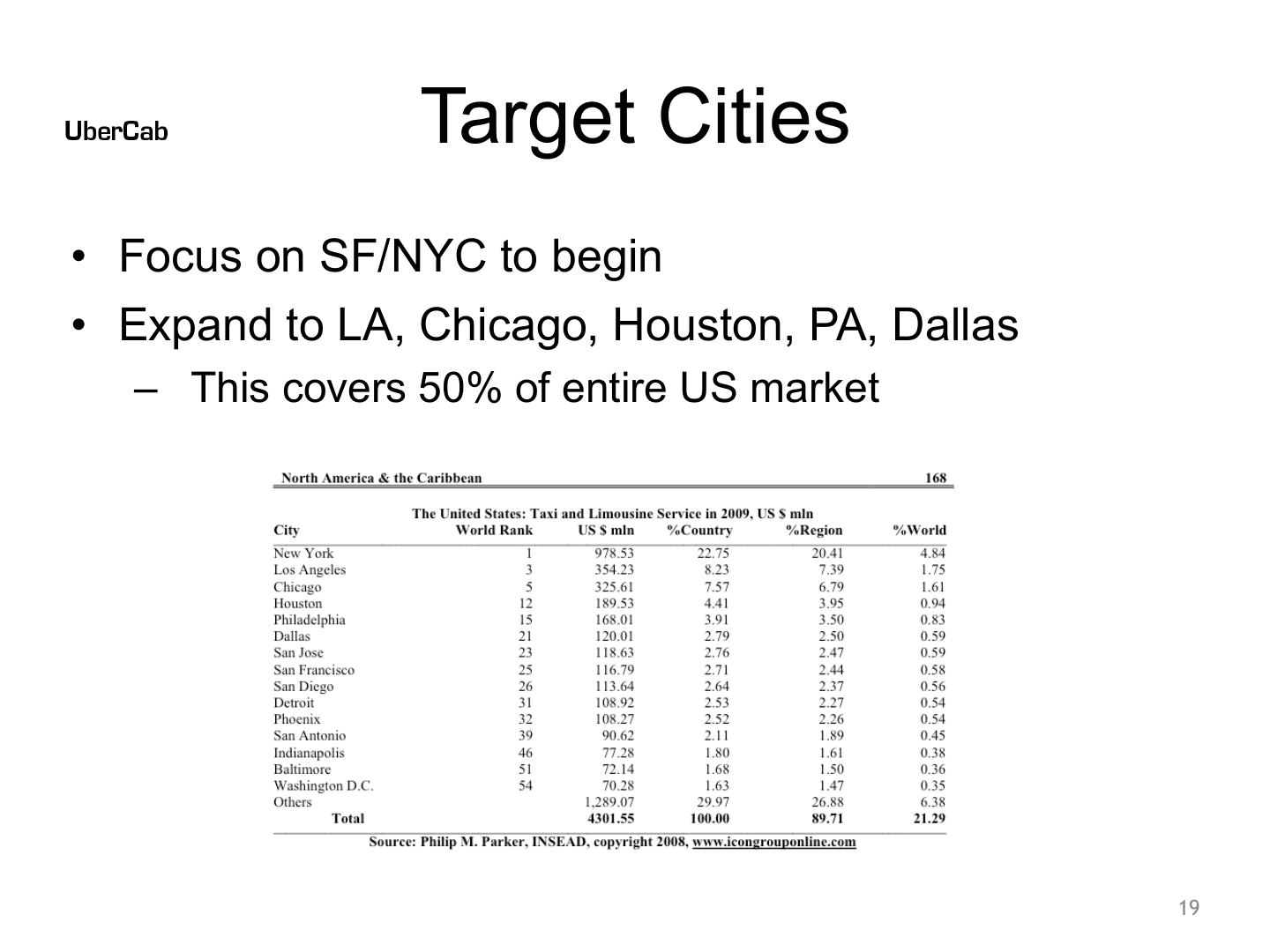
Rollout logic tied to ranked city revenue data. NYC alone is ~23% of US spend. Could merge with slide 14, but the table makes expansion feel disciplined, not opportunistic.
Best case: market leader at $1B+ revenue; realistic: 5% of top five cities and $20–30M profit; worst case: 10-car boutique SF executive service.
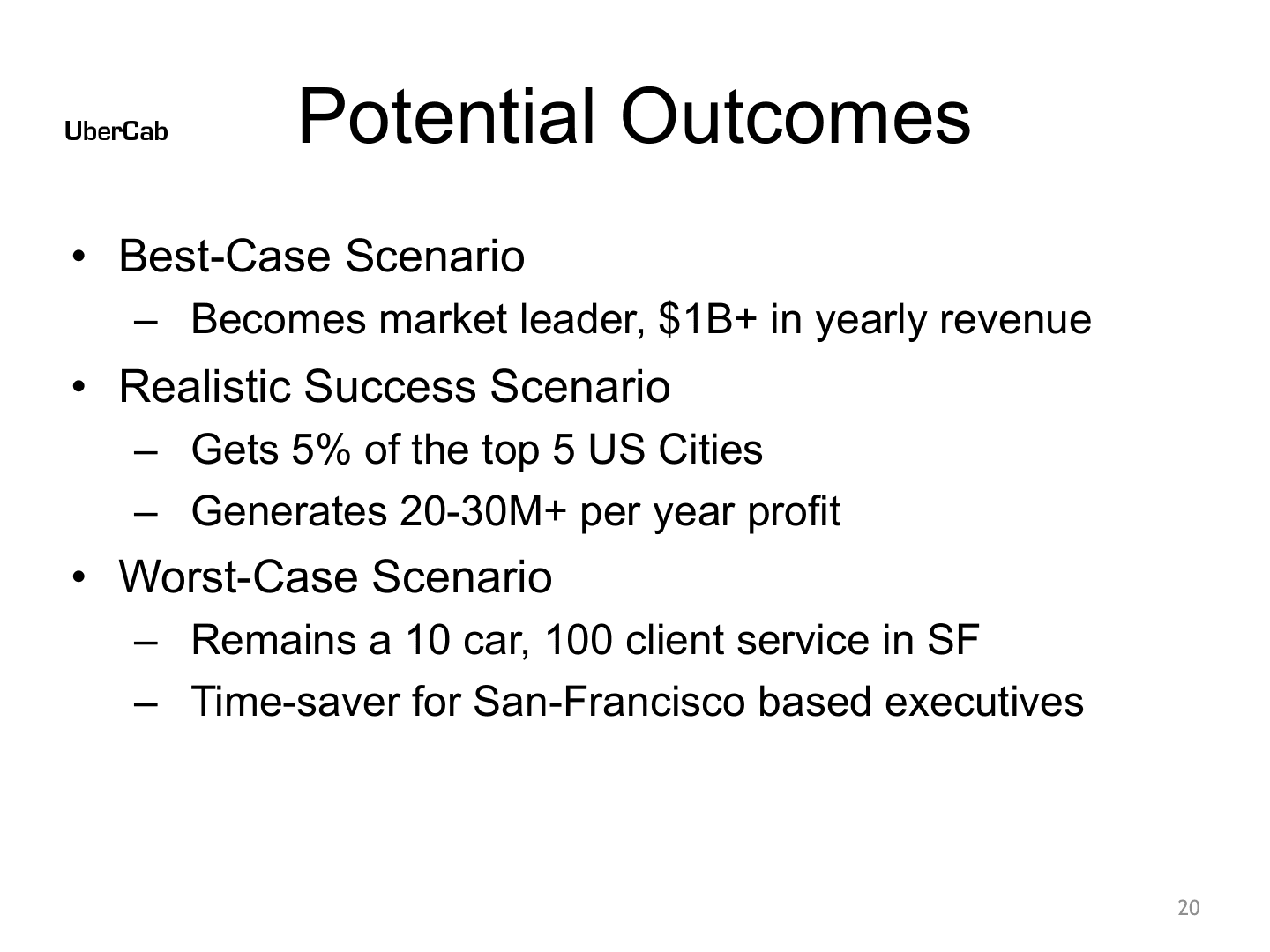
Three-scenario framing de-risks the bet, even the floor is a viable business. Best-case $1B looked bold in 2008; Uber later blew past it, but the structure gave VCs a narrative arc.
US smartphone OS share pie (RIM 32%, Windows Mobile 30%, iPhone 10%) and global manufacturer share by region. Canalys-era charts.
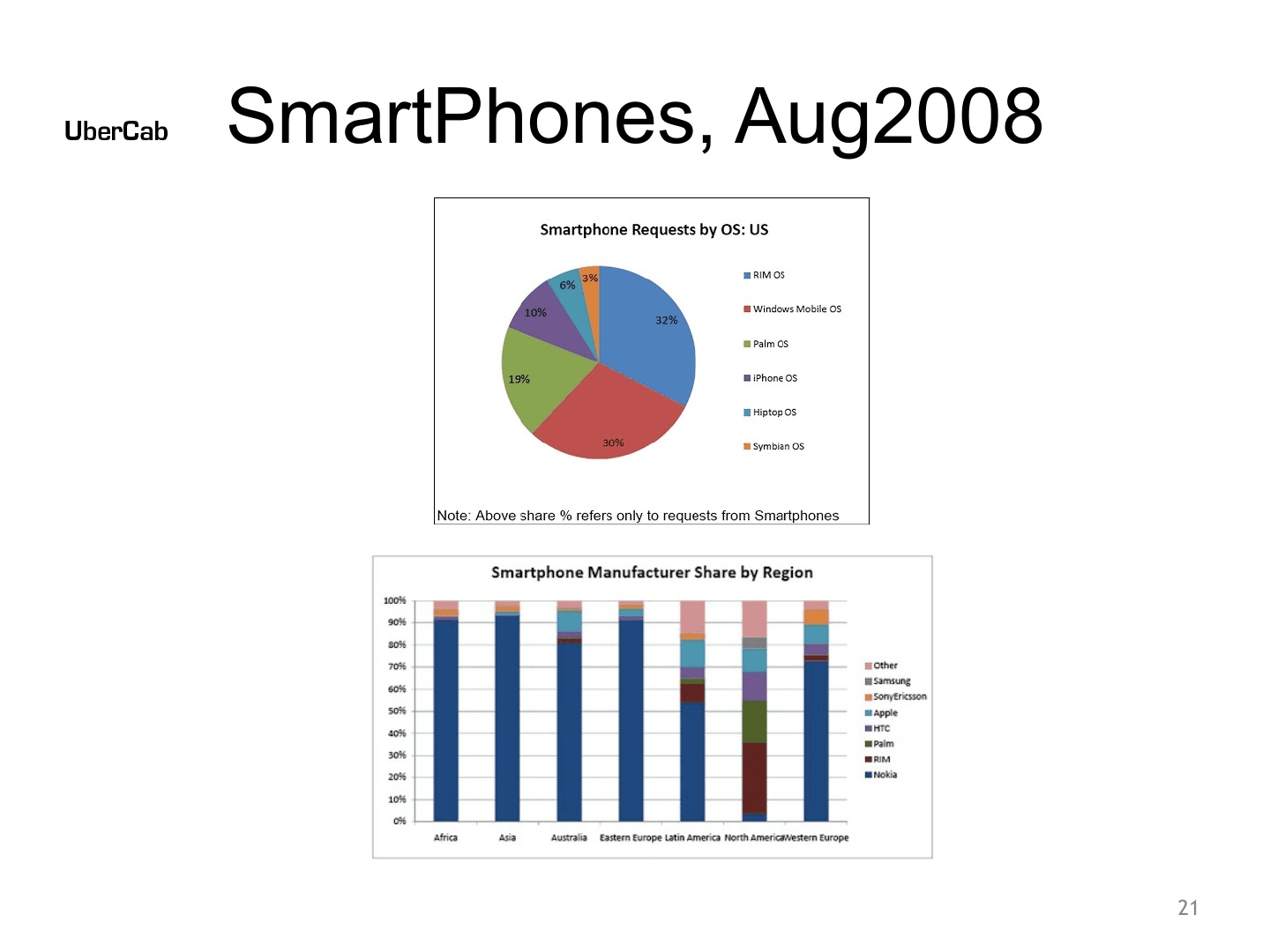
Classic 'why now' slide for pre-iPhone-dominance era. BlackBerry-heavy data explains multi-platform build and professional-user targeting, timing argument for mobile dispatch.
Used and Prius fleet options, better GPS, off-peak discounts, and premium pricing for immediate vs scheduled pickups.
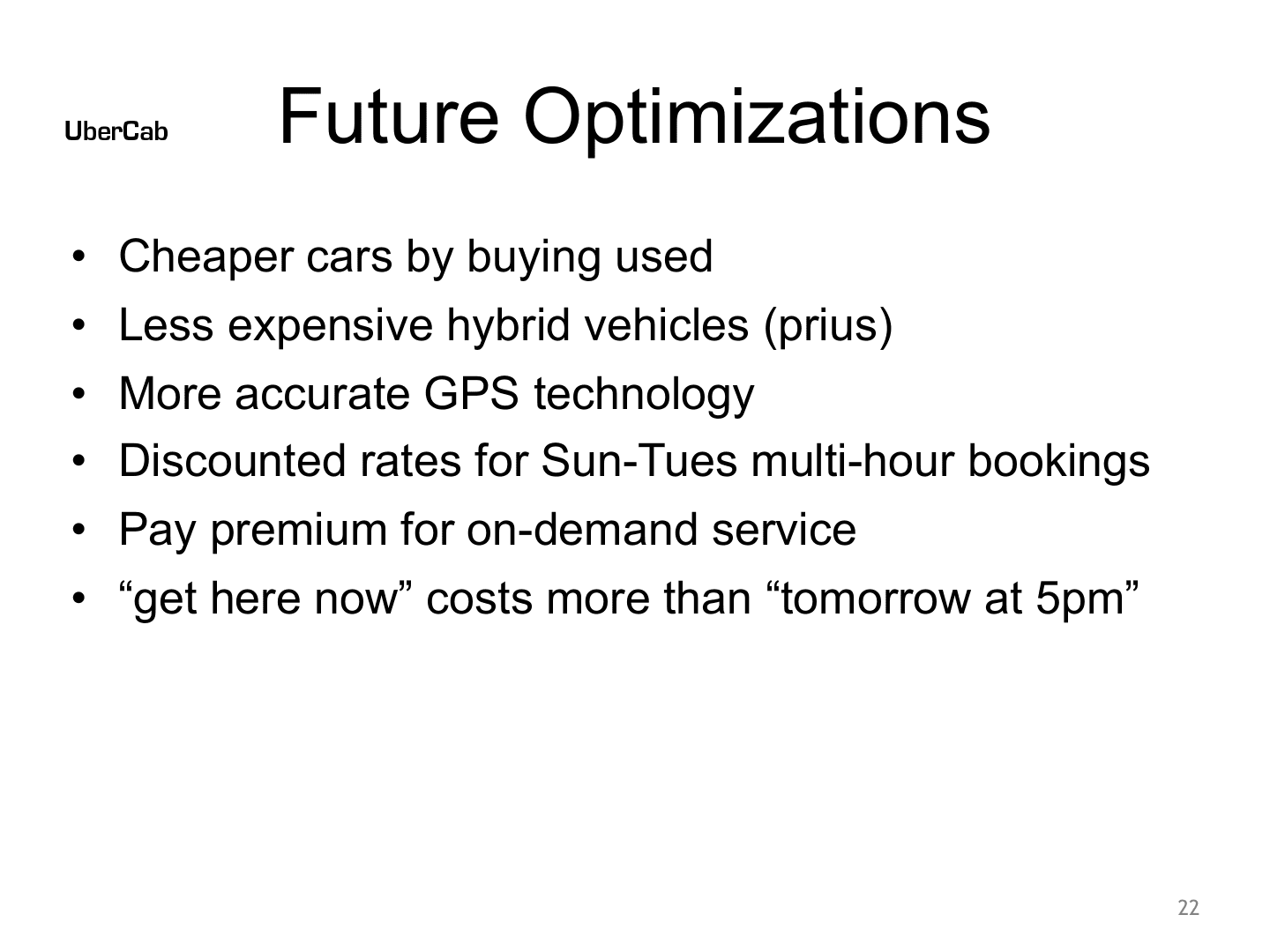
Roadmap slide foreshadows UberX (Prius) and surge pricing years early. Dynamic 'get here now' vs 'tomorrow at 5pm' pricing shows founders understood utilization economics beyond launch fleet.
Become the premium cab brand vs YellowCab, invite-only referrals, slogans: One-click cab, NetJets of limos, Cabs 2.0.
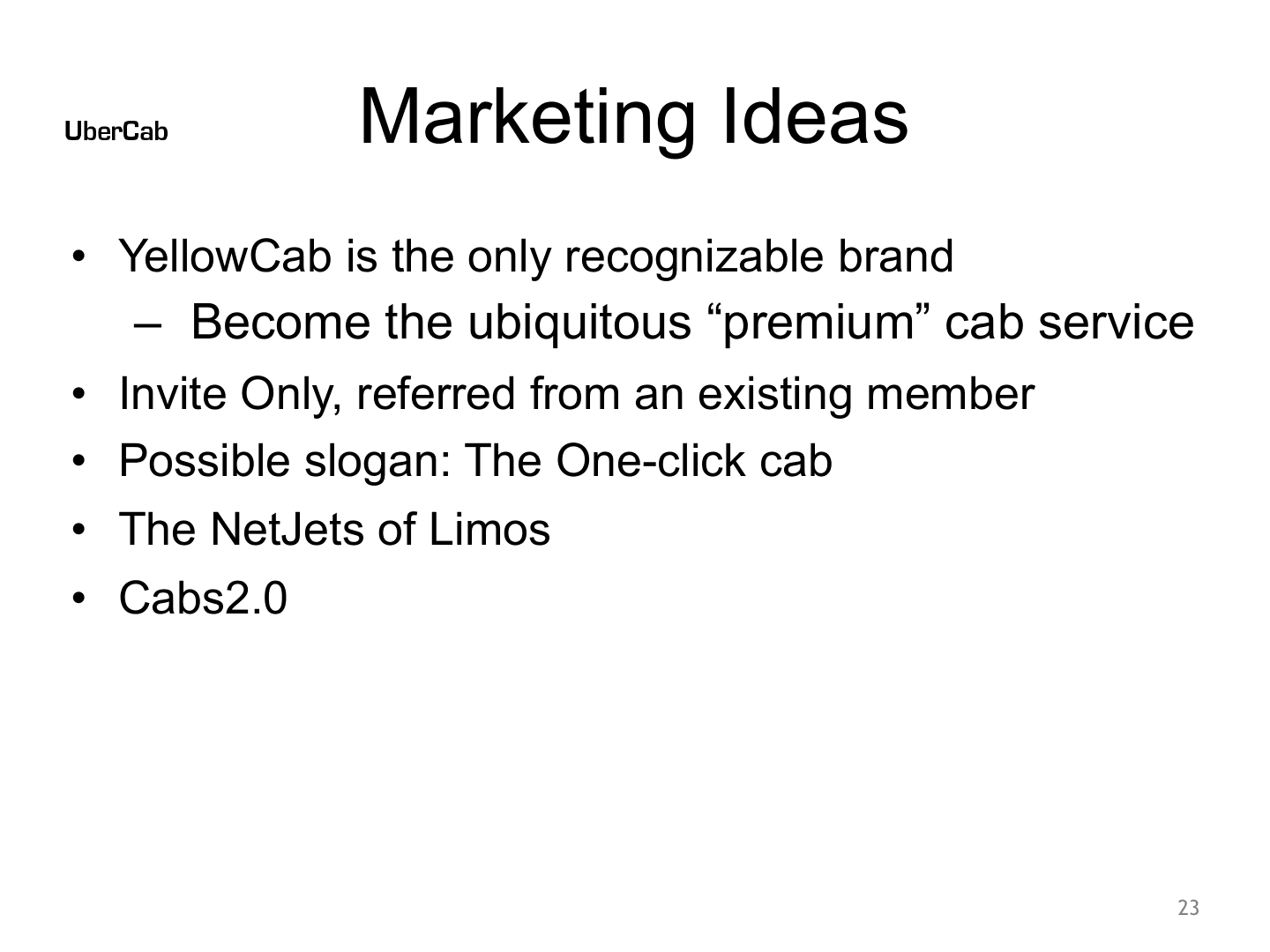
Brainstorm bullets, not a GTM plan, but invite-only referral loop became Uber's early launch playbook. Brand slogans give investors memorable hooks even without ad spend detail.
Extend dispatch infrastructure to delivery and non-critical medical or government LBS. $3.5B industry by 2010, with smartphone shipment growth charts.
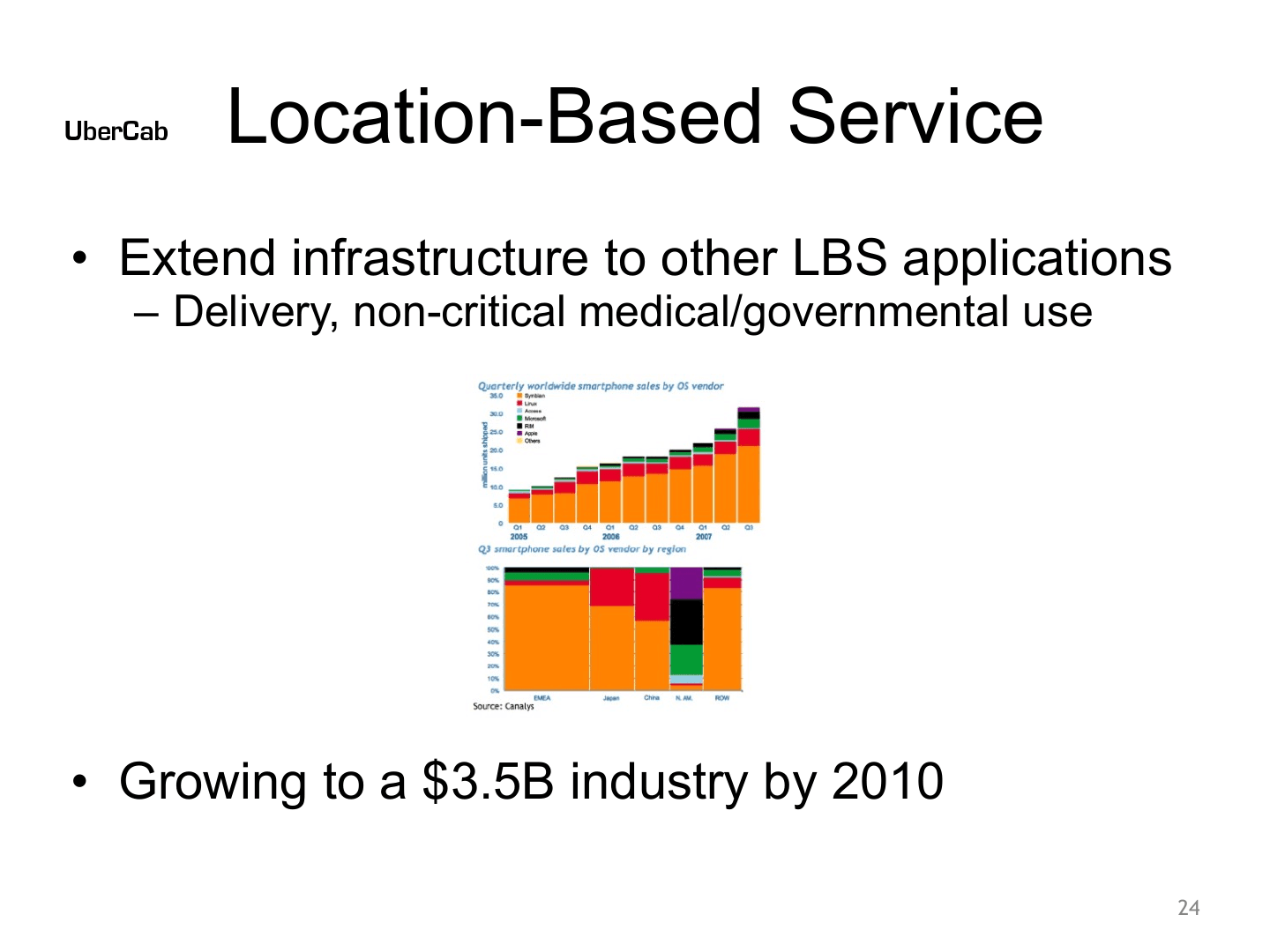
Platform vision slide, delivery explicitly named years before Uber Eats. Smartphone growth charts reinforce slide 21's timing thesis and leave investors thinking about TAM beyond rides.
Domain and SMS code reserved, California LLC and trademark filed, iPhone dev license applied Nov 2008, PayPal account, five advisors, 15 clients, provisional patent, next: three cars, app demo Feb 1, raise a few million.
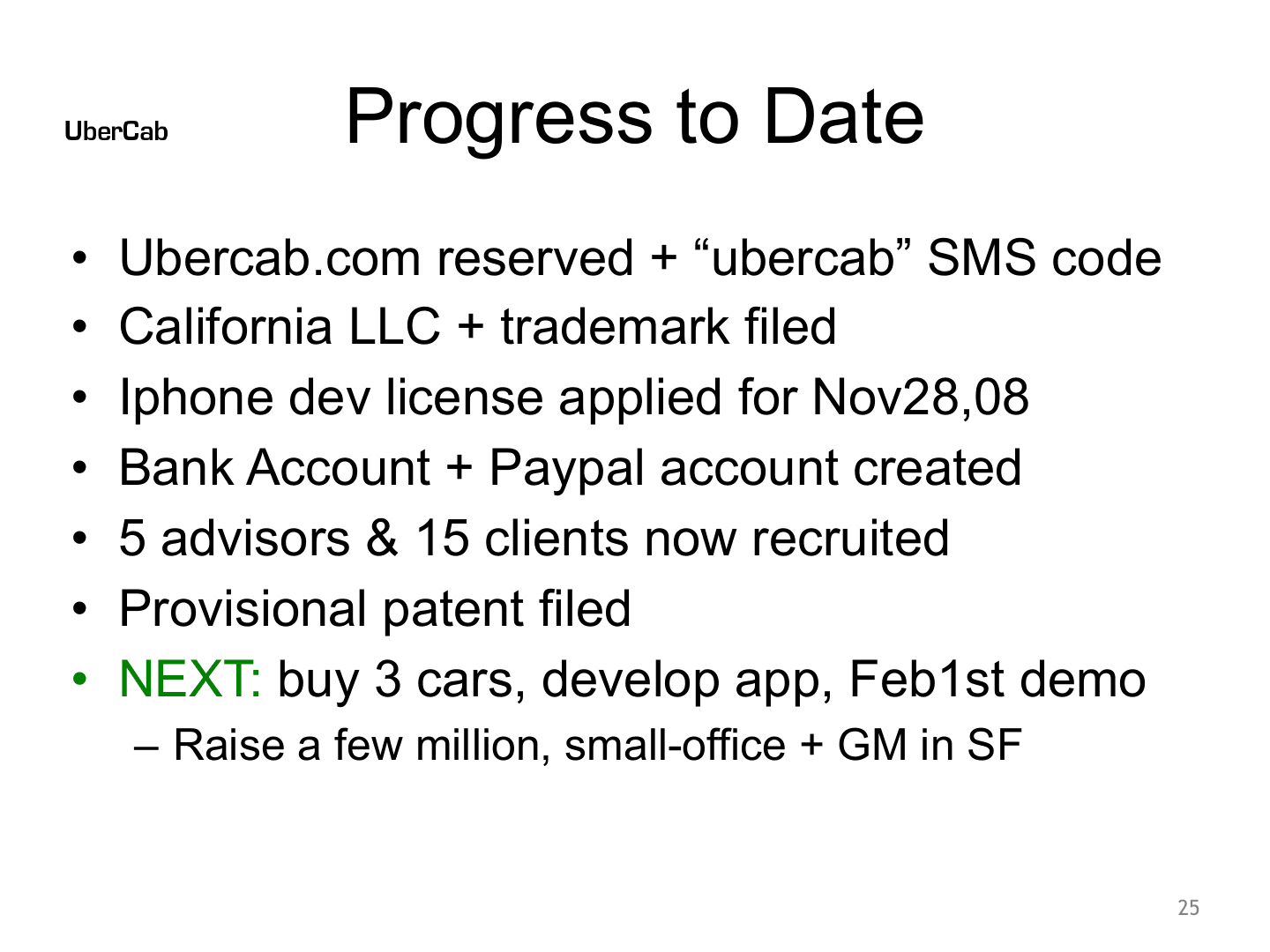
Traction without revenue, legal entity, patent, and recruited clients prove momentum. Green NEXT line states the ask and milestone timeline; missing team and pricing slides are notable gaps Failory still flags today.
Join 100,000+ professionals creating presentations worth presenting.
Uber
Garrett Camp and Travis Kalanick pitched UberCab in late 2008 with a 25-slide deck that raised $200K, before ride-hailing was a category. The deck sells a members-only luxury car service for urban professionals: one tap on your iPhone or BlackBerry, Mercedes sedans, cashless billing, and GPS-optimized dispatch. It is long by modern seed standards but famous for market sizing, product screenshots, and framing taxis as a broken monopoly ripe for digital hail.
Original 2008 deck · 25 slides. Click a thumbnail or scroll down for the full breakdown.
UberCab. Next-Generation Car Service, with a black Mercedes flanked by an iPhone and a BlackBerry.
The cover states category and positioning in one line. Luxury car plus dual smartphone icons signal premium mobile dispatch, investors know the wedge
Radio dispatch with no GPS, Ford Crown Victoria fleets at 14 mpg, and hailing by hand or phone with significant driver dead-time.
Three concrete industry failures with a yellow-cab photo anchor the problem in 2008 reality. Founders describe supply-side inefficiency, not just rider frustration.
NYC medallions near $500K while drivers earn ~$31K, no accountability, and a green line: digital hail can make street hail unnecessary.
Regulatory economics plus a 30-year medallion price chart show why incumbents cannot innovate. The digital-hail teaser bridges problem to solution without a product screenshot yet.
On-demand car service for urban professionals. NYC cab convenience plus chauffeur experience in SF and NYC, automated dispatch, NetJets of car services.
NetJets analogy gives investors a mental model for a members-only premium fleet. Targeting professionals in two dense cities keeps the wedge believable at seed stage.
Members-only digital hail, no street hailing, no medallions, guaranteed pickup with driver and rider photos via the mobile app.
This slide is also a regulatory strategy: pre-screened members and app-based requests sidestep medallion rules. Guaranteed pickup directly answers slide 2's dead-time and uncertainty pain.
Members only, one-click hailing, fast response, Mercedes sedans, rate-your-trip, geo-aware dispatch, and optimized fleet software.
Seven scannable differentiators in a grid, each maps to a taxi pain point. Trip ratings and geo-dispatch were novel in 2008 and foreshadow Uber's two-sided reputation loop.
Luxury on-demand, fuel-efficient fleet, computer-coordinated service, optimized response time, cashless pre-paid billing, profitable by design.
Mission bullets read aspirational without metrics, useful as talking points live, thin on a standalone deck. Cashless billing and profit-by-design are the lines investors remember.
One-click requests from geo-aware devices plus SMS pickup commands like 'pickup @work in 5', shown on iPhone, BlackBerry, and Nokia.
Multi-platform hardware photos prove mobile-first thinking before the App Store era. SMS fallback widens addressable users beyond early smartphone owners.
Web portal to book trips, view fleet status and history, and save labeled locations (home, work) with Google Maps lat/long for easy SMS hailing.
Product depth beyond the app, saved places and fleet map show a full dispatch stack. The SF map screenshot makes abstract logistics tangible for investors skimming alone.
Restaurants and bars, parking-scarce trips, pre-scheduled airport runs, in-car WiFi commutes with rideshare, school drop-offs, and elderly transport.
Everyday scenarios expand TAM beyond business travel, airport and nightlife use cases still drive Uber volume today. WiFi-in-car and campus rideshare hint at UberPool years early.
Cabs can take 45 minutes with no pickup guarantee; limos need hours of notice and $60+ transfers. UberCab splits the difference on speed, price, and cleanliness.
Positions UberCab between taxi and limo on a value spectrum, faster than car service, nicer than a cab. Repetitive after earlier slides but gives investors a one-line positioning sound bite.
Less fare-seeking dead-time (35% in NYC), hybrid Mercedes and Lexus fleets at 2× cab efficiency, and rideshare incentives for SFO and event trips.
Efficiency arguments double as unit-economics story, fewer empty miles mean better driver utilization. Carpool bullet is prophetic; it became core product strategy, not a footnote.
Premium S550 for SF beta, future S400 hybrid at 30 mpg, standard Lexus GS450h or E320 at 23 mpg, versus 14–16 mpg for existing cab fleets.
Specific vehicle tiers signal luxury positioning and fuel-efficiency moat. Founders assumed owned or regulated fleet, a plan Uber later abandoned for the asset-light marketplace model.
Launch in central San Francisco first, Manhattan soon after, map pin on downtown SF.
Classic wedge GTM: two dense coastal cities with painful taxi markets and high-income professionals. Map visual makes geographic focus impossible to miss.
iPhone, BlackBerry, and Symbian apps with operations-research route optimization, payment and reputation tracking, patent-pending system design.
Positions UberCab as a logistics software company, not a car company. Route-optimization diagrams add technical credibility beyond bullet claims.
Cars hover in statistically optimized positions to minimize pickup time by hour, weather, and traffic. SF grid heat-map visualization.
Predictive positioning is the defensibility slide, traditional dispatch cannot replicate this. The heat-map visual sells data science before 'AI' was pitch-deck vocabulary.
$4.2B US taxi and limousine market growing to ~$4.8B by 2014; top four players hold only 22% of revenue.
INSEAD-sourced table backs the TAM number investors can cite. Fragmentation stat argues a tech entrant can win share without displacing a single dominant incumbent.
2007 segment pie chart. 64% retail non-airport trips, 15% business non-airport, 12% retail airport, 9% business airport; focus on urban on-demand.
Segmentation justifies everyday urban rides, not just airport black-car niche. Retail non-airport majority supports the use-case slides and a mass-market path Uber eventually took.
Start SF and NYC, expand to LA, Chicago, Houston, Philadelphia, and Dallas, six cities covering ~50% of the US market with city-by-city revenue table.
Rollout logic tied to ranked city revenue data. NYC alone is ~23% of US spend. Could merge with slide 14, but the table makes expansion feel disciplined, not opportunistic.
Best case: market leader at $1B+ revenue; realistic: 5% of top five cities and $20–30M profit; worst case: 10-car boutique SF executive service.
Three-scenario framing de-risks the bet, even the floor is a viable business. Best-case $1B looked bold in 2008; Uber later blew past it, but the structure gave VCs a narrative arc.
US smartphone OS share pie (RIM 32%, Windows Mobile 30%, iPhone 10%) and global manufacturer share by region. Canalys-era charts.
Classic 'why now' slide for pre-iPhone-dominance era. BlackBerry-heavy data explains multi-platform build and professional-user targeting, timing argument for mobile dispatch.
Used and Prius fleet options, better GPS, off-peak discounts, and premium pricing for immediate vs scheduled pickups.
Roadmap slide foreshadows UberX (Prius) and surge pricing years early. Dynamic 'get here now' vs 'tomorrow at 5pm' pricing shows founders understood utilization economics beyond launch fleet.
Become the premium cab brand vs YellowCab, invite-only referrals, slogans: One-click cab, NetJets of limos, Cabs 2.0.
Brainstorm bullets, not a GTM plan, but invite-only referral loop became Uber's early launch playbook. Brand slogans give investors memorable hooks even without ad spend detail.
Extend dispatch infrastructure to delivery and non-critical medical or government LBS. $3.5B industry by 2010, with smartphone shipment growth charts.
Platform vision slide, delivery explicitly named years before Uber Eats. Smartphone growth charts reinforce slide 21's timing thesis and leave investors thinking about TAM beyond rides.
Domain and SMS code reserved, California LLC and trademark filed, iPhone dev license applied Nov 2008, PayPal account, five advisors, 15 clients, provisional patent, next: three cars, app demo Feb 1, raise a few million.
Traction without revenue, legal entity, patent, and recruited clients prove momentum. Green NEXT line states the ask and milestone timeline; missing team and pricing slides are notable gaps Failory still flags today.
Join 100,000+ professionals creating presentations worth presenting.