
Original 2005 deck · 11 slides. Click a thumbnail or scroll down for the full breakdown.
YouTube
In 2005, Chad Hurley, Steve Chen, and Jawed Karim, three early PayPal alumni, pitched YouTube to Sequoia Capital with a deck that barely broke ten slides. Online video was broken: files were too big to email, formats did not play everywhere, and nothing connected clips into a community. They raised $3.5M in a Series A round that November. Google bought the company thirteen months later for $1.65B. This teardown walks through every slide in the circulated deck, including the metrics claim that YouTube was already the category leader weeks after launch.
Original 2005 deck · 11 slides. Click a thumbnail or scroll down for the full breakdown.
YouTube logo and the tagline "Broadcast Yourself" on a white background, no contact info, no date.
Two words do the positioning work: user-generated video, not Hollywood catalog. The cover is almost empty by design, which matches a product era when the homepage was the real pitch.
Become the primary outlet for user-generated video on the Internet, anyone can upload, share, and browse.
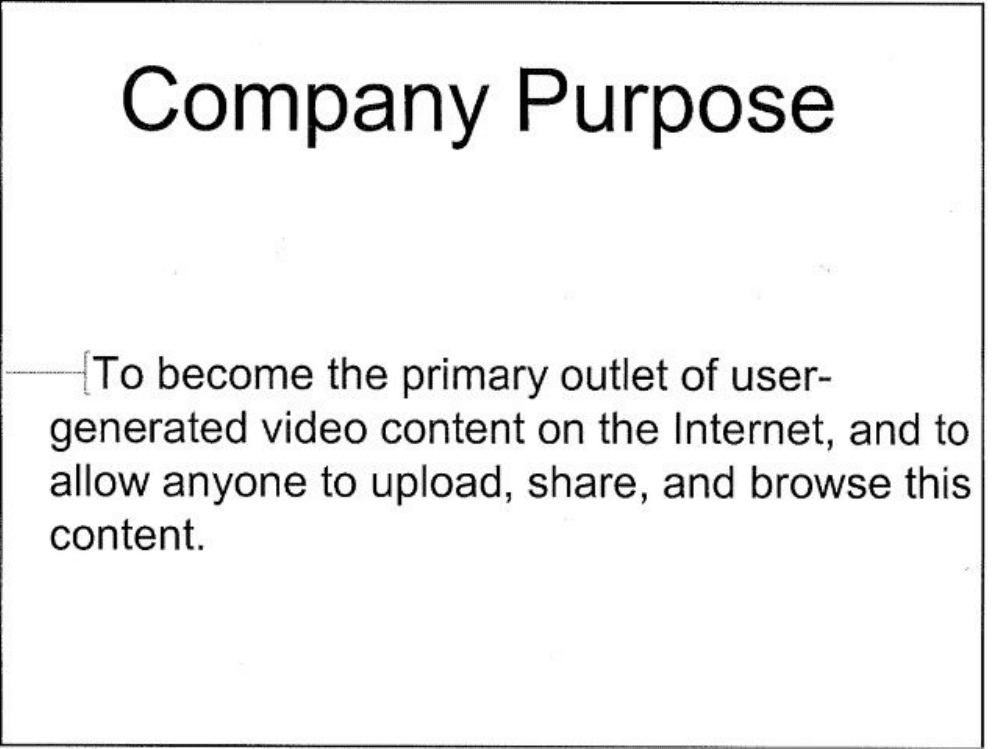
Purpose before problem: investors hear the end state first. "Primary outlet" signals winner-take-most ambition without a TAM chart on slide two.
Four pain points: videos too large to email, too large to host, no standard file format, and clips stuck as isolated files.
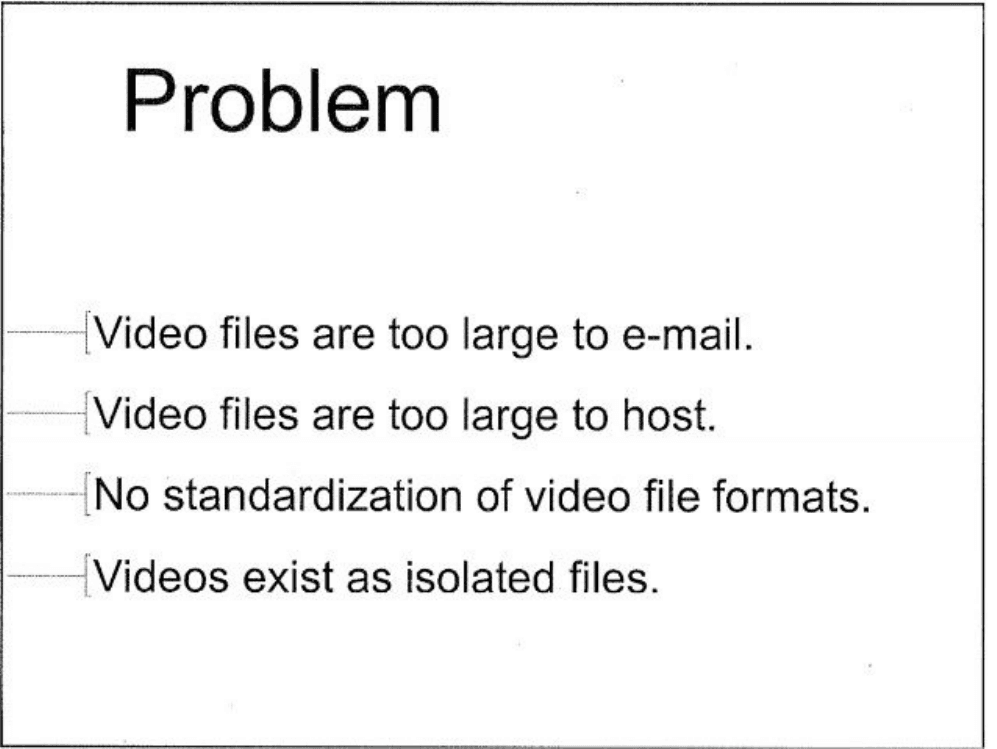
Every bullet is infrastructure friction, not user emotion, but in 2005 that was the blocker. Founders who lived through dial-up and email attachment limits instantly understood the wedge.
Users upload; YouTube serves to millions. Flash Video encoding on the back end. A community linking users to videos, users to users, and videos to videos.
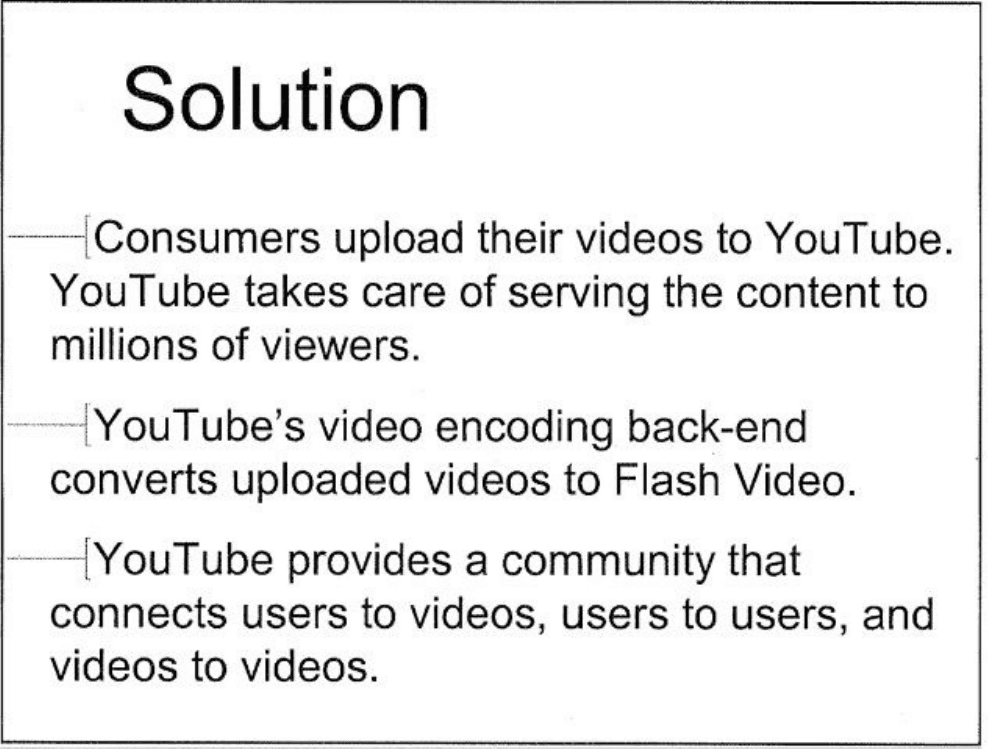
Three layers in one slide: hosting, technical moat (transcode to Flash), and network effects. No screenshots, the deck assumes investors will try the site, but the community line previews YouTube as a platform, not a file locker.
Cheap mass-market digital video recording in consumer devices, plus home broadband reaching critical mass as a video delivery channel.
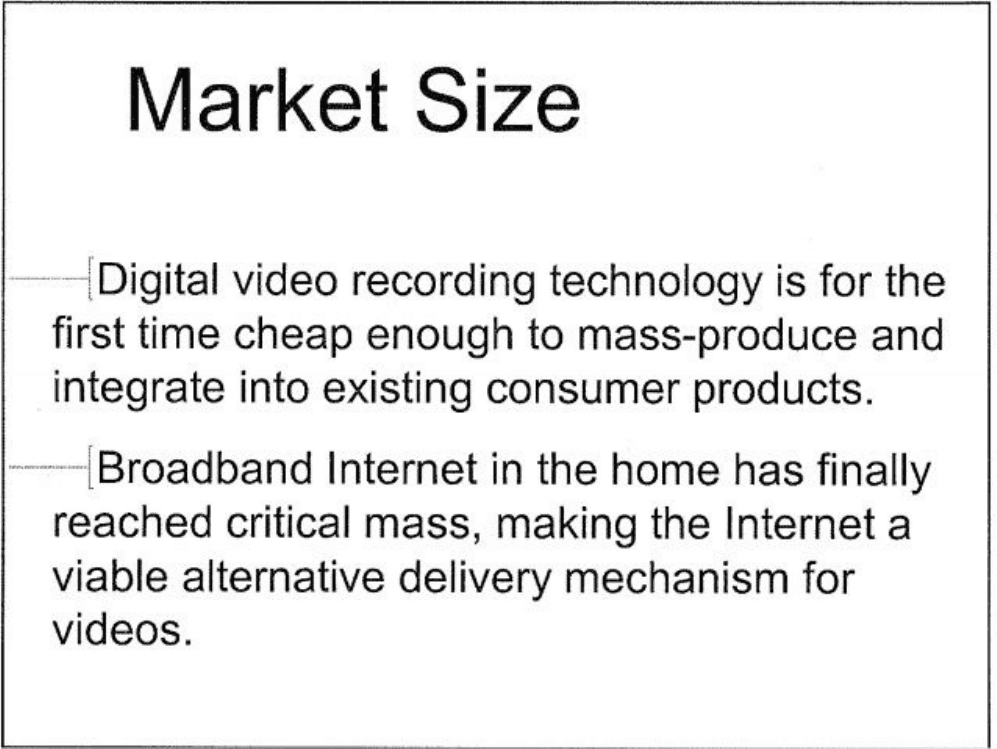
Market sizing via supply-side tailwinds instead of a $XB TAM funnel. Cameras getting cheap and bandwidth getting fast made "everyone will upload" feel inevitable, the classic 2005 consumer-internet bet.
Two rows of rivals: OurMedia.org, Open Media Network, Google Video, then PutFile, DailyMotion, and Vimeo.
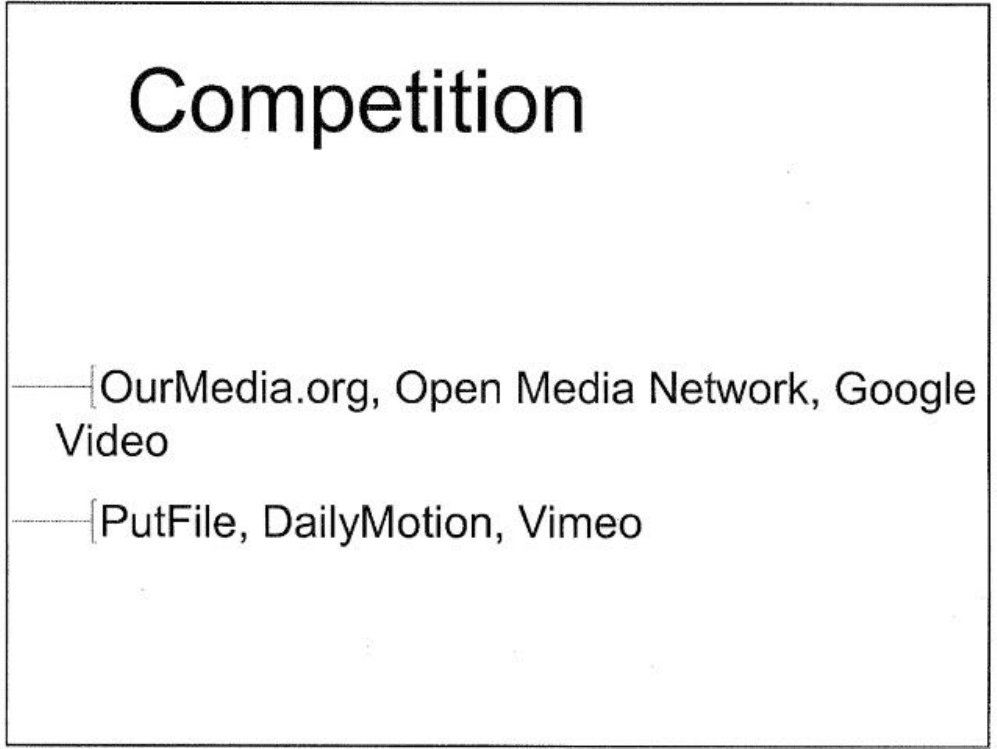
Name the giants early, including Google Video. Listing six competitors without a matrix still shows category heat; investors knew video sharing was crowded and could judge whether YouTube's wedge was sharper.
Four roadmap themes: community, open architecture, vertical markets that need video, and features currently in development.
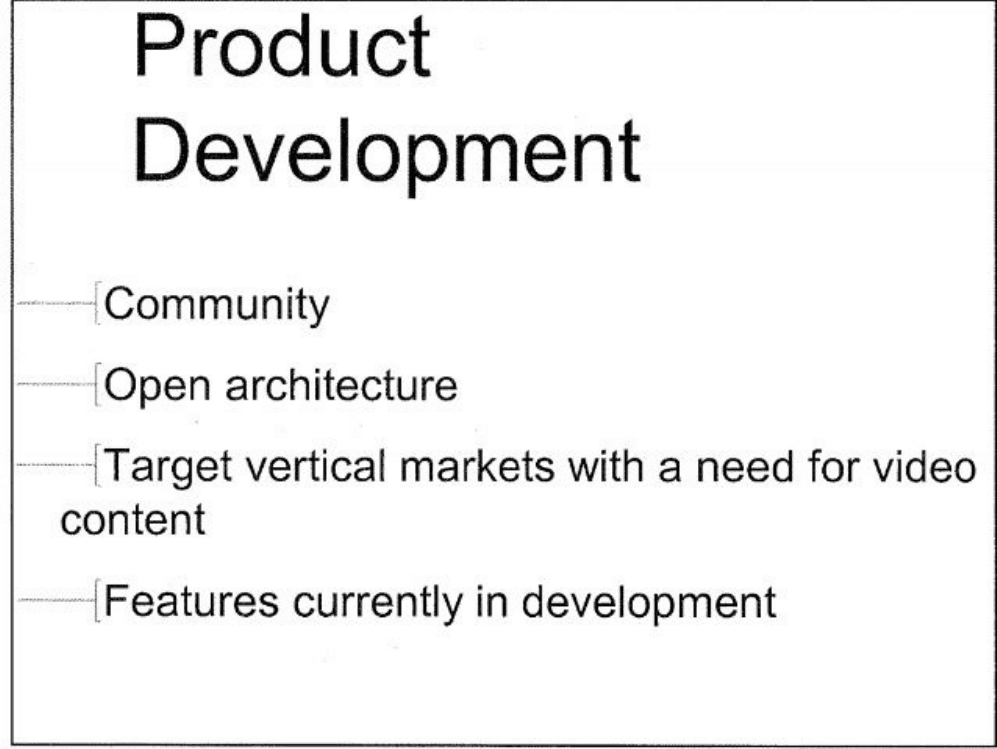
"Open architecture" is the strategic hint, embeddable players and off-site distribution were the growth loop Sequoia would later cite. The slide stays high level, but it signals platform thinking beyond a single website.
Four monetization paths: advertising, paid promotional video distribution, premium features for members, and premium content for viewers.
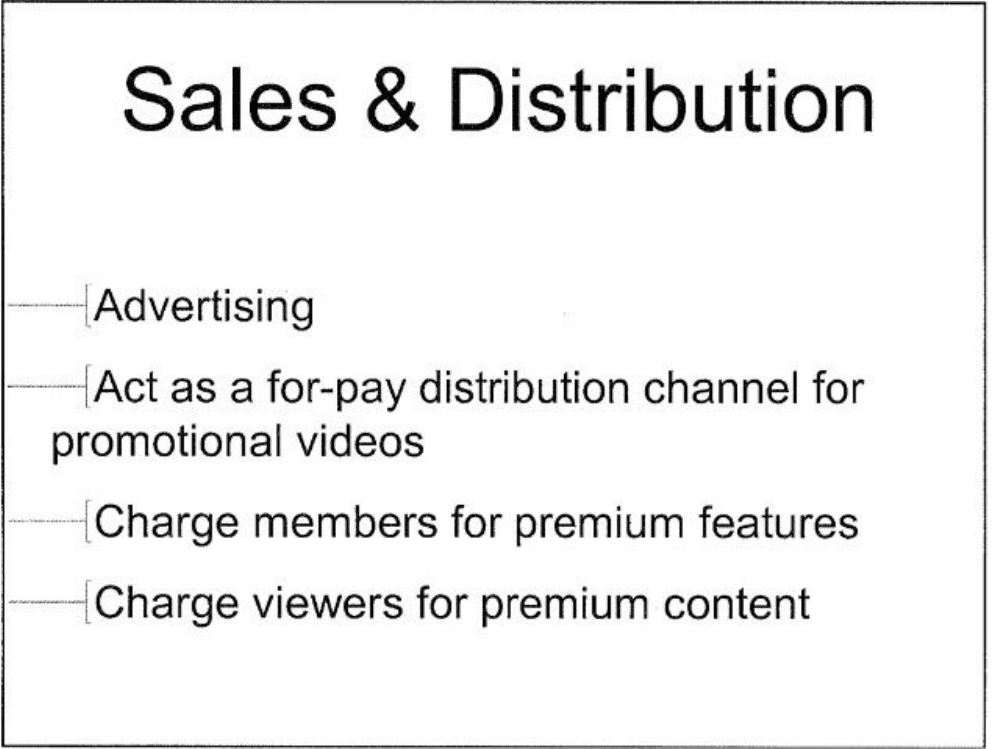
Revenue options before the product was mature, typical for Series A consumer bets. Listing multiple paths showed investors they had thought about money without pretending one model was proven yet.
Steve Chen and Jawed Karim, early PayPal engineers from Illinois CS; Chad Hurley. PayPal's first designer behind the logo and core UX.
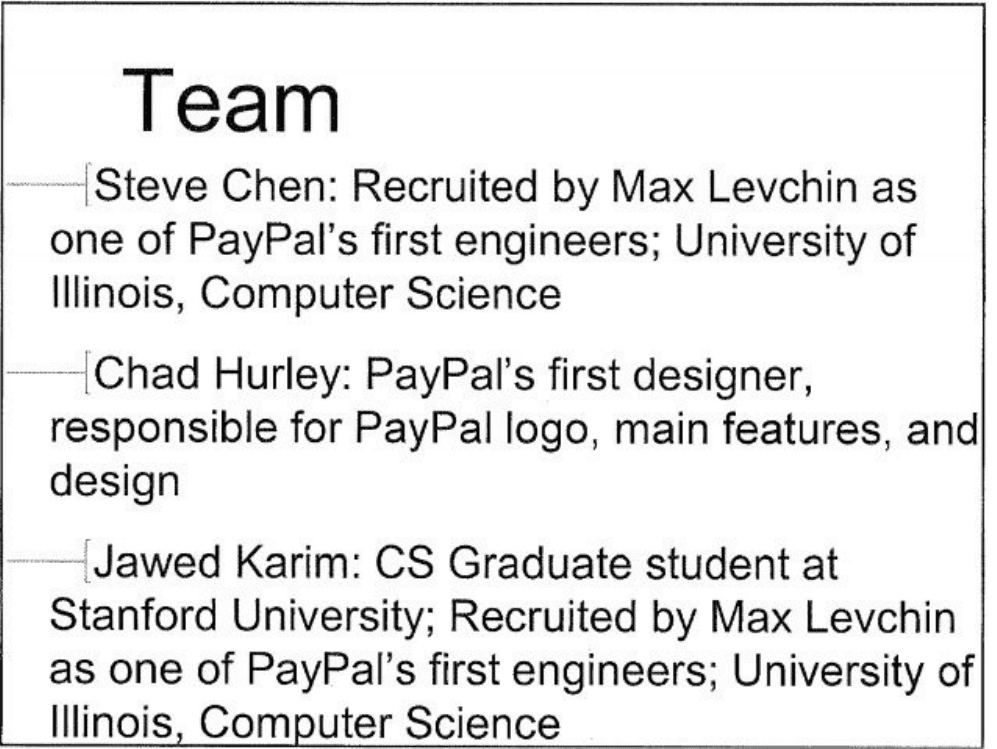
The PayPal Mafia slide does heavy lifting: scaled payments, fraud, and consumer product at a company that sold to eBay. Design + engineering from the same founding era reads as a complete founding team.
Launched June 11th, already overtaken every existing competitor and is the dominant player in the space.
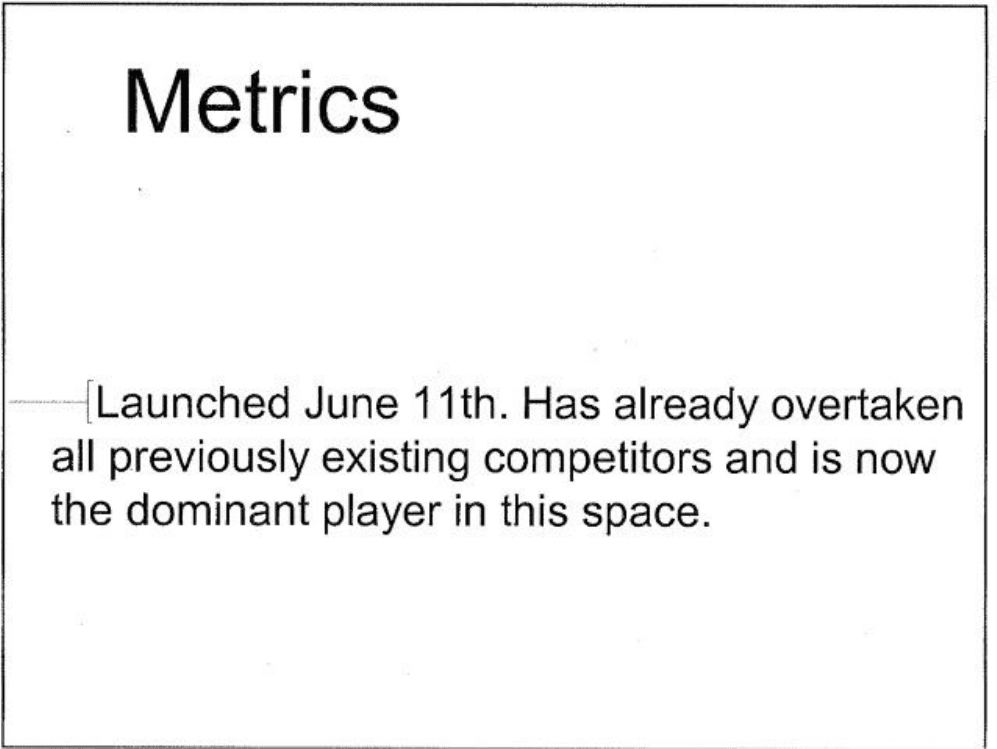
One date, one bold claim, no DAU chart, no revenue. In a land-grab category, "we already won" reframes the round as backing the leader, not funding an experiment. Founders with real traction can sometimes replace spreadsheets with a single sentence.
Promotional end card from deck curator chagency, links to startup pitch deck archives and the agency's blog and social profiles.
Not part of the original Sequoia presentation, appended in circulated PDF copies online. Worth noting so founders do not copy it: investor decks should end on ask, metrics, or vision, never a third-party promo.
Join 100,000+ professionals creating presentations worth presenting.
YouTube
In 2005, Chad Hurley, Steve Chen, and Jawed Karim, three early PayPal alumni, pitched YouTube to Sequoia Capital with a deck that barely broke ten slides. Online video was broken: files were too big to email, formats did not play everywhere, and nothing connected clips into a community. They raised $3.5M in a Series A round that November. Google bought the company thirteen months later for $1.65B. This teardown walks through every slide in the circulated deck, including the metrics claim that YouTube was already the category leader weeks after launch.
Original 2005 deck · 11 slides. Click a thumbnail or scroll down for the full breakdown.
YouTube logo and the tagline "Broadcast Yourself" on a white background, no contact info, no date.
Two words do the positioning work: user-generated video, not Hollywood catalog. The cover is almost empty by design, which matches a product era when the homepage was the real pitch.
Become the primary outlet for user-generated video on the Internet, anyone can upload, share, and browse.
Purpose before problem: investors hear the end state first. "Primary outlet" signals winner-take-most ambition without a TAM chart on slide two.
Four pain points: videos too large to email, too large to host, no standard file format, and clips stuck as isolated files.
Every bullet is infrastructure friction, not user emotion, but in 2005 that was the blocker. Founders who lived through dial-up and email attachment limits instantly understood the wedge.
Users upload; YouTube serves to millions. Flash Video encoding on the back end. A community linking users to videos, users to users, and videos to videos.
Three layers in one slide: hosting, technical moat (transcode to Flash), and network effects. No screenshots, the deck assumes investors will try the site, but the community line previews YouTube as a platform, not a file locker.
Cheap mass-market digital video recording in consumer devices, plus home broadband reaching critical mass as a video delivery channel.
Market sizing via supply-side tailwinds instead of a $XB TAM funnel. Cameras getting cheap and bandwidth getting fast made "everyone will upload" feel inevitable, the classic 2005 consumer-internet bet.
Two rows of rivals: OurMedia.org, Open Media Network, Google Video, then PutFile, DailyMotion, and Vimeo.
Name the giants early, including Google Video. Listing six competitors without a matrix still shows category heat; investors knew video sharing was crowded and could judge whether YouTube's wedge was sharper.
Four roadmap themes: community, open architecture, vertical markets that need video, and features currently in development.
"Open architecture" is the strategic hint, embeddable players and off-site distribution were the growth loop Sequoia would later cite. The slide stays high level, but it signals platform thinking beyond a single website.
Four monetization paths: advertising, paid promotional video distribution, premium features for members, and premium content for viewers.
Revenue options before the product was mature, typical for Series A consumer bets. Listing multiple paths showed investors they had thought about money without pretending one model was proven yet.
Steve Chen and Jawed Karim, early PayPal engineers from Illinois CS; Chad Hurley. PayPal's first designer behind the logo and core UX.
The PayPal Mafia slide does heavy lifting: scaled payments, fraud, and consumer product at a company that sold to eBay. Design + engineering from the same founding era reads as a complete founding team.
Launched June 11th, already overtaken every existing competitor and is the dominant player in the space.
One date, one bold claim, no DAU chart, no revenue. In a land-grab category, "we already won" reframes the round as backing the leader, not funding an experiment. Founders with real traction can sometimes replace spreadsheets with a single sentence.
Promotional end card from deck curator chagency, links to startup pitch deck archives and the agency's blog and social profiles.
Not part of the original Sequoia presentation, appended in circulated PDF copies online. Worth noting so founders do not copy it: investor decks should end on ask, metrics, or vision, never a third-party promo.
Join 100,000+ professionals creating presentations worth presenting.