

Original 2011 deck · 13 slides. Click a thumbnail or scroll down for the full breakdown.
Buffer
Joel Gascoigne and Leo Widrich used this 13-slide deck in 2011 to close a roughly $450K seed round after pitching around 200 investors. Buffer already had 55,000 users, 800 paying customers, and a $150K annual revenue run rate, so the deck leads with traction and unit economics, not vision slides. The founders later published it openly, making it one of the most cited SaaS seed decks for bootstrapped founders raising their first institutional round.
Original 2011 deck · 13 slides. Click a thumbnail or scroll down for the full breakdown.
Buffer wordmark and stacked-layers logo on a dark textured background.
Minimal cover, brand only, no tagline. By 2011 Buffer was already known in the Twitter scheduling niche, so the logo did the work.
Zuckerberg's Law on sharing doubling yearly, a Donanza quote on social surpassing SEO, and a photo of Facebook's engagement growth curve.
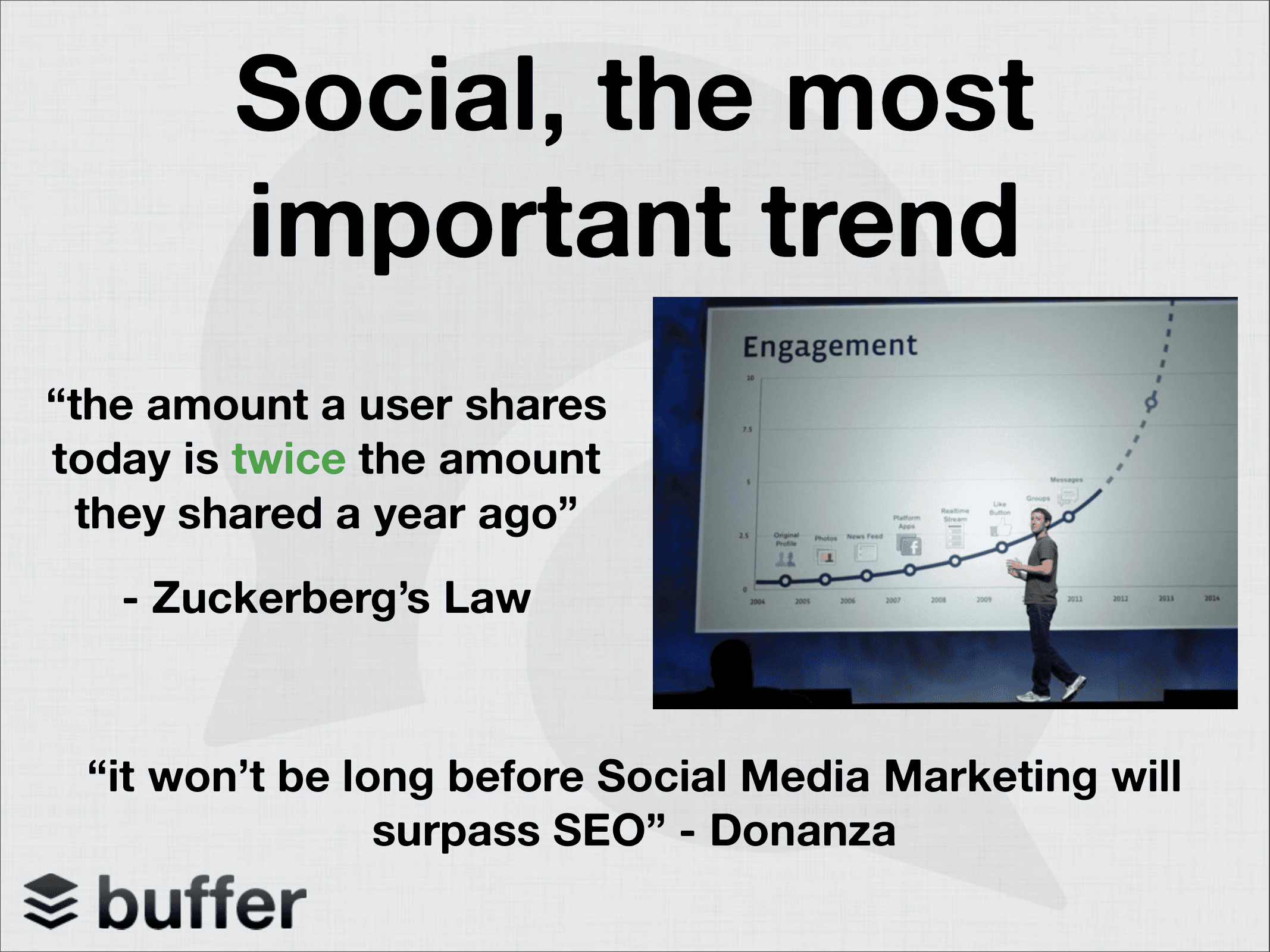
Opens with macro tailwinds before the product, anchors the pitch in an inevitable market shift. Third-party quotes do the heavy lifting so Buffer doesn't have to argue the category exists.
One question centered on the slide: "How do you use social to drive traffic?"

Problem as a single provocative question, not a bullet list. Every marketer and founder in the room has felt this, it frames Buffer as the answer without over-explaining pain points.
"Queue your updates", screenshot of the Buffer web app with tweets scheduled across days and times.
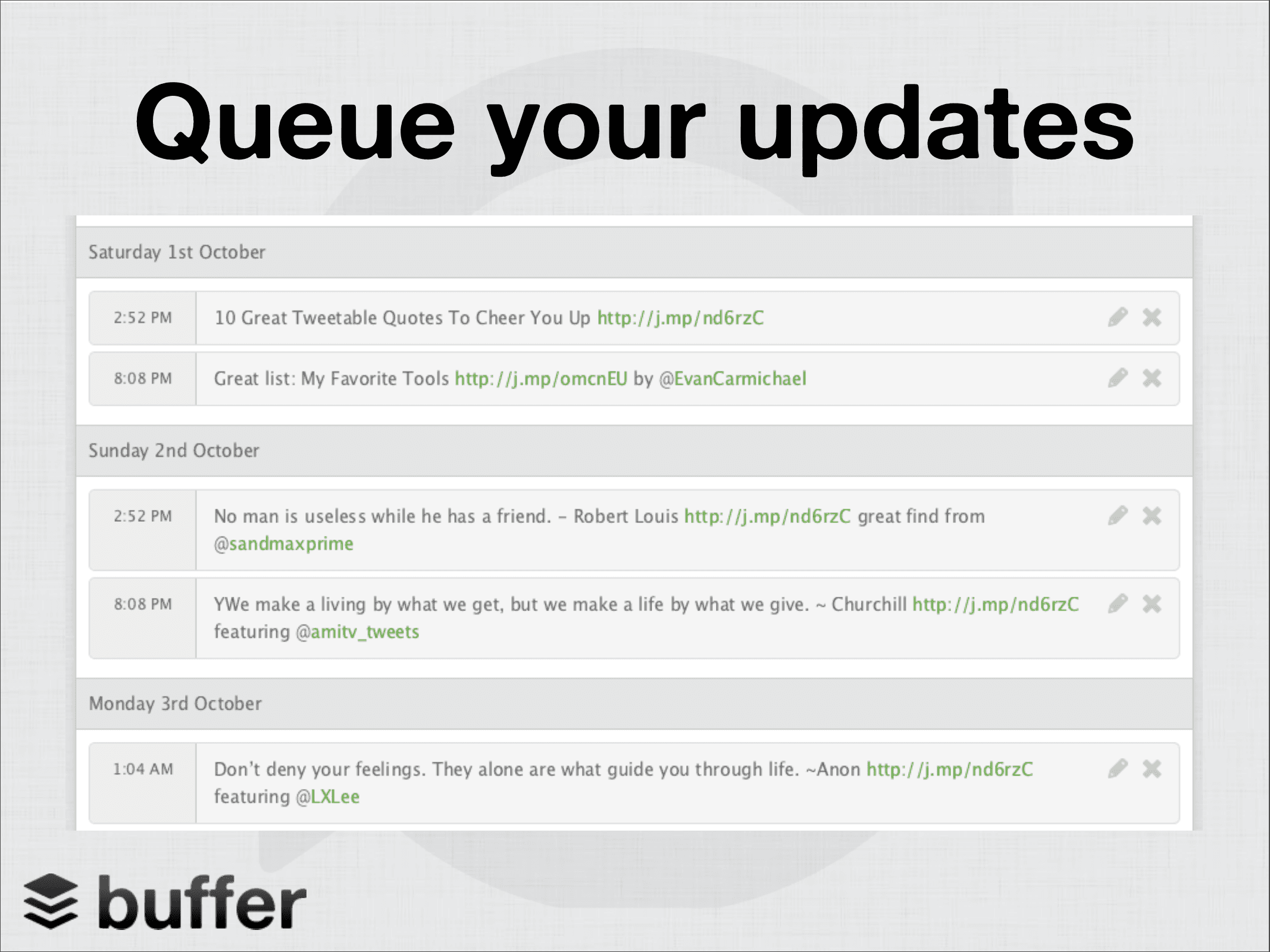
Solution is the product itself. Real UI with queued posts proves the thing works; investors see scheduling, timing, and the core loop in one glance.
800 paying users, $150K annual revenue run rate, 97% margins, 55,000 users growing 40% per month, 1.5M updates buffered, with an upward growth curve.
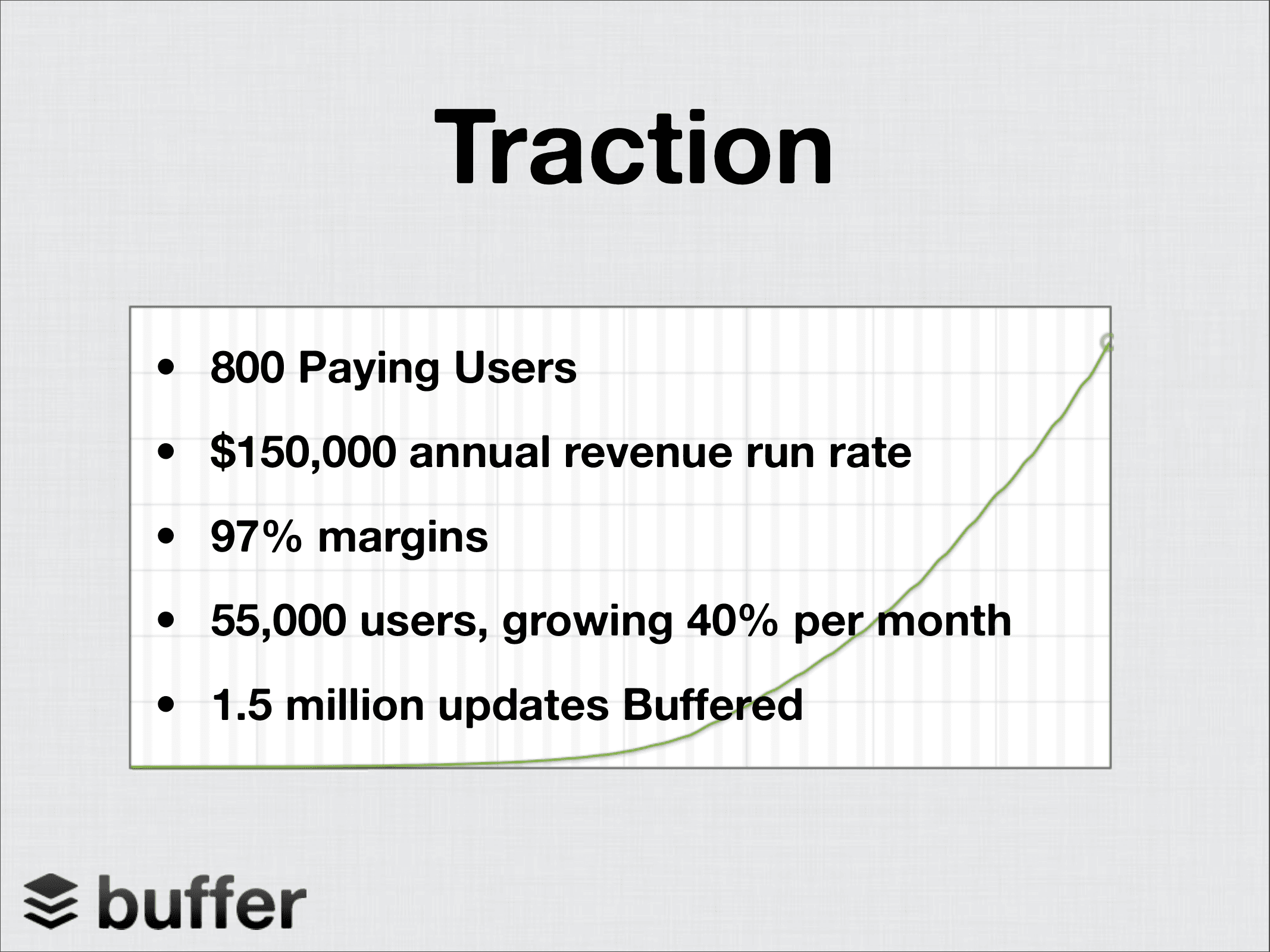
The slide investors remember. Hard revenue and user numbers with a hockey-stick visual, this is why Buffer could raise on 13 slides while others needed 25.
Timeline from Jan 2011 launch through Oct 2011 traction, then green forward targets: API, 50 integrations, 100K users, 1M users by Jan 2013.
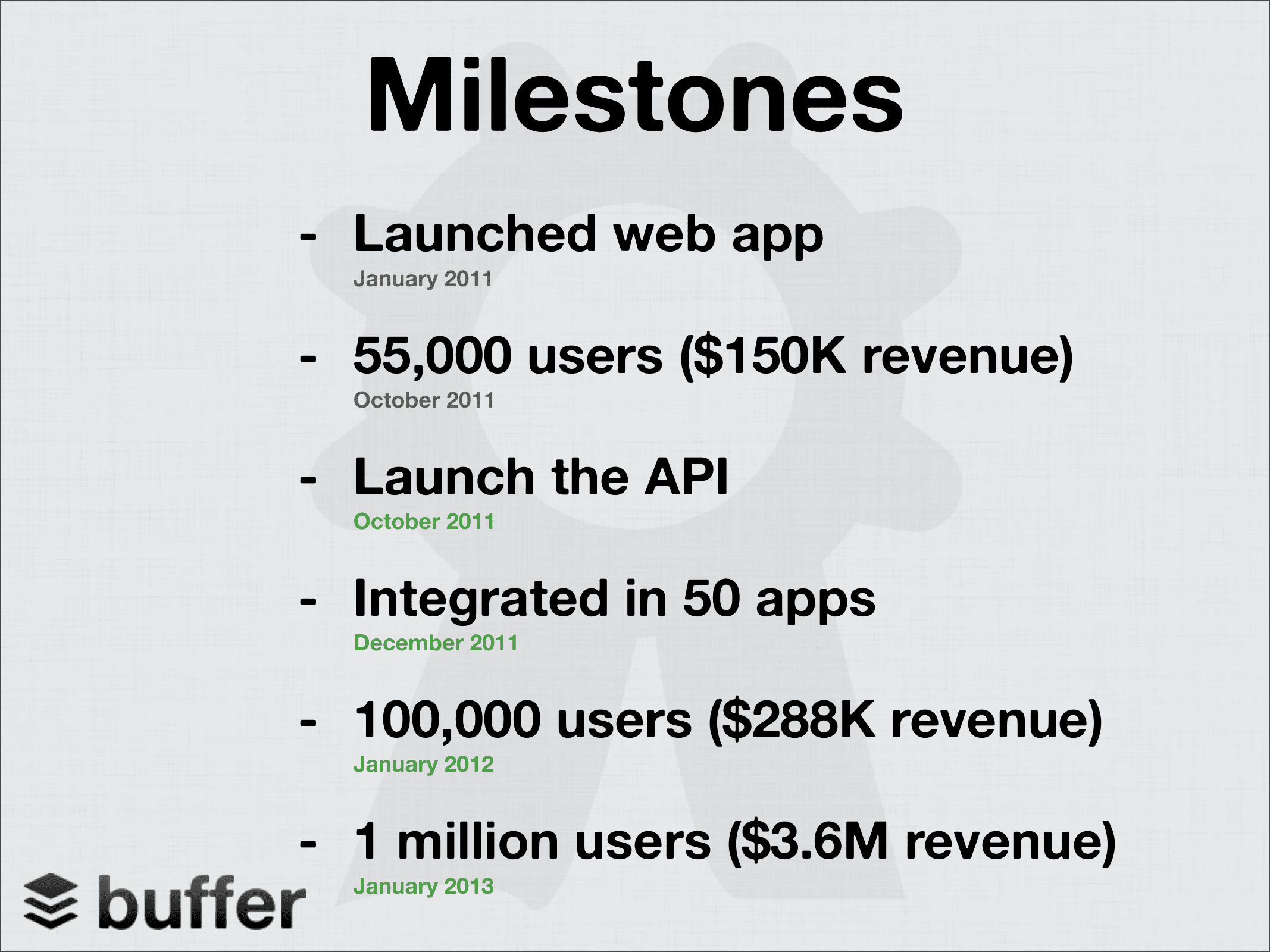
Past milestones in gray, future ones in green, separates proof from ambition. Shows a credible roadmap without a dense financial model.
Freemium with 2% free-to-paid conversion, 5% churn ($240 LTV), up to $5 CAC per free user, $3.6M projected revenue at 1M users.
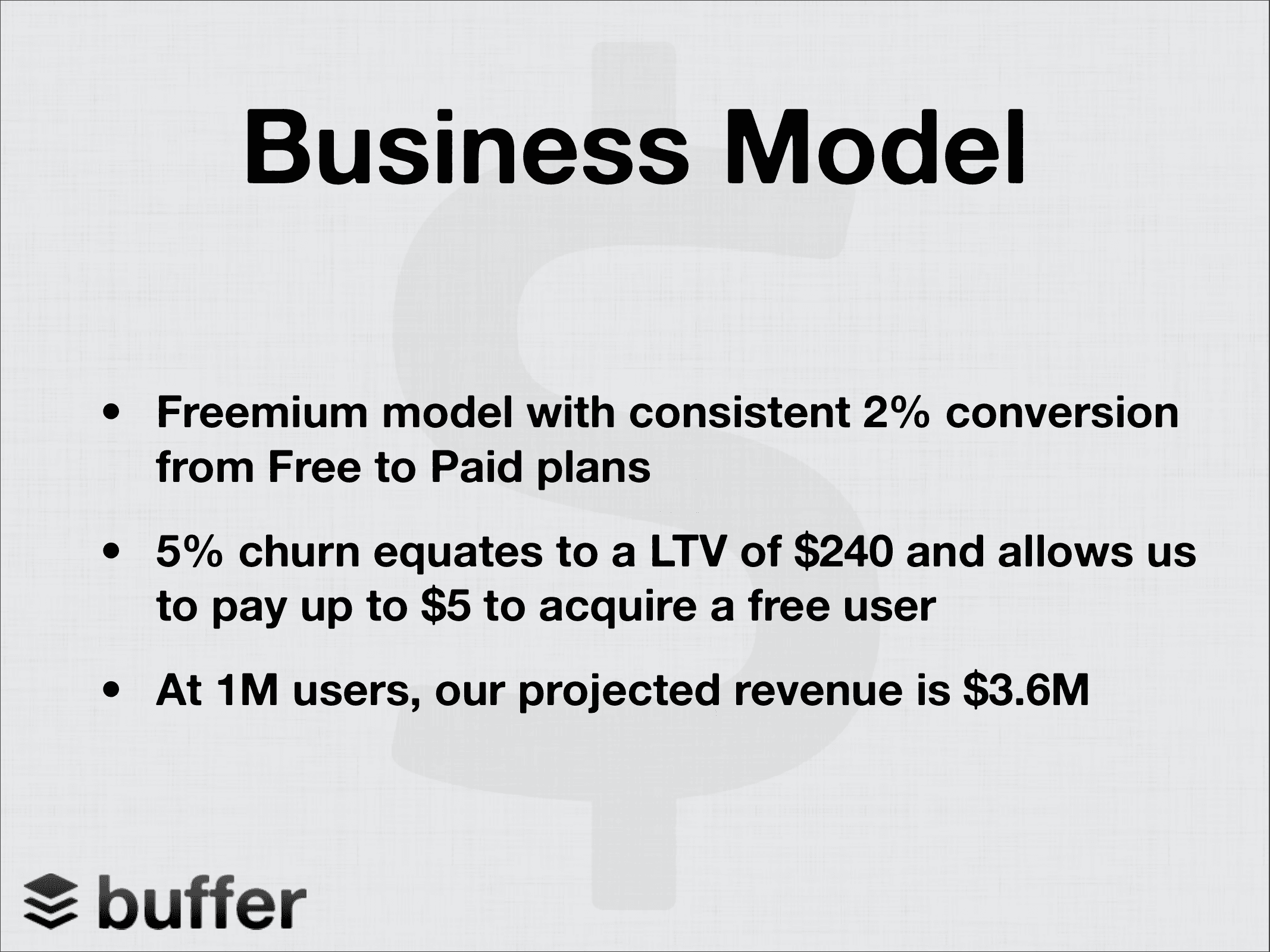
Unit economics on one slide, conversion, churn, LTV, and acquisition cap. Investors can sanity-check the math instead of guessing whether freemium works.
200M daily tweets (55% with links), 4B Facebook shares per day, Zuckerberg's Law, and social traffic soon surpassing search.
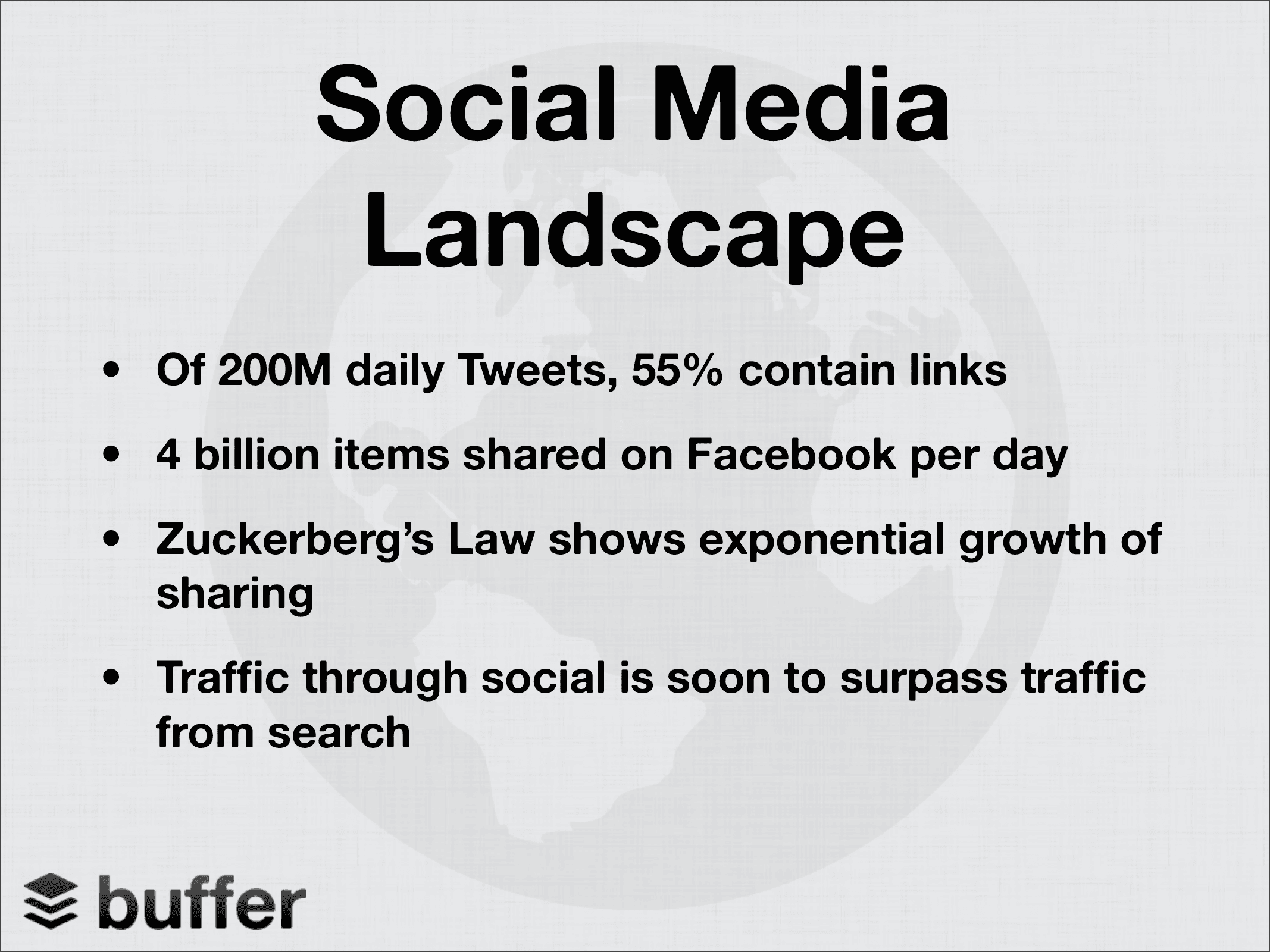
Market-size slide built from sharing volume, not a TAM spreadsheet. Ties back to slide 2 and makes the scheduling problem feel enormous.
ReadWriteWeb headline: "Buffer Finds Tweet Scheduling Can Increase Clicks by 200%."
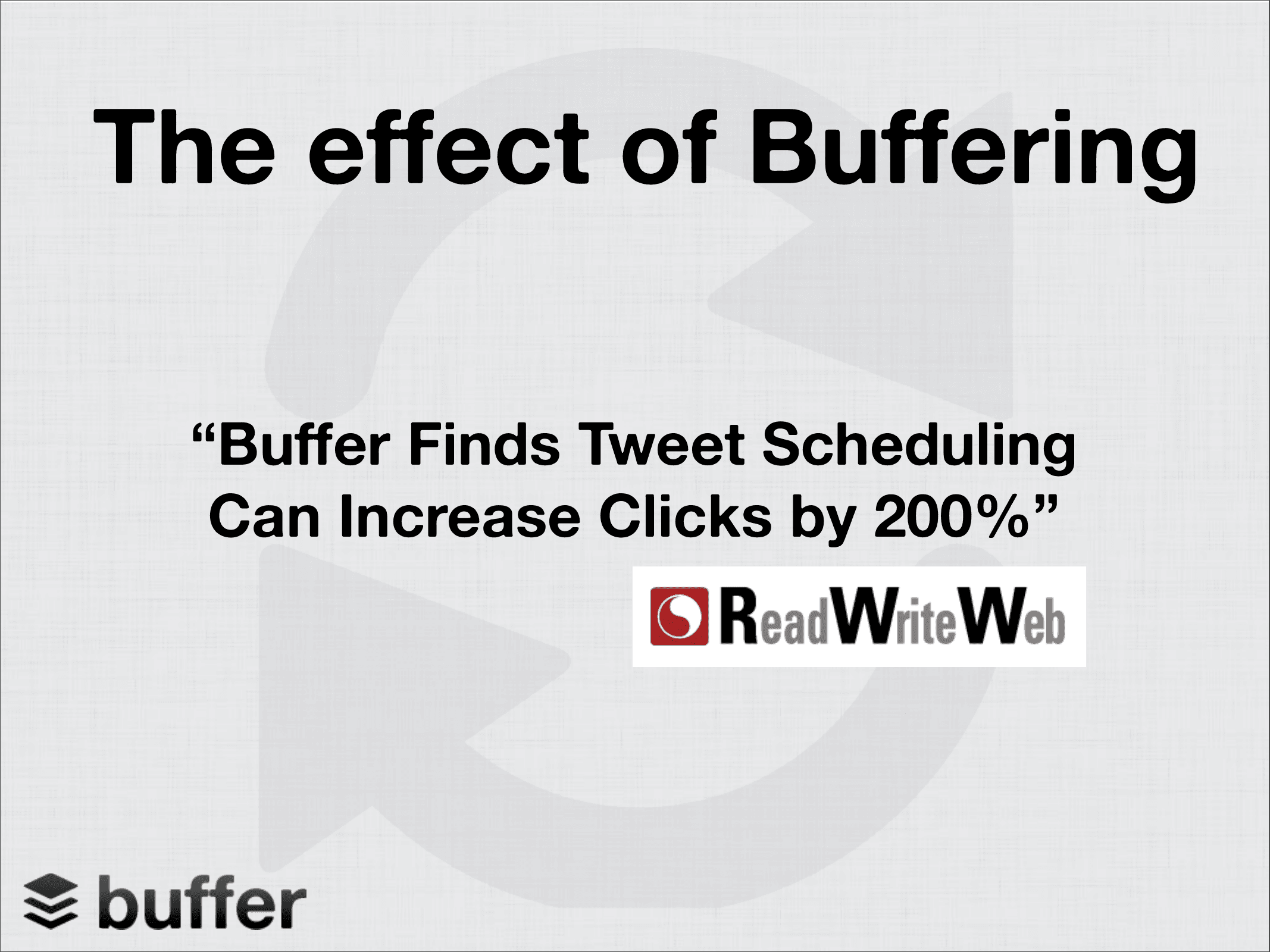
Third-party validation beats self-promotion. A named publication with a concrete performance stat gives investors something to cite in partner meetings.
"A sharing standard". 6 integrations live, talks with Reeder, Pocket, and Feedly, goal to be the default share target in any app; iPhone share sheet mockup.
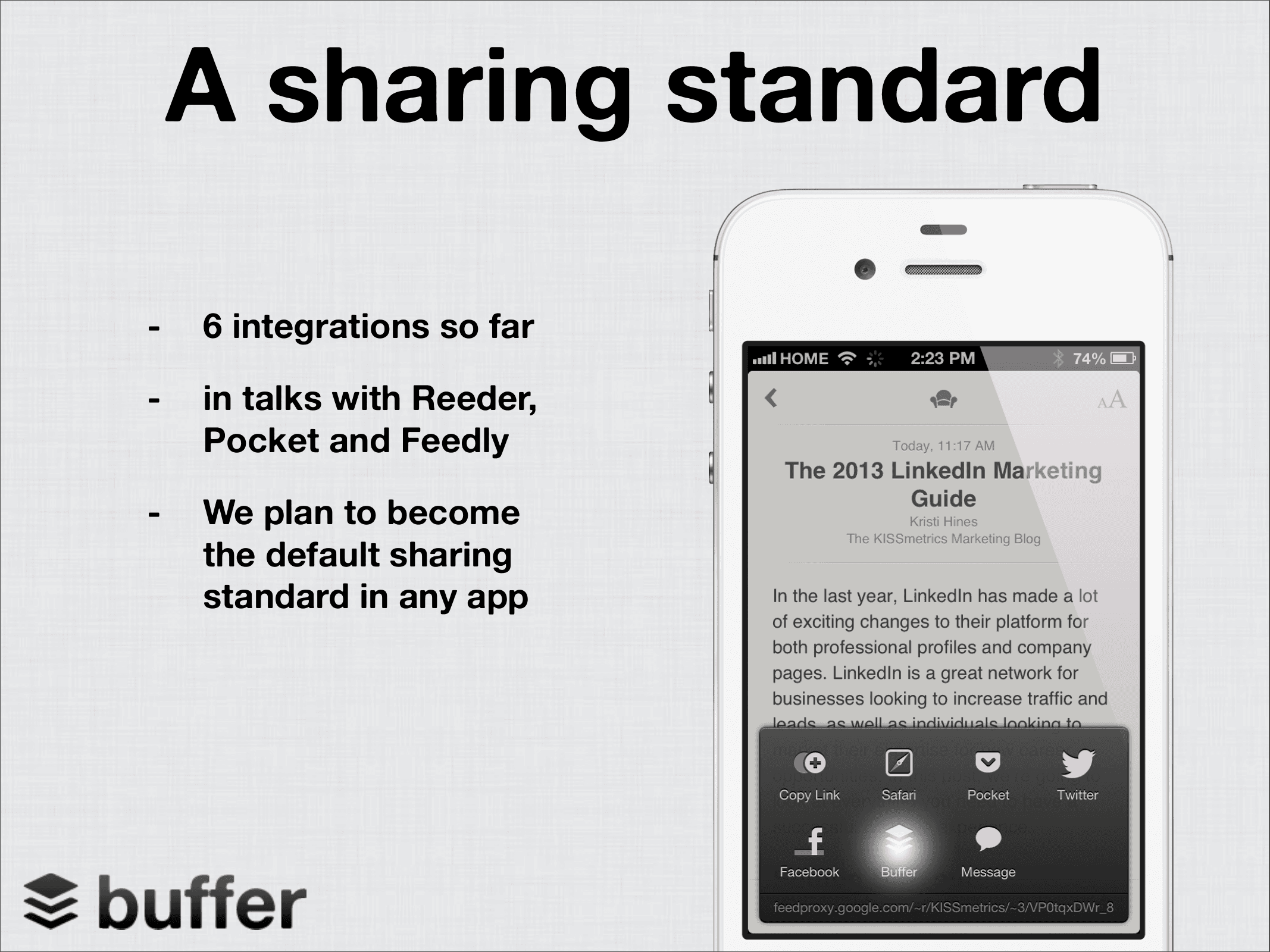
Platform play, not just a web app. The share-sheet screenshot shows distribution through other products' workflows, a wedge Hootsuite-style dashboards don't own.
Circular landscape map: social networks at center, competitors grouped as dashboards, intelligent sharing, sharing platforms, and scheduling apps. Buffer in two quadrants.
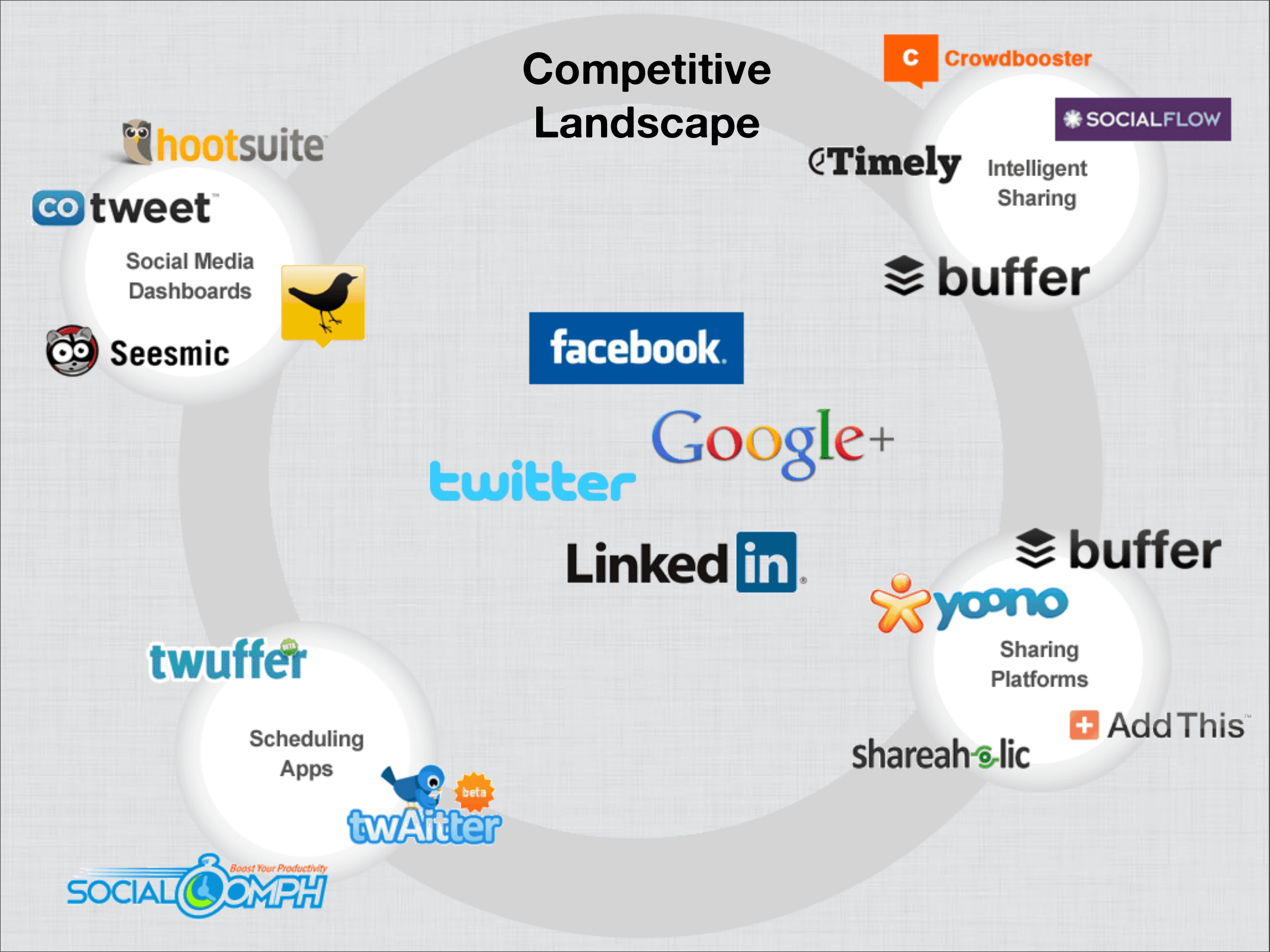
Category map instead of a comparison table. Buffer sits in "intelligent sharing" and "sharing platforms," not crowded dashboard territory, makes the positioning memorable.
Joel Gascoigne (idea to revenue in 7 weeks, CS master's) and Leo Widrich (200 to 55K users); advisors Guy Kawasaki and Hiten Shah; prior investors AngelPad, Inspiration, Sierra Ventures, InterWest.
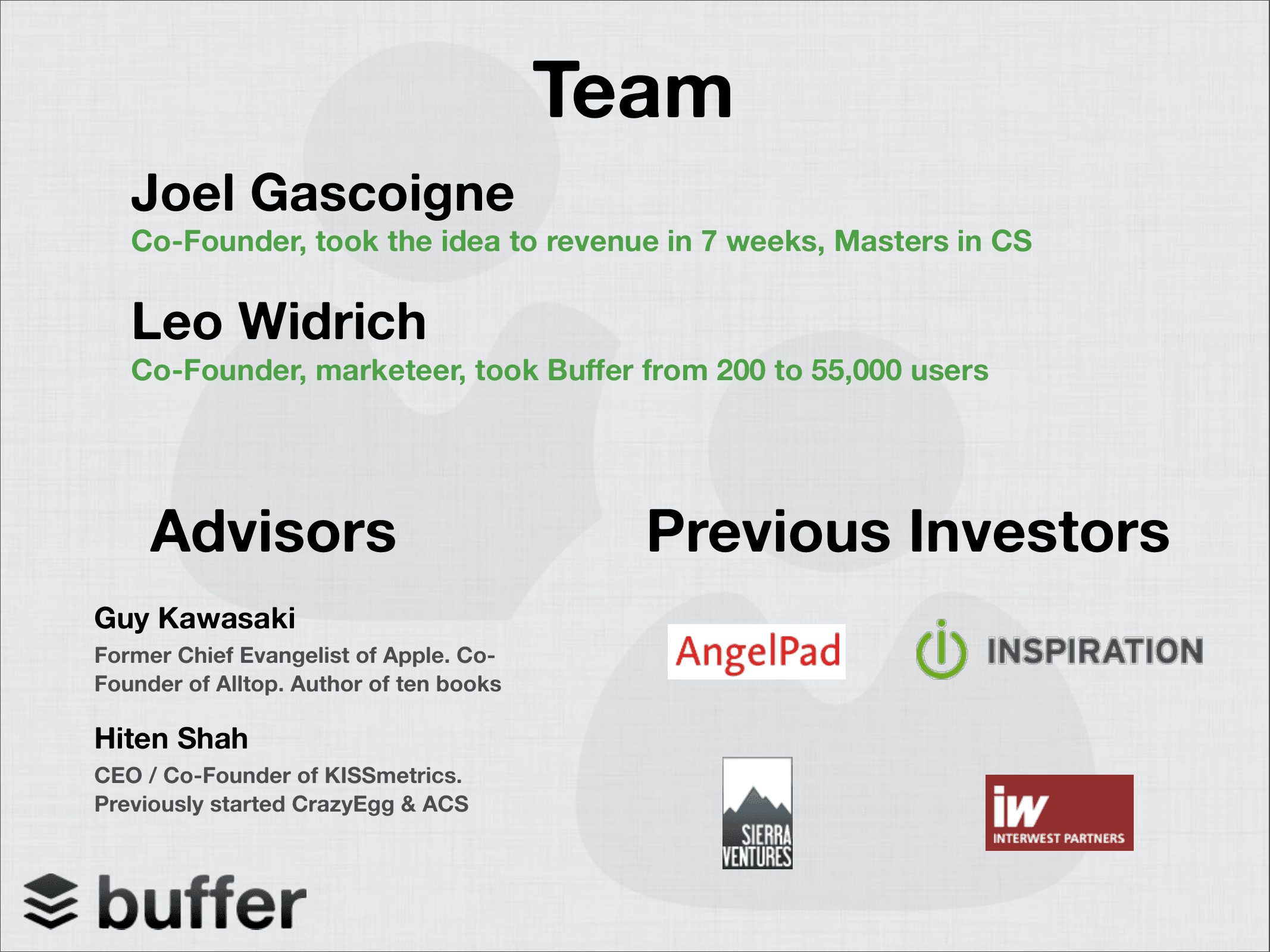
Execution credentials first, revenue speed and user growth, not résumé fluff. Named advisors and prior institutional logos close the credibility gap for first-time founders.
founders@bufferapp.com on a minimal slide with a faint Buffer logo watermark.

No ask slide with terms, just an email. At this traction level the round was largely de-risked; the deck's job was to get the meeting, not negotiate on paper.
Join 100,000+ professionals creating presentations worth presenting.
Buffer
Joel Gascoigne and Leo Widrich used this 13-slide deck in 2011 to close a roughly $450K seed round after pitching around 200 investors. Buffer already had 55,000 users, 800 paying customers, and a $150K annual revenue run rate, so the deck leads with traction and unit economics, not vision slides. The founders later published it openly, making it one of the most cited SaaS seed decks for bootstrapped founders raising their first institutional round.
Original 2011 deck · 13 slides. Click a thumbnail or scroll down for the full breakdown.
Buffer wordmark and stacked-layers logo on a dark textured background.
Minimal cover, brand only, no tagline. By 2011 Buffer was already known in the Twitter scheduling niche, so the logo did the work.
Zuckerberg's Law on sharing doubling yearly, a Donanza quote on social surpassing SEO, and a photo of Facebook's engagement growth curve.
Opens with macro tailwinds before the product, anchors the pitch in an inevitable market shift. Third-party quotes do the heavy lifting so Buffer doesn't have to argue the category exists.
One question centered on the slide: "How do you use social to drive traffic?"
Problem as a single provocative question, not a bullet list. Every marketer and founder in the room has felt this, it frames Buffer as the answer without over-explaining pain points.
"Queue your updates", screenshot of the Buffer web app with tweets scheduled across days and times.
Solution is the product itself. Real UI with queued posts proves the thing works; investors see scheduling, timing, and the core loop in one glance.
800 paying users, $150K annual revenue run rate, 97% margins, 55,000 users growing 40% per month, 1.5M updates buffered, with an upward growth curve.
The slide investors remember. Hard revenue and user numbers with a hockey-stick visual, this is why Buffer could raise on 13 slides while others needed 25.
Timeline from Jan 2011 launch through Oct 2011 traction, then green forward targets: API, 50 integrations, 100K users, 1M users by Jan 2013.
Past milestones in gray, future ones in green, separates proof from ambition. Shows a credible roadmap without a dense financial model.
Freemium with 2% free-to-paid conversion, 5% churn ($240 LTV), up to $5 CAC per free user, $3.6M projected revenue at 1M users.
Unit economics on one slide, conversion, churn, LTV, and acquisition cap. Investors can sanity-check the math instead of guessing whether freemium works.
200M daily tweets (55% with links), 4B Facebook shares per day, Zuckerberg's Law, and social traffic soon surpassing search.
Market-size slide built from sharing volume, not a TAM spreadsheet. Ties back to slide 2 and makes the scheduling problem feel enormous.
ReadWriteWeb headline: "Buffer Finds Tweet Scheduling Can Increase Clicks by 200%."
Third-party validation beats self-promotion. A named publication with a concrete performance stat gives investors something to cite in partner meetings.
"A sharing standard". 6 integrations live, talks with Reeder, Pocket, and Feedly, goal to be the default share target in any app; iPhone share sheet mockup.
Platform play, not just a web app. The share-sheet screenshot shows distribution through other products' workflows, a wedge Hootsuite-style dashboards don't own.
Circular landscape map: social networks at center, competitors grouped as dashboards, intelligent sharing, sharing platforms, and scheduling apps. Buffer in two quadrants.
Category map instead of a comparison table. Buffer sits in "intelligent sharing" and "sharing platforms," not crowded dashboard territory, makes the positioning memorable.
Joel Gascoigne (idea to revenue in 7 weeks, CS master's) and Leo Widrich (200 to 55K users); advisors Guy Kawasaki and Hiten Shah; prior investors AngelPad, Inspiration, Sierra Ventures, InterWest.
Execution credentials first, revenue speed and user growth, not résumé fluff. Named advisors and prior institutional logos close the credibility gap for first-time founders.
founders@bufferapp.com on a minimal slide with a faint Buffer logo watermark.
No ask slide with terms, just an email. At this traction level the round was largely de-risked; the deck's job was to get the meeting, not negotiate on paper.
Join 100,000+ professionals creating presentations worth presenting.