

Original 2016 deck · 24 slides. Click a thumbnail or scroll down for the full breakdown.
Front
Front's 2016 Series A deck raised $10 million led by Social Capital, with Stuart Butterfield and other angels joining, on a metrics-heavy story about turning shared inboxes into collaborative communication. CEO Mathilde Collin later published the deck on Medium, calling out capital efficiency and land-and-expand cohorts as the slides that closed the round, and organic acquisition as the weak spot. This 24-slide teardown walks through the SaaS traction narrative that made team email investable.
Original 2016 deck · 24 slides. Click a thumbnail or scroll down for the full breakdown.
Front logo and wordmark centered on a solid blue background.
Minimal brand cover, no raise amount, no tagline. By Series A the product name carried recognition in the inbox-collaboration category, so the deck opens clean and moves straight to substance.
Email was never built for teams to collaborate, shared addresses like sales@ and support@ cause productivity slowdown, lost business, and bad customer experience.
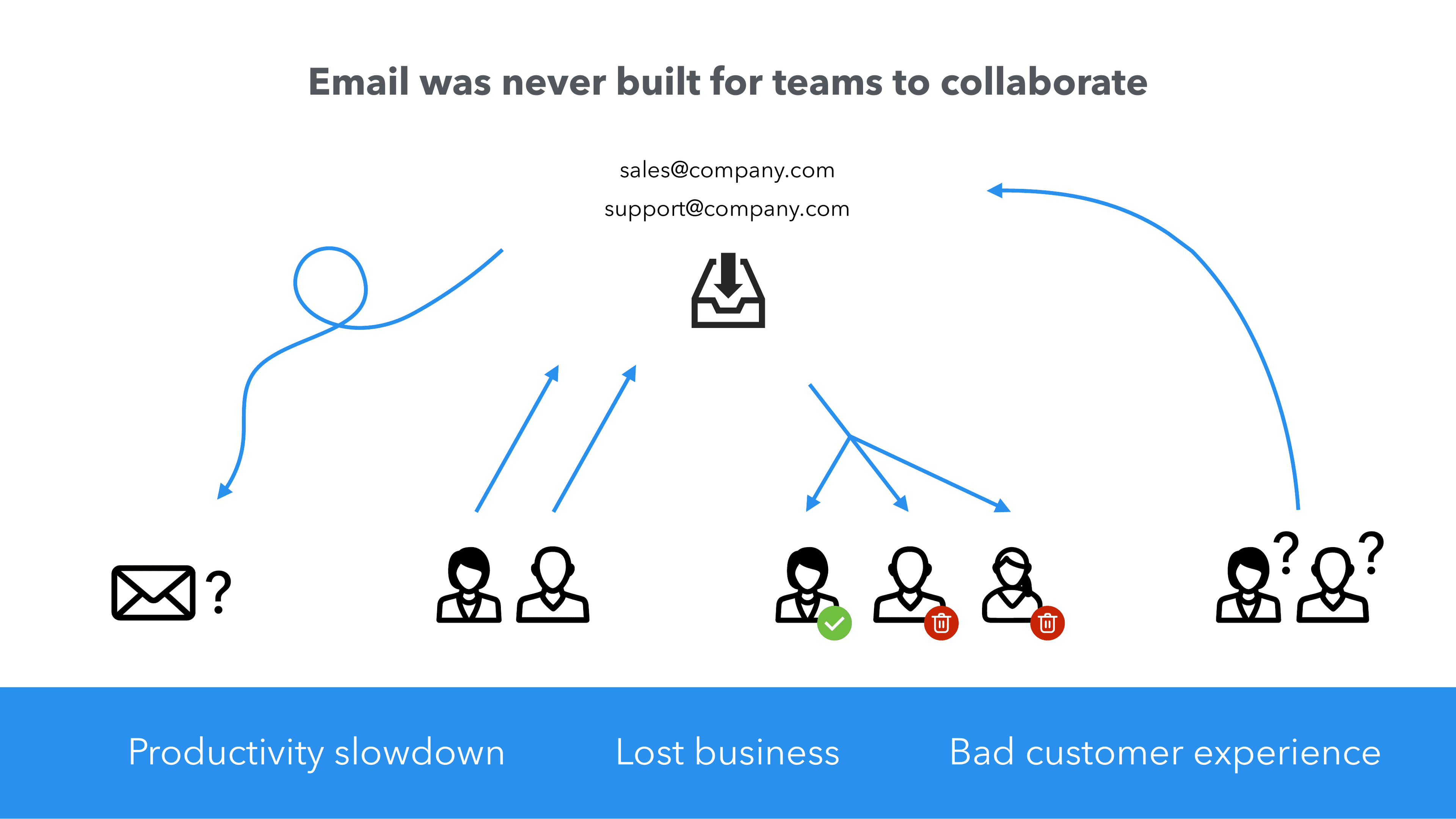
Problem is visual, not textual, arrows show duplicate replies, missed messages, and confused ownership. Three business outcomes at the bottom turn a UX complaint into revenue and CSAT risk investors recognize.
Front built the first shared email client, team inboxes with assignment, internal comments, and @mentions on real customer threads.
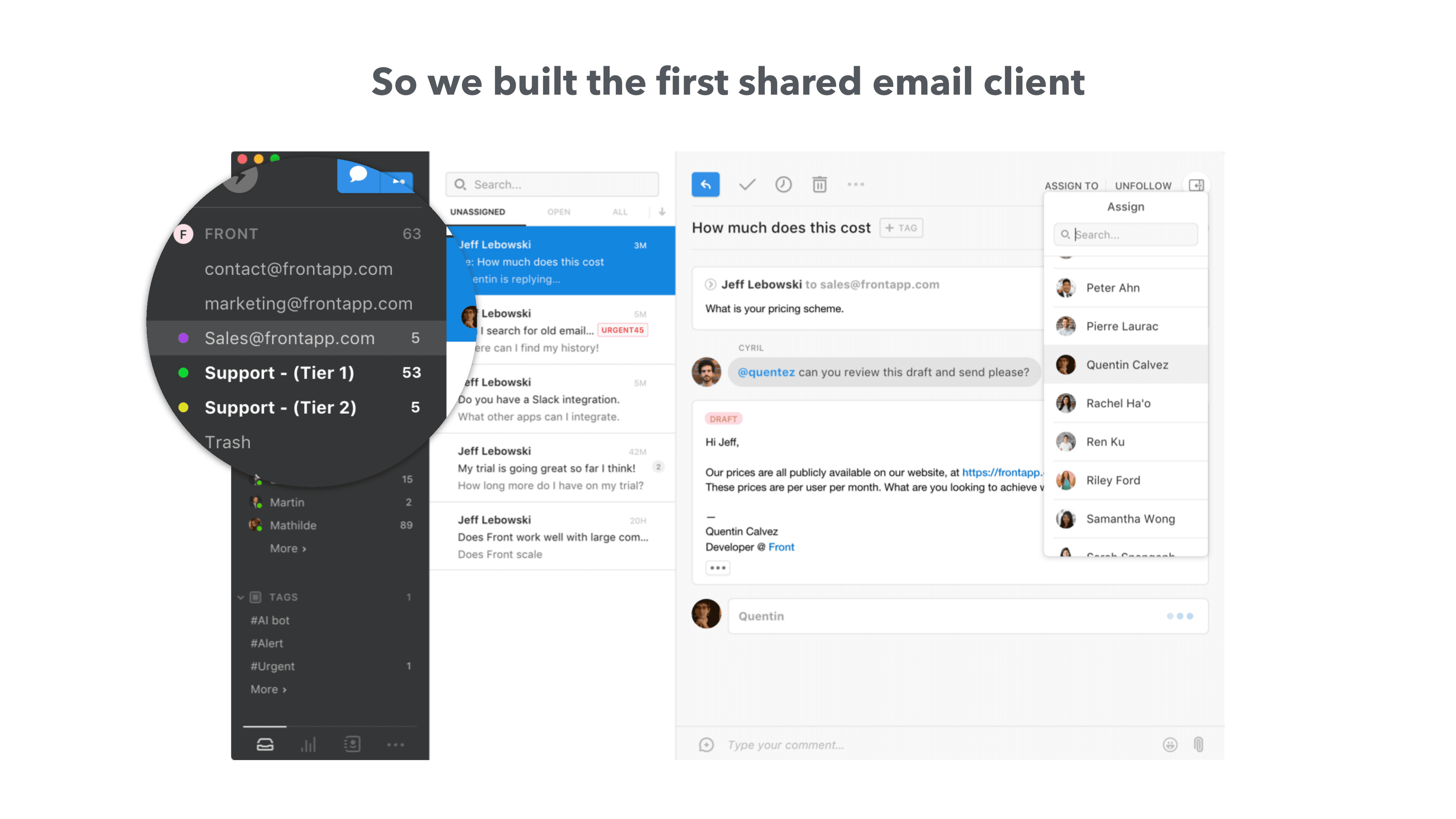
Solution slide is a live product screenshot, not a mockup. Assign dropdown and @quentez comment thread prove the workflow exists, critical for a category Front had to define.
Feature callouts across the UI: automated rules, reminders, canned answers, share draft, comment & mention, assign email, and robust analytics.
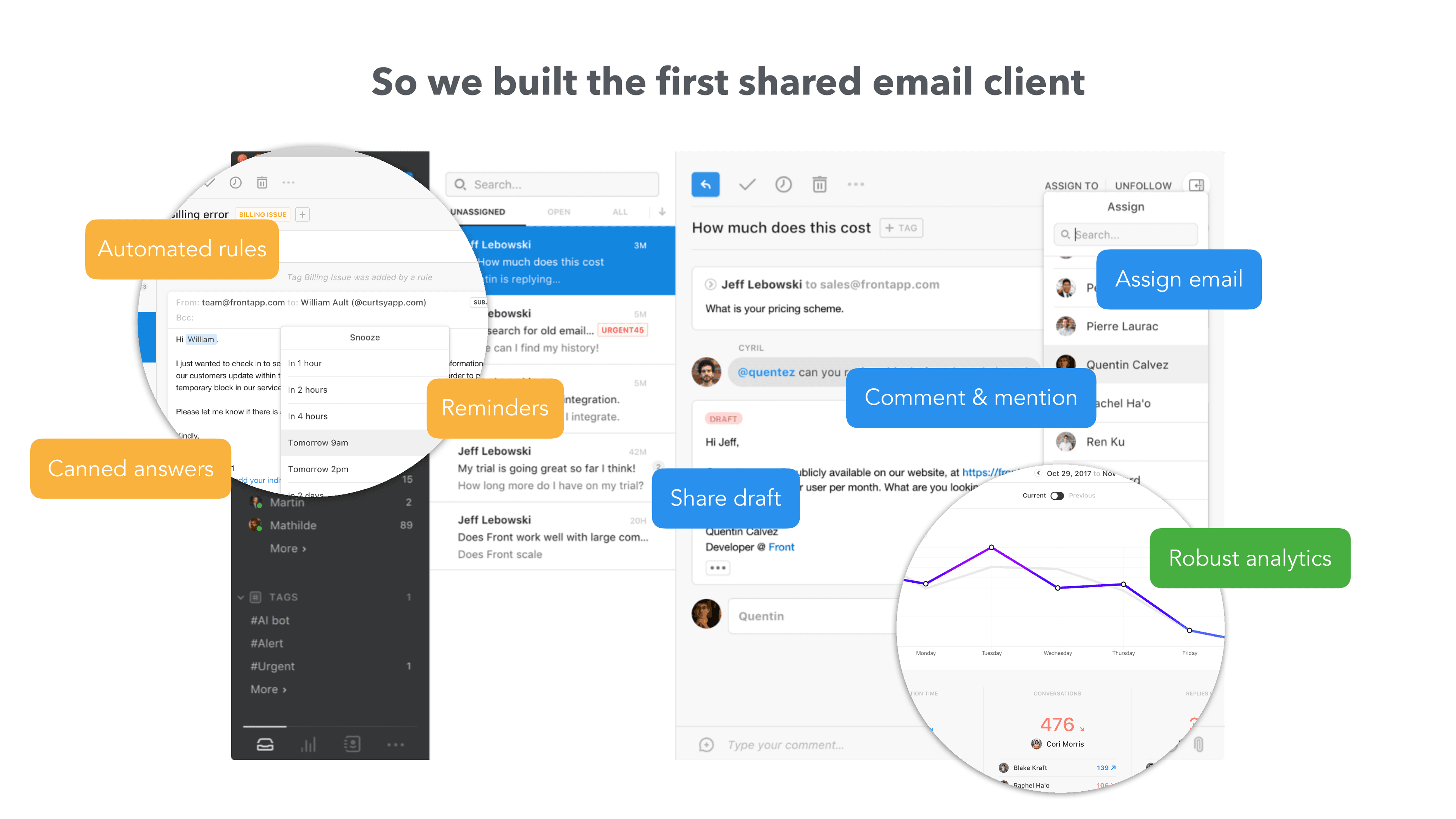
Second product slide maps features to jobs-to-be-done with color-coded labels, orange for automation, blue for collaboration, green for analytics. Shows depth beyond "shared inbox" without a feature matrix.
Front broadened from shared email to multi-channel (Twitter, Messenger, SMS), individual-yet-collaborative workflows, and integrations with Slack, Salesforce, GitHub, and more.
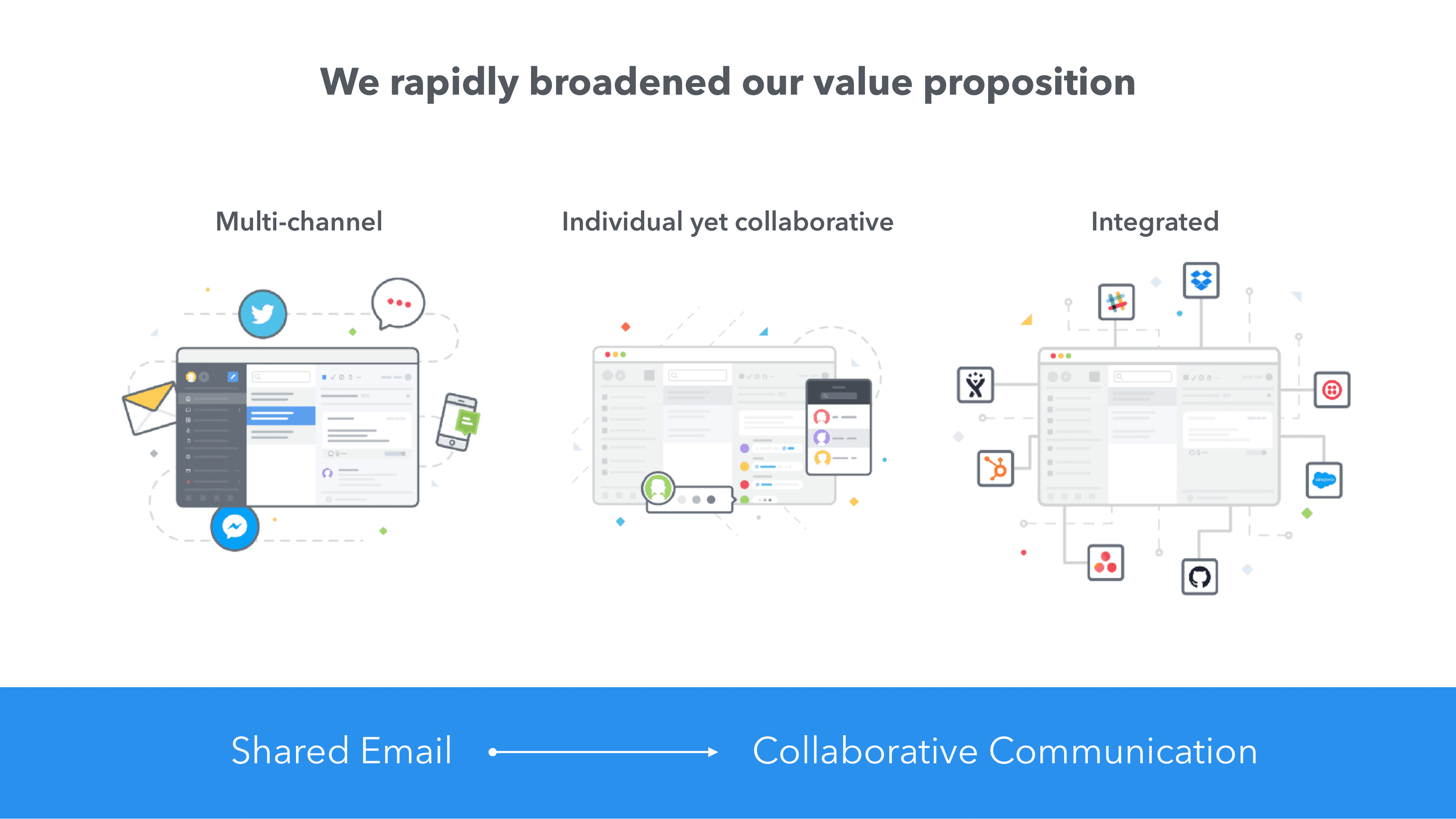
Evolution slide reframes the company: Shared Email → Collaborative Communication. Investors see a wedge that expands into a platform without abandoning the core inbox metaphor.
2,300 companies use Front, logos include Shopify, LVMH, Cisco Meraki, and HubSpot, with bar charts on industry mix (tech-heavy) and use-case diversity (support, client services, IT).
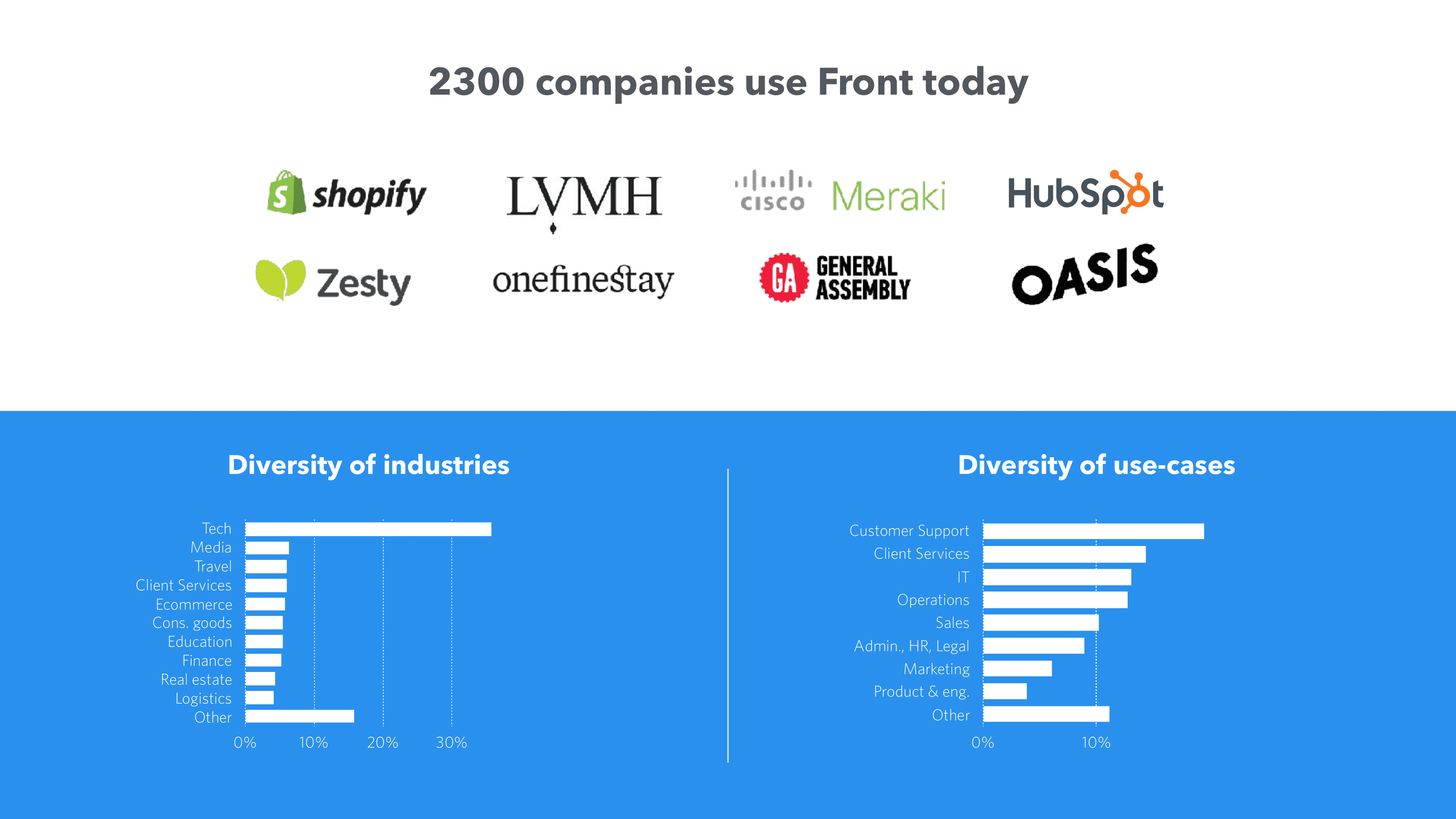
Traction pairs logo social proof with segmentation charts. Tech leads at ~36% but bars spread across finance, travel, and ecommerce, signals horizontal SaaS, not a single vertical bet.
Vertical bar chart showing consistent month-over-month ARR growth accelerating into a hockey stick.
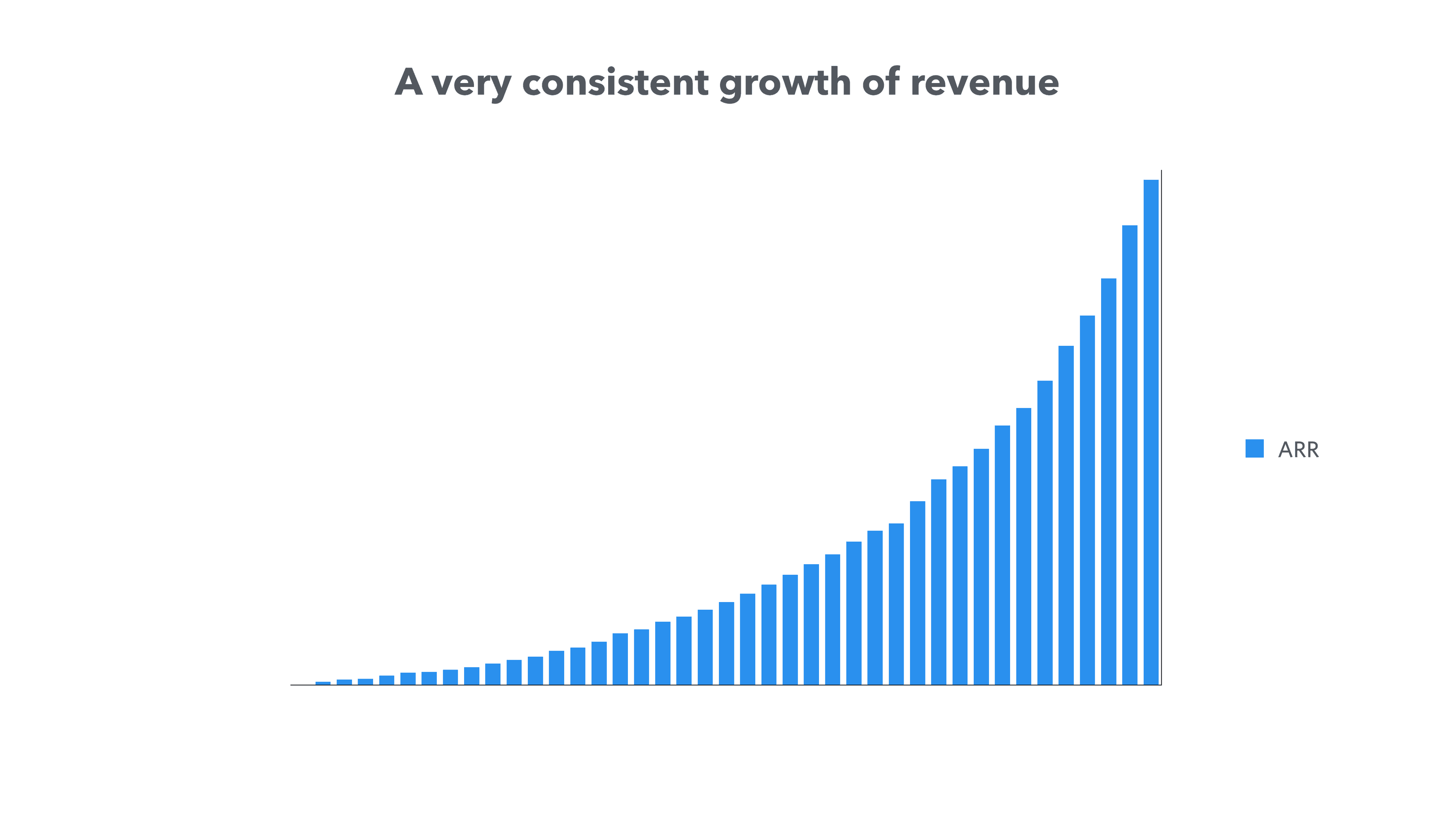
No axis labels, the shape tells the story. For Series A, a clean ascending ARR chart beats a spreadsheet; investors can ask for numbers in diligence.
Three declining lines, gross churn, net MRR churn, and logo churn, all trending lower over roughly three years.
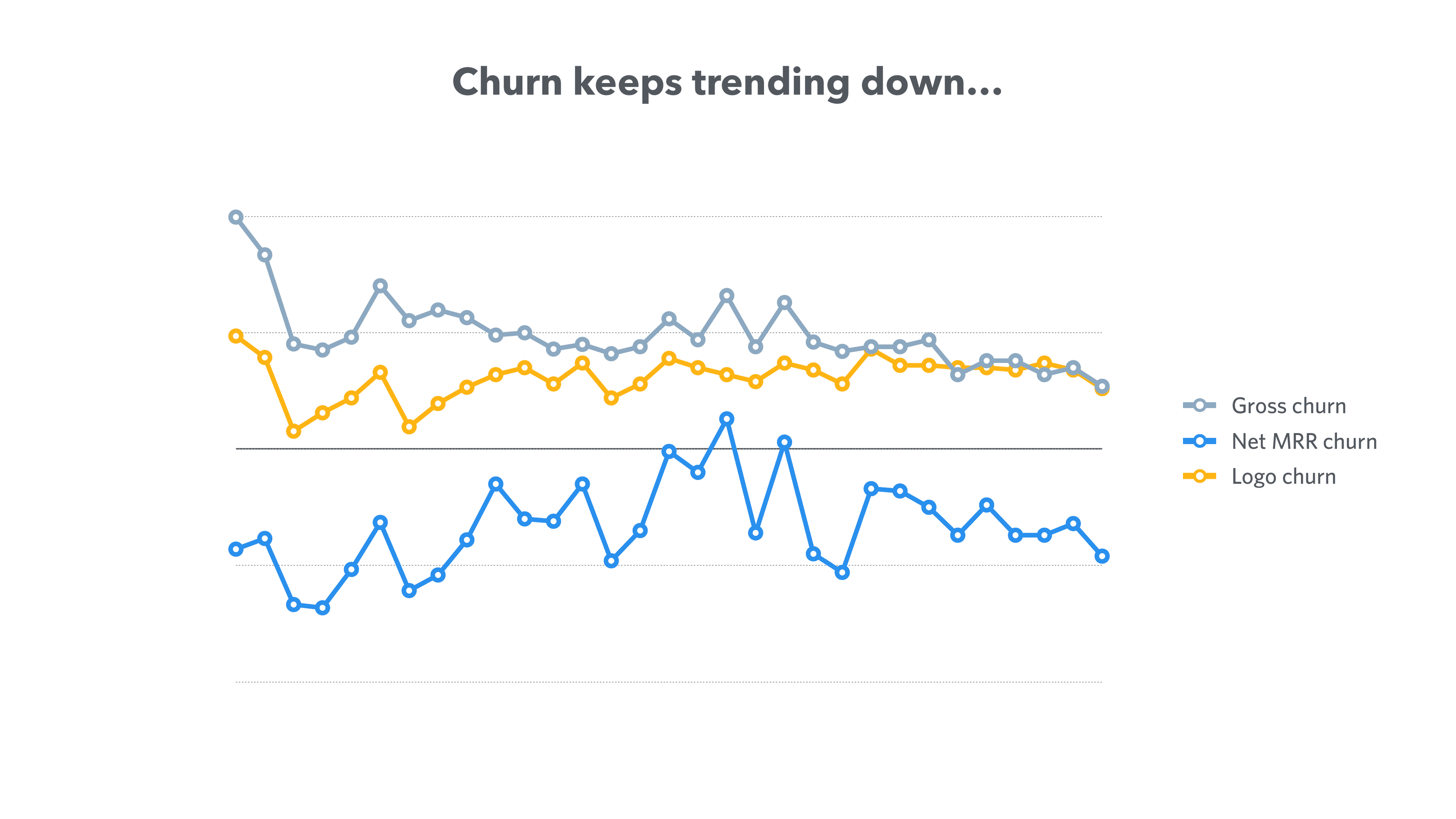
Churn slide answers the retention question before it's asked. Net MRR churn below gross shows expansion offsetting losses, the land-and-expand thesis in one chart.
Messages sent, comments & mentions, and individual email users all growing exponentially in paired bar charts.
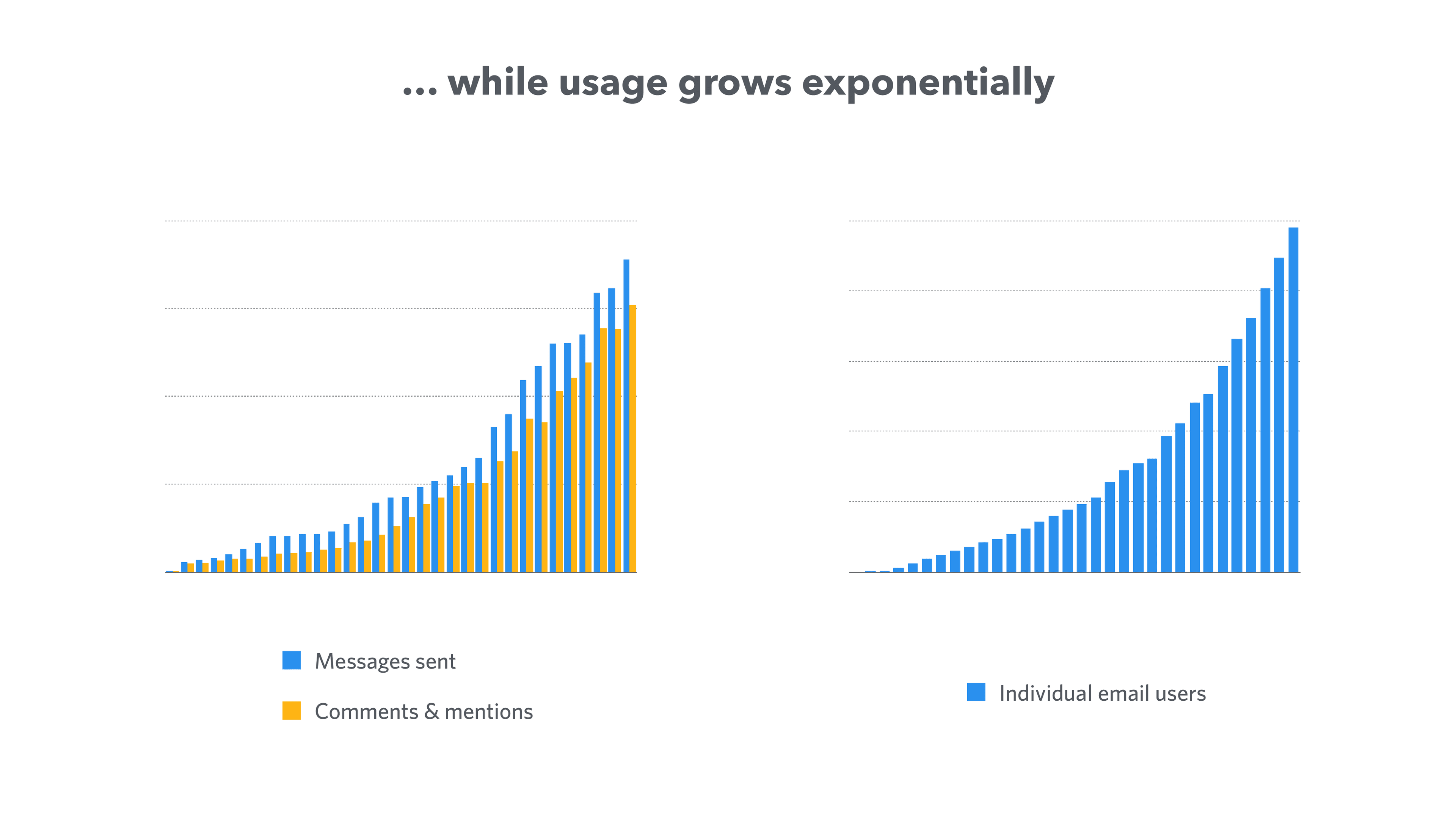
Usage metrics prove stickiness independent of revenue. Comments growing alongside messages shows teams adopt collaboration features, not just read email, depth of engagement investors want in workflow SaaS.
Stacked bars show reps ramping from 2 fully ramped in Q1 17 to 7 of 12 by Q3 17; actual sales exceed sales capacity every quarter.
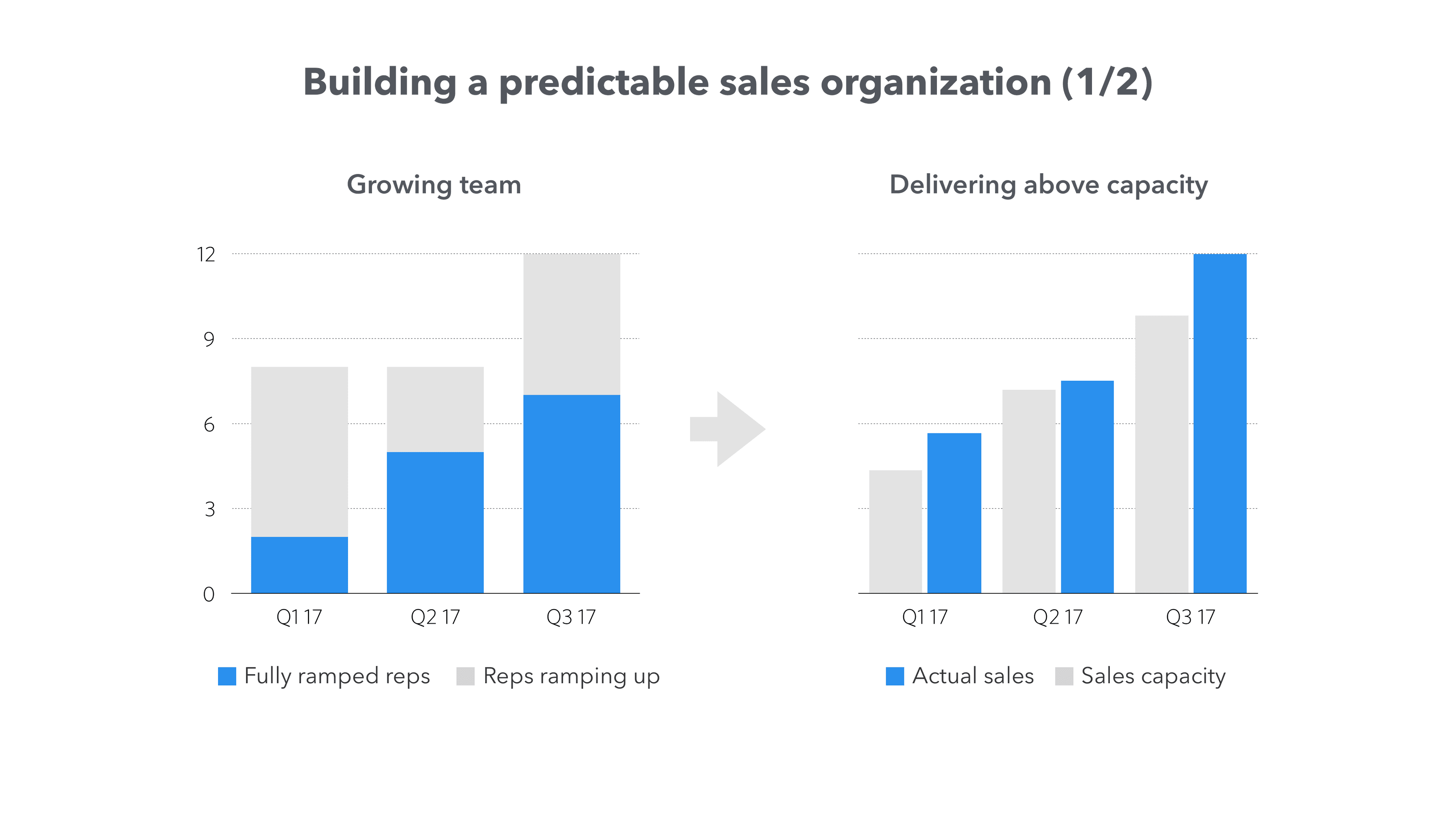
Sales slide pairs hiring plan with output, team grows while performance beats capacity. Predictable sales org is the Series A question; Front answers with ops charts, not headcount promises.
ASP rises every quarter from Q2 16 to Q3 17; large-deal count jumps from near zero to 10 in Q3 17, with anonymized enterprise customer profiles below.
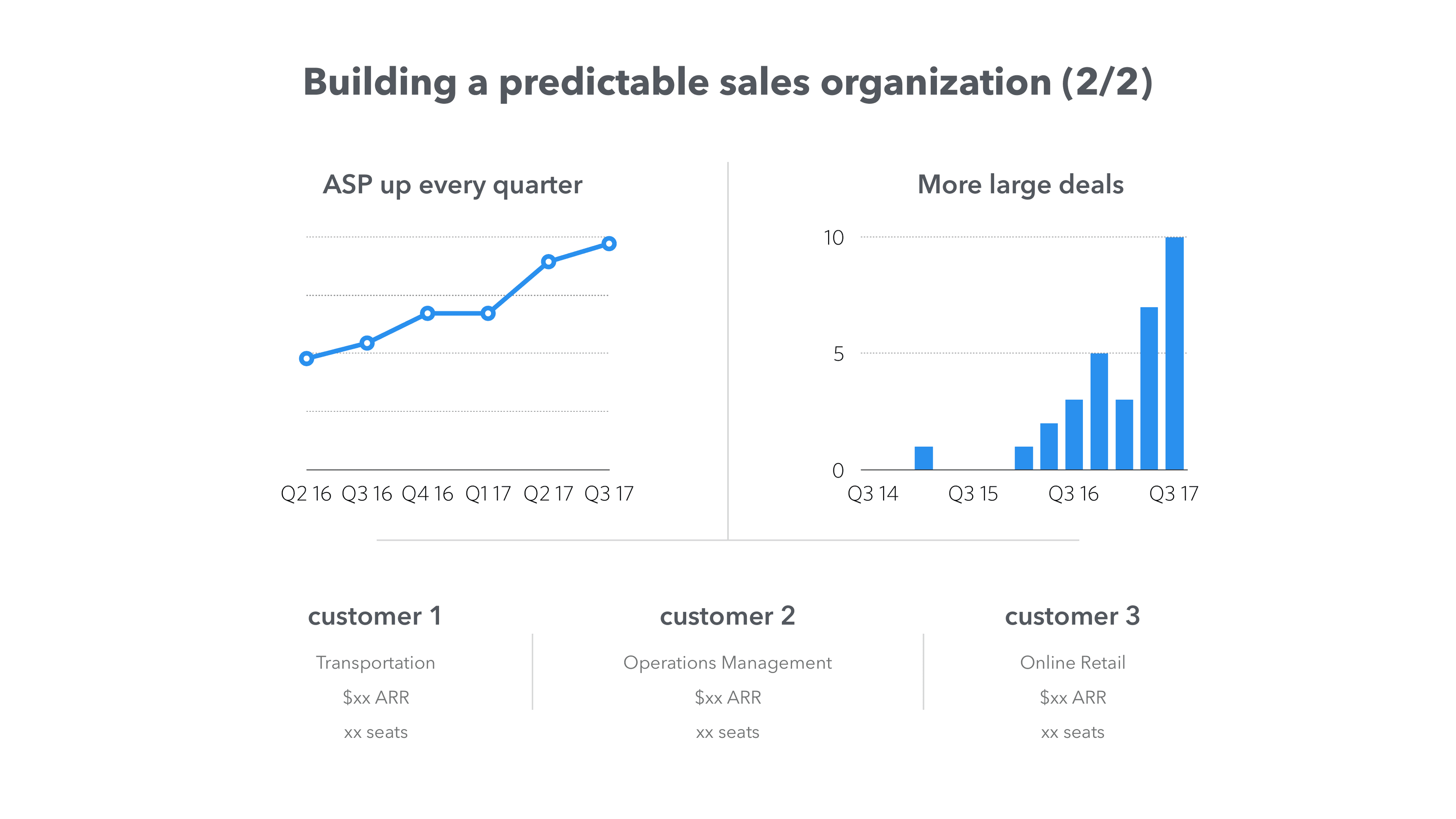
Upmarket motion in two charts, rising ASP plus more big deals. Redacted customer cards (transportation, ops, retail) hint at six-figure contracts without naming logos under NDA.
Marketing spend and lead volume grow Q1–Q3 17; spend stays ~18% of revenue while LTV/CAC improves from 2.5 to 4.4; a five-person marketing team mostly hired within the last year.
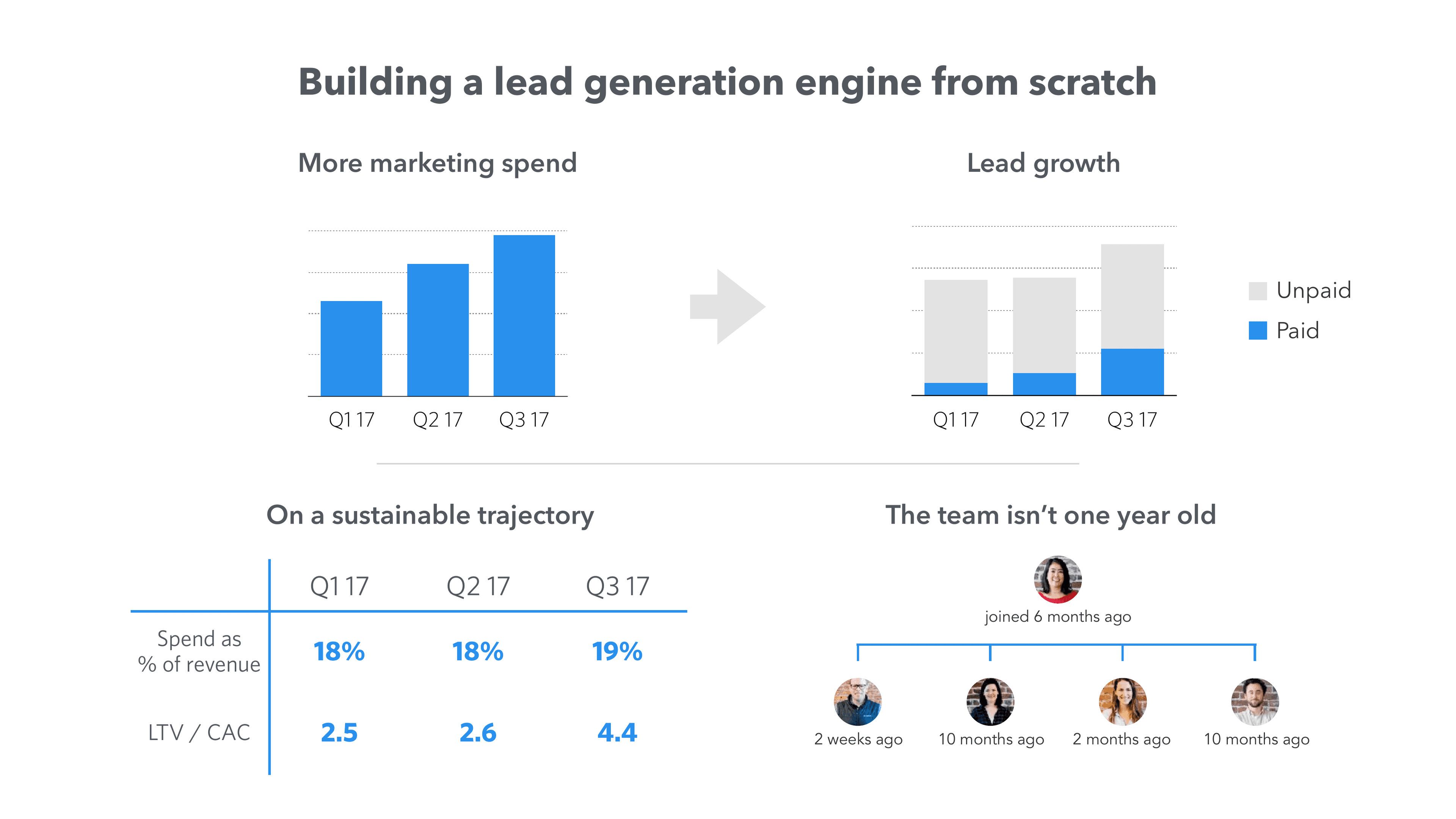
Collin later called organic-heavy acquisition a weakness, but this slide shows they're building paid plus unpaid engines with improving unit economics. LTV/CAC above 4 is the headline number.
120% net retention at six months and 150% at one year; ACV doubled in 15 months; users send 3.9× more messages and write 4.9× more comments after a year.
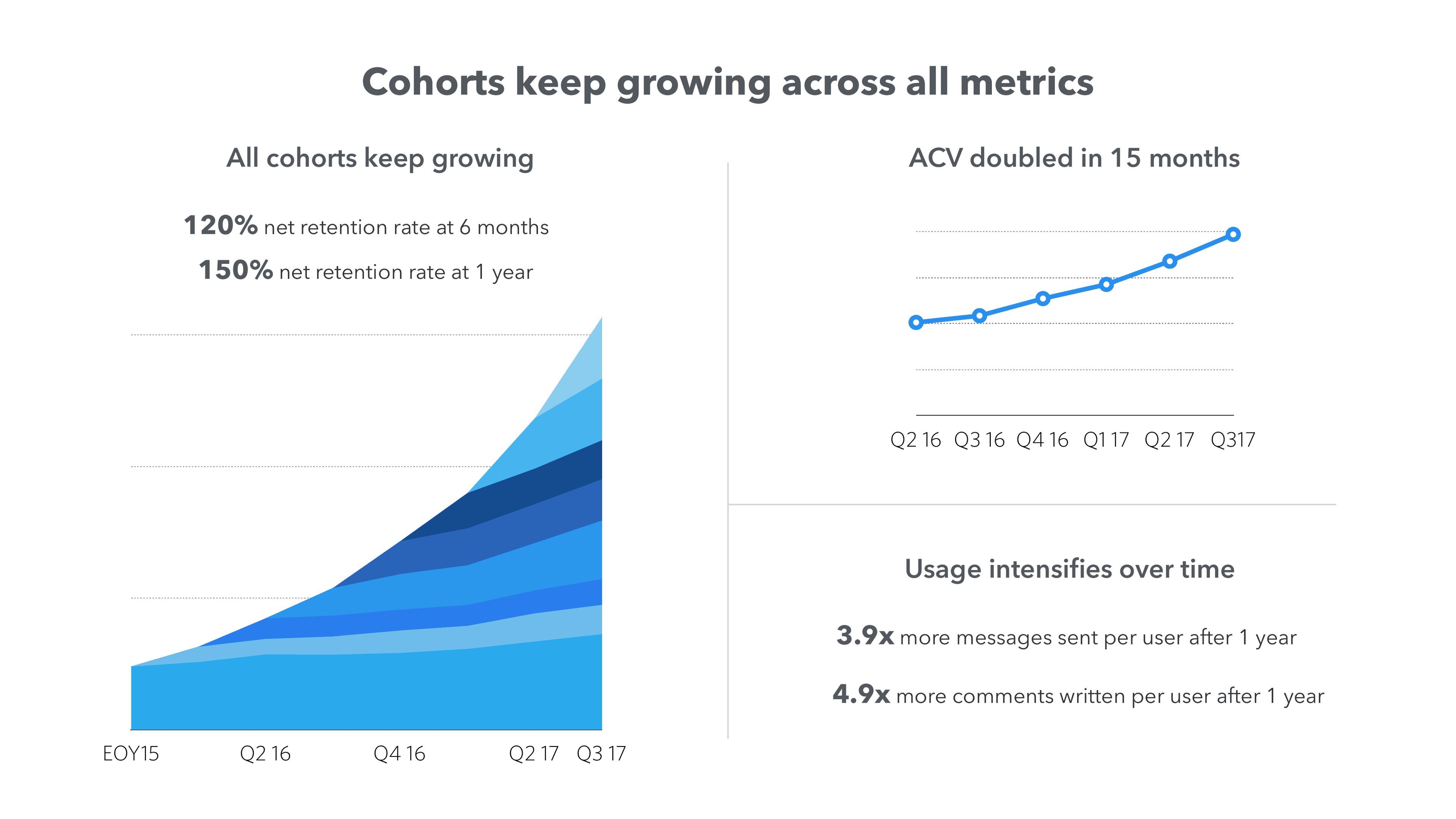
The deck's strongest SaaS slide. Collin said land-and-expand surprised her as a winning narrative. Stacked cohort chart plus usage multipliers prove expansion isn't a projection, it's measured behavior.
Headcount grew from under 10 to ~55 by late 2017; zero voluntary attrition after three months; 5.0 Glassdoor rating with 100% CEO approval; team offsite rated almost entirely 5/5.
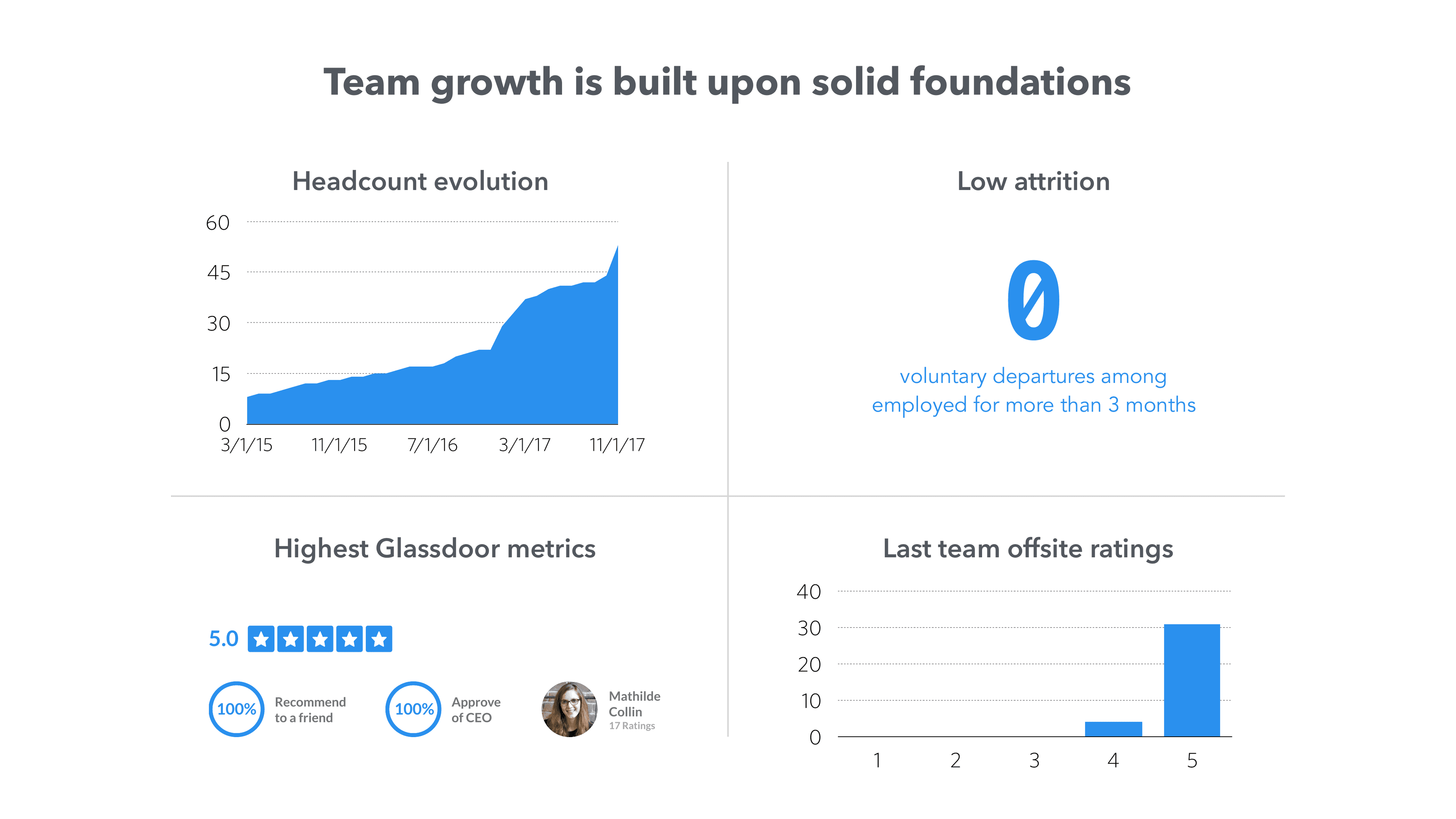
Culture slide before the financial ask, rare but effective when metrics are verifiable. Zero attrition and perfect Glassdoor scores signal execution capacity as the company scales sales and marketing.
$3.1M raised seed to Series A and $10M Series A raised; $7M cash on hand, 18-month runway, and "default alive", profitable in 10 months under stated assumptions.
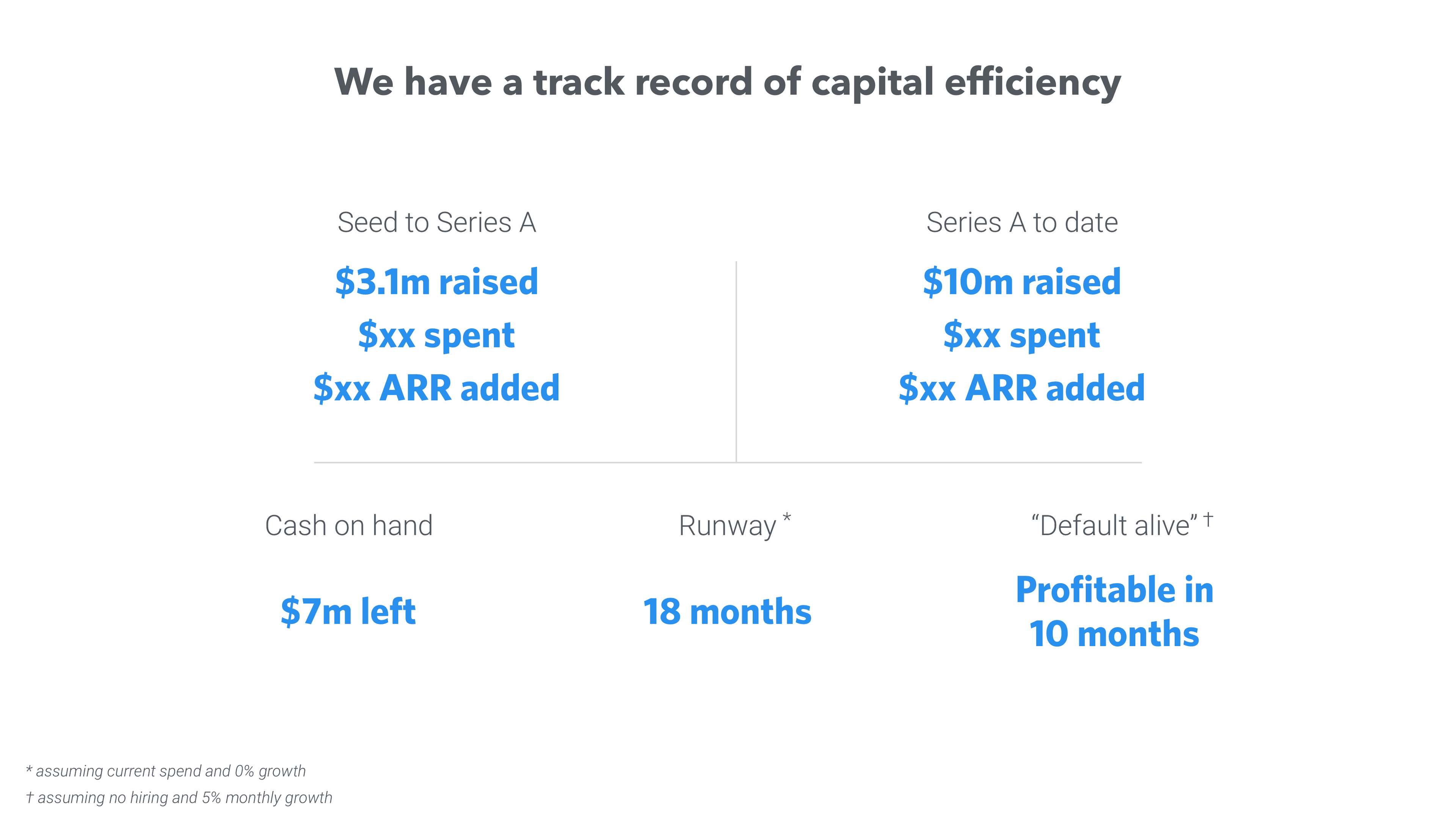
Collin's most-cited slide, spending less than ARR added from seed to A. Default-alive framing (Paul Graham's term) tells investors they won't need to rescue the company; it can reach profitability on current trajectory.
2018 charts project ARR growth alongside declining cash, ~80% gross margin holding steady, and operating margin improving from deeply negative toward breakeven by end of 2019.
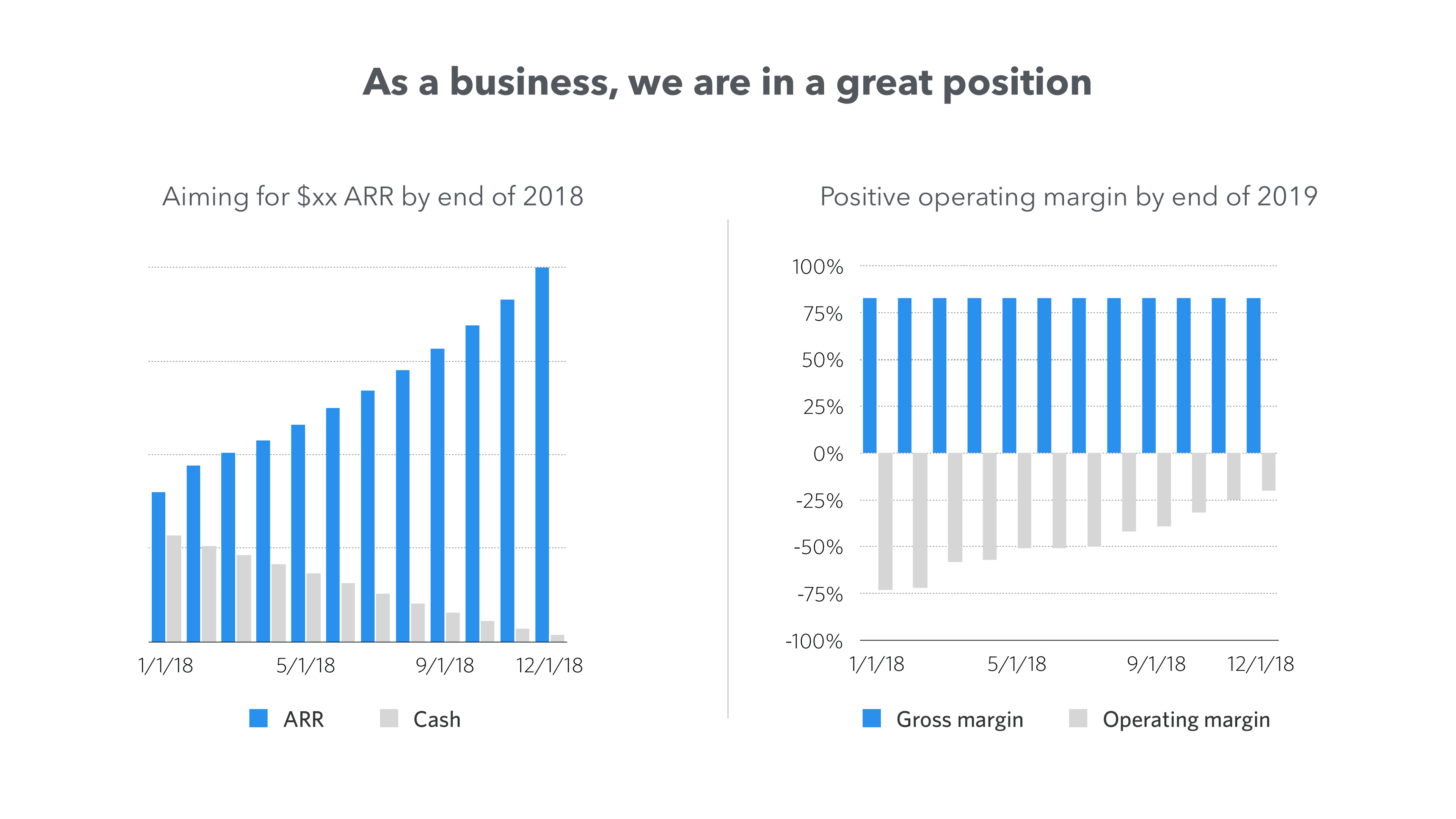
Forward-looking without a full model. Collin admitted projections were a weak spot. Still, margin trajectory and ARR path show path to default alive, which complements the prior slide's runway math.
Single question centered on the slide: "Where do we go from there?"
Breather slide that pivots from backward-looking metrics to forward vision. One line, blue underline, gives the audience a mental reset before the product-moat and roadmap sections.
2.5 hours per user per day and 64% DAU/MAU; access to messages, files, contacts, and meetings; relevant across support, sales, ops, and engineering teams.
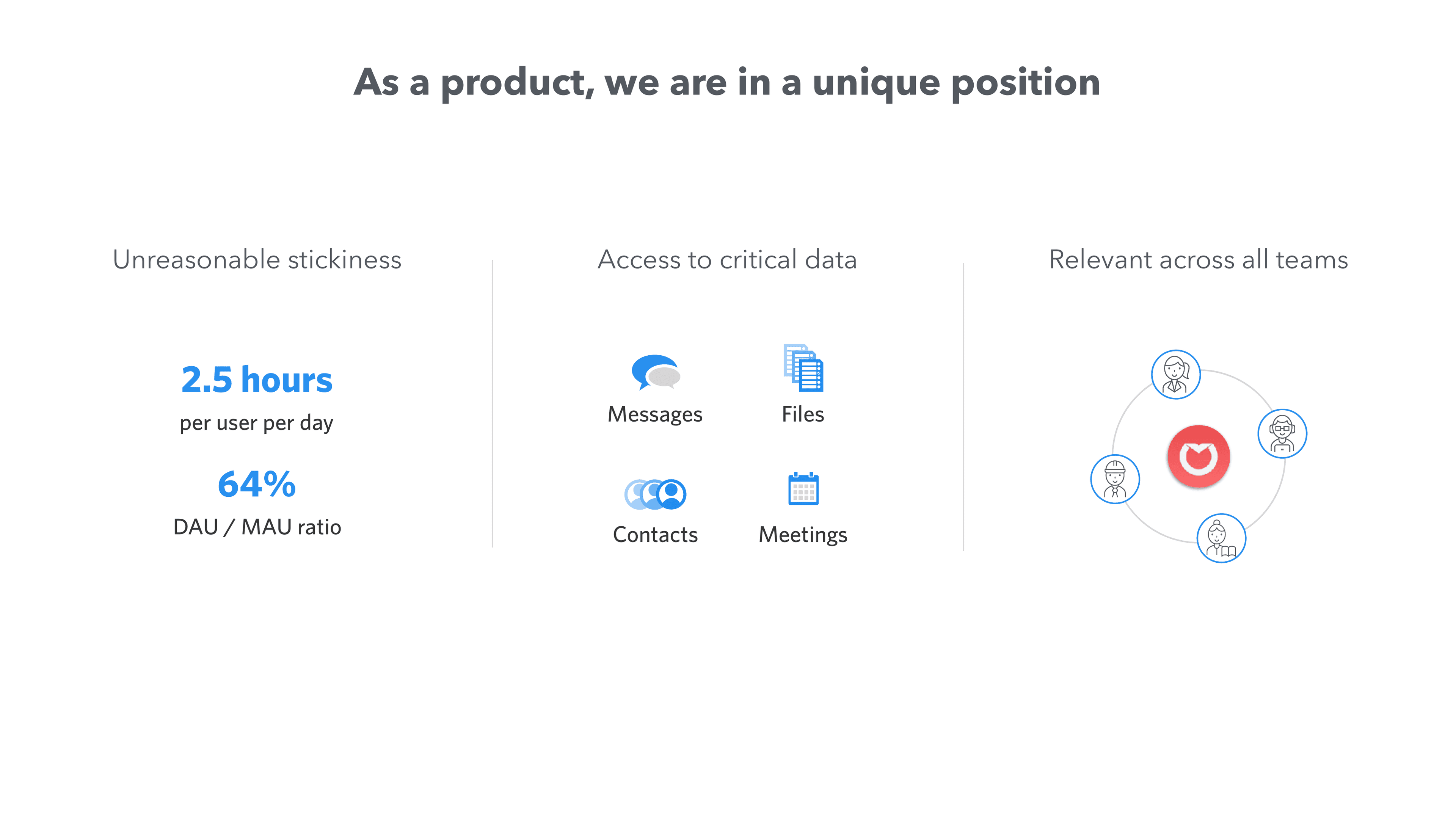
Engagement metrics prove inbox replacement, not sidebar software. Critical-data access (four data types) and cross-team diagram set up the platform story. Front sits where work already happens.
Two strategic pillars for 2018: add more users to increase platform value, and improve the platform so others can build on top of it.
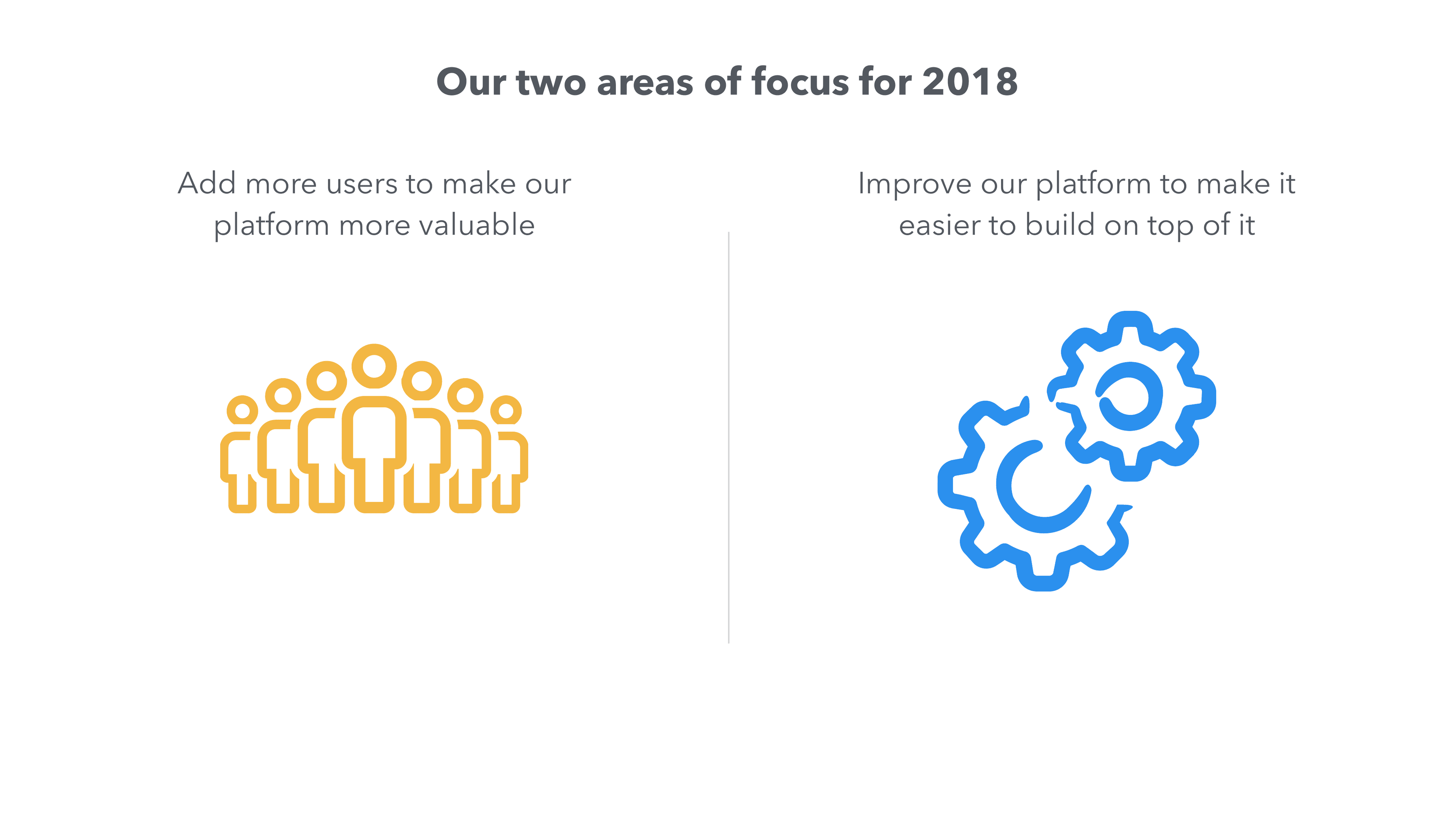
Roadmap opens with network-effects logic, more users make the product more valuable, paired with extensibility. Icons (team silhouettes, gears) keep it scannable before the detailed plan on the next slide.
User growth: maintain core-target leadership, become a great email client, ship products that expand the value prop. Platform: ship Extension API, extend collaboration beyond messaging, launch an app store for third-party apps.
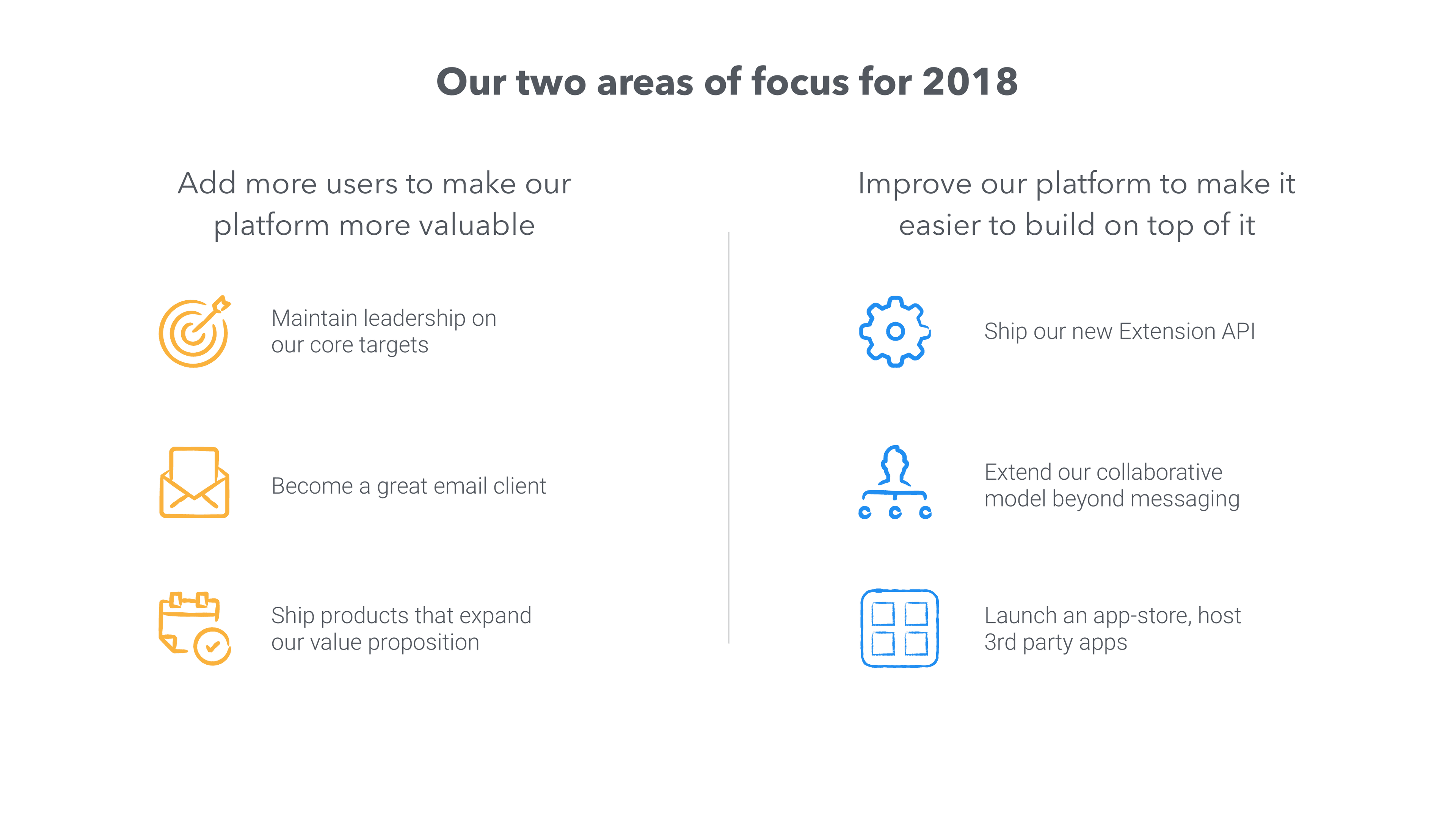
Six concrete initiatives across two columns, growth on orange, platform on blue. App store and API signal Series B ambition: Front as infrastructure, not just a better inbox.
Front login screen mockup over an ocean-wave background, positioning Front as the front door to work communication.
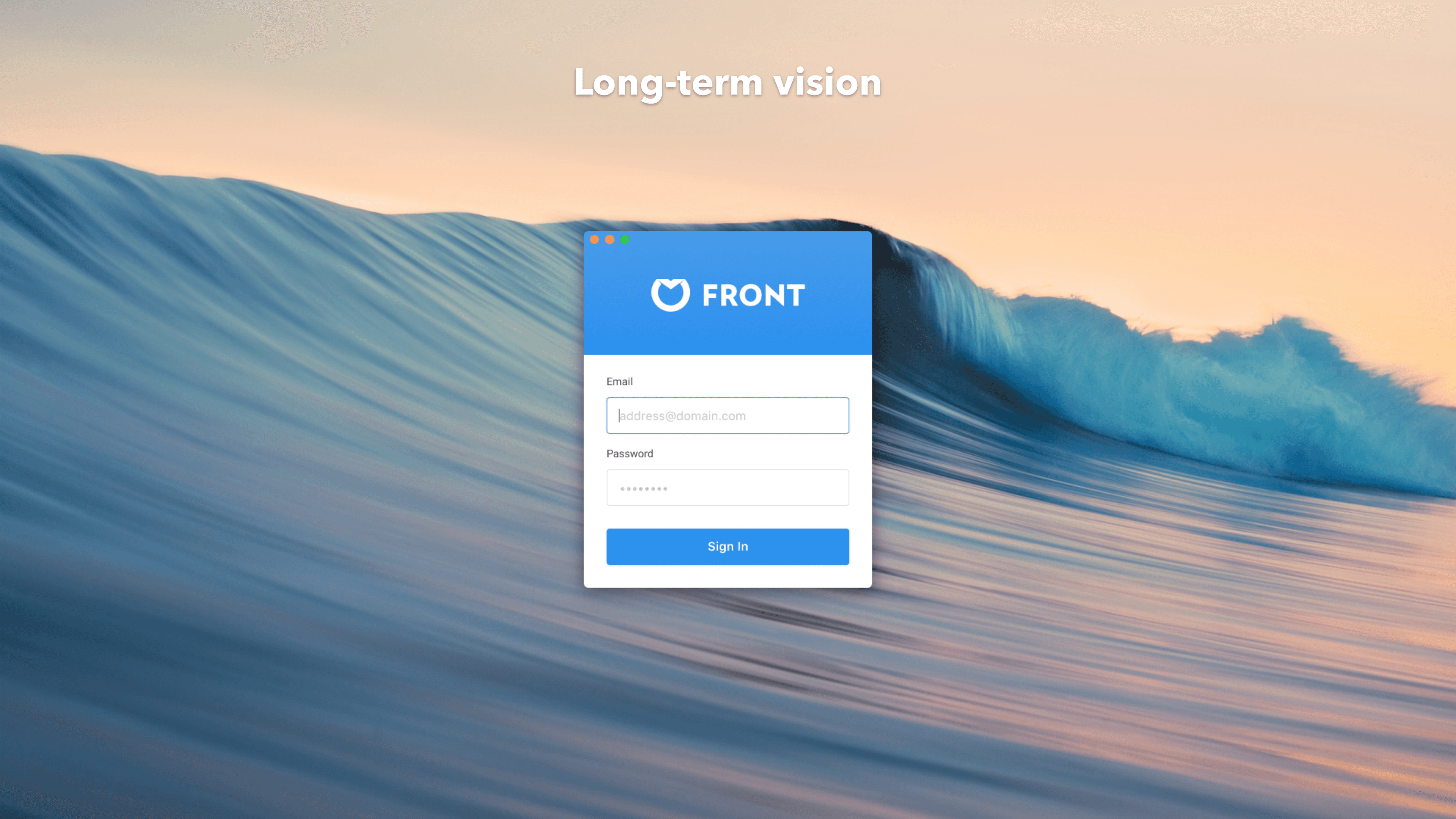
Aspirational close before the ask, wave metaphor plus login UI suggests becoming the default entry point for business email. Visual storytelling where words would feel grandiose.
Same wave-and-login visual with a call to visit frontapp.com/jobs to learn more about Front's long-term vision.
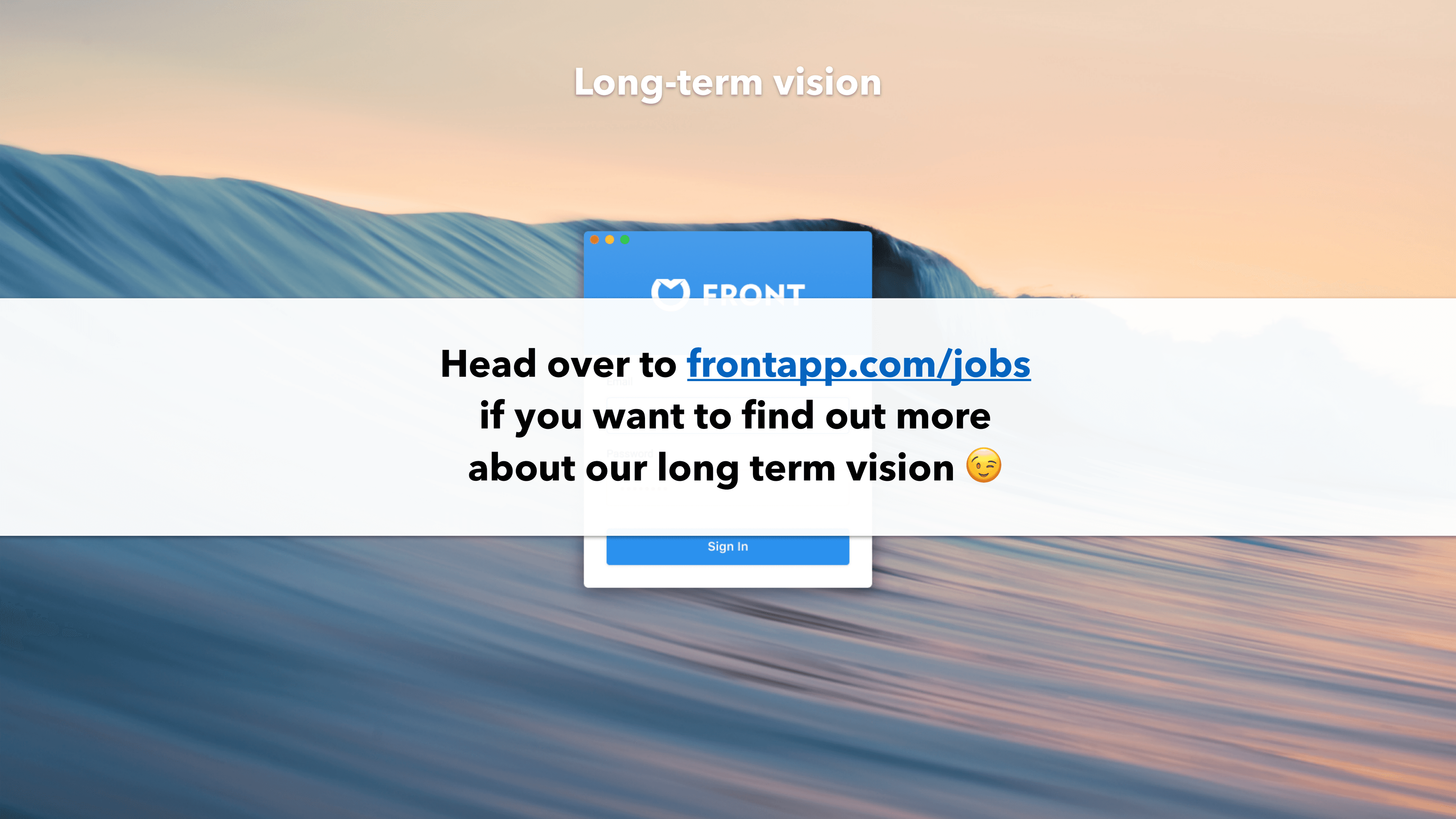
Recruiting CTA on an investor deck, unusual but on-brand for Collin's transparency. Signals the vision is bigger than the Series A check and doubles as employer-brand marketing.
Growth curve from shared email address through collaborative communication ("we are here"), good email client / extensible platform, to a confidential next stage, each milestone tied to ARR targets.
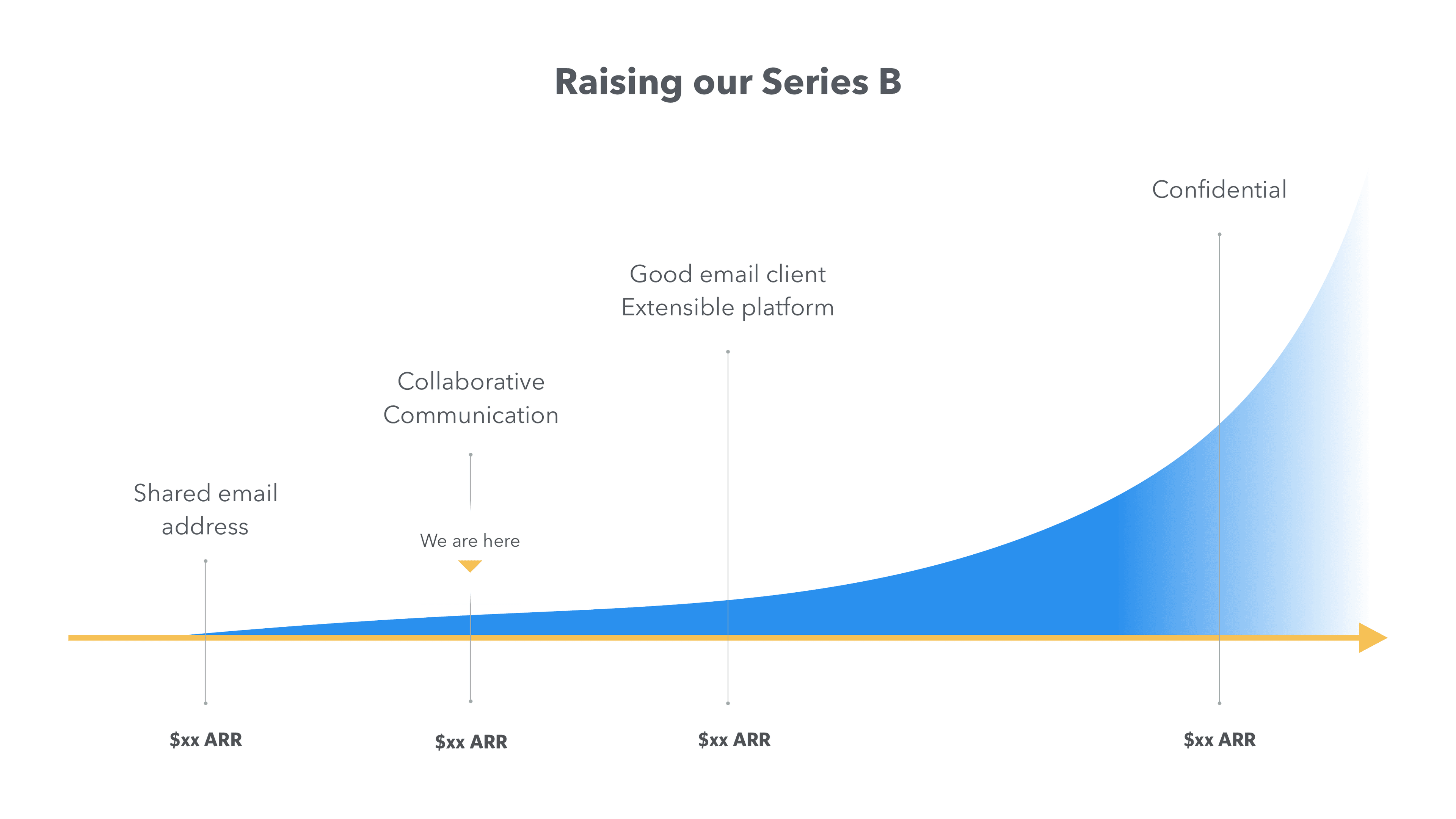
Forward roadmap slide names the category evolution Front is riding. "We are here" marker anchors current stage; confidential peak hints at the billion-dollar outcome without over-promising in the A deck.
Single word. "Thanks", centered on a white slide.

Clean close with no contact info on-slide, appropriate when the presenter is in the room. Lets Q&A start immediately instead of cluttering the final frame.
Join 100,000+ professionals creating presentations worth presenting.
Front
Front's 2016 Series A deck raised $10 million led by Social Capital, with Stuart Butterfield and other angels joining, on a metrics-heavy story about turning shared inboxes into collaborative communication. CEO Mathilde Collin later published the deck on Medium, calling out capital efficiency and land-and-expand cohorts as the slides that closed the round, and organic acquisition as the weak spot. This 24-slide teardown walks through the SaaS traction narrative that made team email investable.
Original 2016 deck · 24 slides. Click a thumbnail or scroll down for the full breakdown.
Front logo and wordmark centered on a solid blue background.
Minimal brand cover, no raise amount, no tagline. By Series A the product name carried recognition in the inbox-collaboration category, so the deck opens clean and moves straight to substance.
Email was never built for teams to collaborate, shared addresses like sales@ and support@ cause productivity slowdown, lost business, and bad customer experience.
Problem is visual, not textual, arrows show duplicate replies, missed messages, and confused ownership. Three business outcomes at the bottom turn a UX complaint into revenue and CSAT risk investors recognize.
Front built the first shared email client, team inboxes with assignment, internal comments, and @mentions on real customer threads.
Solution slide is a live product screenshot, not a mockup. Assign dropdown and @quentez comment thread prove the workflow exists, critical for a category Front had to define.
Feature callouts across the UI: automated rules, reminders, canned answers, share draft, comment & mention, assign email, and robust analytics.
Second product slide maps features to jobs-to-be-done with color-coded labels, orange for automation, blue for collaboration, green for analytics. Shows depth beyond "shared inbox" without a feature matrix.
Front broadened from shared email to multi-channel (Twitter, Messenger, SMS), individual-yet-collaborative workflows, and integrations with Slack, Salesforce, GitHub, and more.
Evolution slide reframes the company: Shared Email → Collaborative Communication. Investors see a wedge that expands into a platform without abandoning the core inbox metaphor.
2,300 companies use Front, logos include Shopify, LVMH, Cisco Meraki, and HubSpot, with bar charts on industry mix (tech-heavy) and use-case diversity (support, client services, IT).
Traction pairs logo social proof with segmentation charts. Tech leads at ~36% but bars spread across finance, travel, and ecommerce, signals horizontal SaaS, not a single vertical bet.
Vertical bar chart showing consistent month-over-month ARR growth accelerating into a hockey stick.
No axis labels, the shape tells the story. For Series A, a clean ascending ARR chart beats a spreadsheet; investors can ask for numbers in diligence.
Three declining lines, gross churn, net MRR churn, and logo churn, all trending lower over roughly three years.
Churn slide answers the retention question before it's asked. Net MRR churn below gross shows expansion offsetting losses, the land-and-expand thesis in one chart.
Messages sent, comments & mentions, and individual email users all growing exponentially in paired bar charts.
Usage metrics prove stickiness independent of revenue. Comments growing alongside messages shows teams adopt collaboration features, not just read email, depth of engagement investors want in workflow SaaS.
Stacked bars show reps ramping from 2 fully ramped in Q1 17 to 7 of 12 by Q3 17; actual sales exceed sales capacity every quarter.
Sales slide pairs hiring plan with output, team grows while performance beats capacity. Predictable sales org is the Series A question; Front answers with ops charts, not headcount promises.
ASP rises every quarter from Q2 16 to Q3 17; large-deal count jumps from near zero to 10 in Q3 17, with anonymized enterprise customer profiles below.
Upmarket motion in two charts, rising ASP plus more big deals. Redacted customer cards (transportation, ops, retail) hint at six-figure contracts without naming logos under NDA.
Marketing spend and lead volume grow Q1–Q3 17; spend stays ~18% of revenue while LTV/CAC improves from 2.5 to 4.4; a five-person marketing team mostly hired within the last year.
Collin later called organic-heavy acquisition a weakness, but this slide shows they're building paid plus unpaid engines with improving unit economics. LTV/CAC above 4 is the headline number.
120% net retention at six months and 150% at one year; ACV doubled in 15 months; users send 3.9× more messages and write 4.9× more comments after a year.
The deck's strongest SaaS slide. Collin said land-and-expand surprised her as a winning narrative. Stacked cohort chart plus usage multipliers prove expansion isn't a projection, it's measured behavior.
Headcount grew from under 10 to ~55 by late 2017; zero voluntary attrition after three months; 5.0 Glassdoor rating with 100% CEO approval; team offsite rated almost entirely 5/5.
Culture slide before the financial ask, rare but effective when metrics are verifiable. Zero attrition and perfect Glassdoor scores signal execution capacity as the company scales sales and marketing.
$3.1M raised seed to Series A and $10M Series A raised; $7M cash on hand, 18-month runway, and "default alive", profitable in 10 months under stated assumptions.
Collin's most-cited slide, spending less than ARR added from seed to A. Default-alive framing (Paul Graham's term) tells investors they won't need to rescue the company; it can reach profitability on current trajectory.
2018 charts project ARR growth alongside declining cash, ~80% gross margin holding steady, and operating margin improving from deeply negative toward breakeven by end of 2019.
Forward-looking without a full model. Collin admitted projections were a weak spot. Still, margin trajectory and ARR path show path to default alive, which complements the prior slide's runway math.
Single question centered on the slide: "Where do we go from there?"
Breather slide that pivots from backward-looking metrics to forward vision. One line, blue underline, gives the audience a mental reset before the product-moat and roadmap sections.
2.5 hours per user per day and 64% DAU/MAU; access to messages, files, contacts, and meetings; relevant across support, sales, ops, and engineering teams.
Engagement metrics prove inbox replacement, not sidebar software. Critical-data access (four data types) and cross-team diagram set up the platform story. Front sits where work already happens.
Two strategic pillars for 2018: add more users to increase platform value, and improve the platform so others can build on top of it.
Roadmap opens with network-effects logic, more users make the product more valuable, paired with extensibility. Icons (team silhouettes, gears) keep it scannable before the detailed plan on the next slide.
User growth: maintain core-target leadership, become a great email client, ship products that expand the value prop. Platform: ship Extension API, extend collaboration beyond messaging, launch an app store for third-party apps.
Six concrete initiatives across two columns, growth on orange, platform on blue. App store and API signal Series B ambition: Front as infrastructure, not just a better inbox.
Front login screen mockup over an ocean-wave background, positioning Front as the front door to work communication.
Aspirational close before the ask, wave metaphor plus login UI suggests becoming the default entry point for business email. Visual storytelling where words would feel grandiose.
Same wave-and-login visual with a call to visit frontapp.com/jobs to learn more about Front's long-term vision.
Recruiting CTA on an investor deck, unusual but on-brand for Collin's transparency. Signals the vision is bigger than the Series A check and doubles as employer-brand marketing.
Growth curve from shared email address through collaborative communication ("we are here"), good email client / extensible platform, to a confidential next stage, each milestone tied to ARR targets.
Forward roadmap slide names the category evolution Front is riding. "We are here" marker anchors current stage; confidential peak hints at the billion-dollar outcome without over-promising in the A deck.
Single word. "Thanks", centered on a white slide.
Clean close with no contact info on-slide, appropriate when the presenter is in the room. Lets Q&A start immediately instead of cluttering the final frame.
Join 100,000+ professionals creating presentations worth presenting.